
Blog

  • GTA 6 vs GTA 5: What’s Actually New and Is It Worth the Upgrade?

    GTA 6 vs GTA 5: What’s Actually New and Is It Worth the Upgrade?

    GTA 6 vs GTA 5 is the question every open-world fan is asking as Rockstar’s long-awaited sequel closes in on its November 19, 2026 launch. GTA 5 has been the benchmark for over a decade — one of the best-selling games of all time — and now GTA 6 arrives with a new setting, two protagonists and a full generational leap in hardware. So what genuinely changes, and is it worth jumping in on day one? This neutral, up-to-date comparison breaks down setting, characters, platforms, price and what we do (and don’t yet) know — with a clear, use-case verdict.

    GTA 6 vs GTA 5: Quick Answer

    If you want the newest world, the biggest technical leap and to play the story everyone will be talking about, GTA 6 is the obvious pick once it launches — a brand-new map, dual protagonists and current-gen-only hardware.

    GTA 6 vs GTA 5 features and price comparison infographic

    If you want something you can play right now, on almost any platform, for very little money — including a massive online mode, GTA 5 is still the smarter buy today, and will be for a while. For most people the honest answer comes down to timing: GTA 5 is the value play available now; GTA 6 is the event you wait for if you own a PS5 or Xbox Series console.

    GTA 6 vs GTA 5 at a Glance

    GTA 6GTA 5
    Release dateNovember 19, 2026September 2013 (still updated)
    SettingState of Leonida (Vice City / Florida)State of San Andreas (Los Santos / California)
    ProtagonistsTwo — Jason Duval & Lucia CaminosThree — Michael, Franklin & Trevor
    Platforms at launchPS5, PS5 Pro, Xbox Series X/S onlyPS3/360 → PS4/Xbox One → PS5/Xbox Series → PC
    PC versionNot yet announcedYes (available for years)
    US price$79.99 Standard / $99.99 UltimateOften under $20–$30 (frequent sales)
    EngineRAGE 9RAGE (2013-era)
    Online modeNot yet detailed by RockstarGTA Online — huge, still active
    AvailabilityPre-order only until launchAvailable now, everywhere

    (Details for GTA 6 reflect Rockstar’s official confirmations as of 2026; anything not officially confirmed is noted as such below. Always check Rockstar’s site before pre-ordering.)

    Setting and Map

    The biggest, most obvious change is where you play. GTA 5 is set in San Andreas, built around Los Santos — Rockstar’s satirical take on Los Angeles and Southern California, complete with hills, desert and coastline.

    GTA 6 moves across the country to the fictional state of Leonida, a modern reimagining of Florida, centred on a rebuilt Vice City (Rockstar’s Miami). Confirmed regions include Vice City itself plus surrounding areas like the Leonida Keys and national-park-style wilderness. It’s a return to Vice City for the first time in a mainline 3D game since 2002, which carries huge nostalgia — but rebuilt at modern scale and density.

    Bottom line: GTA 5 gives you a proven California playground; GTA 6 offers a brand-new, far denser Florida world built for current hardware.

    Characters and Story

    GTA 5 broke ground with three switchable protagonists — Michael, Franklin and Trevor — letting you swap between them mid-mission. It was a genuine innovation for the series.

    GTA 6 narrows that to two central characters: Jason Duval and Lucia Caminos, a criminal couple that Rockstar and press have compared to a modern Bonnie and Clyde. It’s the first mainline GTA to feature a female lead protagonist, and the two-character dynamic is built around their relationship rather than three separate lifestyles. Rockstar has confirmed a fully offline single-player campaign.

    Bottom line: GTA 5 offers variety through three very different personalities; GTA 6 trades that for a tighter, relationship-driven two-hander with a fresh dynamic.

    Platforms and Hardware

    This is where the split gets practical — and where GTA 5 still has a real edge for many players. GTA 5 has been re-released across three console generations and PC; almost anyone with any modern system can play it.

    GTA 6 vs GTA 5 platform and hardware comparison illustration

    GTA 6 launches exclusively on PS5, PS5 Pro and Xbox Series X/S. There is no PS4/Xbox One version, and — crucially — no PC release has been announced. Based on Rockstar’s history (GTA 5 and Red Dead Redemption 2 both landed on PC roughly a year or more after console), PC players will likely wait until late 2027 or beyond. If you don’t own a current-gen console, GTA 6 simply isn’t an option at launch.

    Bottom line: GTA 5 plays almost anywhere including PC; GTA 6 is current-gen console only, with PC gamers left waiting.

    Price and Editions

    GTA 5 is now one of gaming’s great bargains — over a decade old, it frequently sells for under $20–$30 and is regularly bundled or discounted. GTA 6 launches at the new AAA standard: $79.99 for the Standard Edition and $99.99 for the Ultimate Edition in the US, with pre-orders (and pre-launch purchases) including a Vintage Vice City bonus pack, and digital buyers getting one month of GTA+.

    Bottom line: GTA 5 is dramatically cheaper today; GTA 6 is a full-price, brand-new release.

    Online and Longevity

    A huge part of GTA 5’s staying power is GTA Online — a sprawling, still-updated multiplayer world that has kept the game alive and profitable for over a decade. It’s a major reason people still buy GTA 5 in 2026.

    For GTA 6, Rockstar has so far marketed the game primarily as a single-player experience and has not detailed its online/multiplayer plans. An online successor is widely expected given GTA Online’s success, but nothing is confirmed. If a thriving online mode is the reason you play GTA, GTA 5 has the known quantity today; GTA 6’s online future is still an open question.

    Bottom line: GTA 5’s online is proven and massive right now; GTA 6’s is unannounced.

    The Original Angle: The “Wait or Play Now” Cost-and-Timing Test

    Most GTA 6 vs GTA 5 articles just list what’s new. Here’s a practical way to decide that you won’t find on other pages — a simple framework based on what you own and what you’d spend.

    The three-question test:

    QuestionIf YESIf NO
    Do you own a PS5 / PS5 Pro / Xbox Series?GTA 6 is possible for youGTA 6 is off the table at launch — GTA 5 wins by default
    Is $80–$100 at launch fine for you?Pre-order GTA 6GTA 5 (~$20–$30) gives huge value now
    Do you mainly play online with friends?GTA 5 is the safe pick today (GTA 6 online unconfirmed)GTA 6’s new single-player story is the draw

    The money math nobody spells out. If you’re a PC-only player, “GTA 6 vs GTA 5” isn’t really a choice yet — GTA 6 has no PC date. Your realistic 2026 options are: buy GTA 5 now for ~$25 and get years of proven content, or wait 1–2 years for a possible GTA 6 PC port at ~$80. That’s a roughly $55 gap and a multi-year wait for the newer game — so for PC players specifically, GTA 5 remains the only sensible pick in 2026.

    The console-owner calculation. If you own a PS5 or Xbox Series, the real question isn’t money — it’s whether you want to play the biggest game launch of the decade at release, or save $50+ by sticking with GTA 5’s still-massive world a while longer. There’s no wrong answer; there’s only your answer.

    (Figures use typical US pricing; GTA 5’s price varies with frequent sales.)

    Verdict: Which Should You Choose?

    No fence-sitting — here’s the use-case call, backed by everything above.

    • Choose GTA 6 if you own a PS5, PS5 Pro or Xbox Series console, you want the newest world and story, and full price at launch doesn’t bother you. It’s the bigger, newer, technically superior game and the cultural event of the year.
    • Choose GTA 5 if you’re on PC or last-gen hardware, you want to play right now for a fraction of the price, or GTA Online with friends is your main reason to play. It’s the unbeatable value pick and still one of the best open-world games ever made.
    • For most people, it comes down to timing and platform, not which game is “better”: GTA 6 is the future and worth waiting for if you can play it, while GTA 5 is the smart, cheap, available-now choice — especially for PC players who have no GTA 6 option yet. Many will do both: enjoy GTA 5 today, jump to GTA 6 at launch.

    Whichever you pick, GTA 6’s arrival doesn’t kill GTA 5 — it just gives the series two great entry points at very different prices.

    Frequently Asked Questions

    When does GTA 6 come out? GTA 6 launches on November 19, 2026, on PS5, PS5 Pro and Xbox Series X/S. Pre-loading begins November 12. No PC release date has been announced.

    Is GTA 6 on PC or PS4? No. GTA 6 launches only on PS5, PS5 Pro and Xbox Series X/S — there’s no PS4 or Xbox One version, and no PC release has been confirmed. A PC version is widely expected later, based on Rockstar’s history, but is unannounced.

    How much does GTA 6 cost compared to GTA 5? GTA 6 costs $79.99 (Standard) or $99.99 (Ultimate) in the US at launch. GTA 5, now over a decade old, often sells for under $20–$30, making it far cheaper today.

    What’s the biggest difference between GTA 6 and GTA 5? Setting and scope. GTA 5 is set in San Andreas (California) with three protagonists; GTA 6 moves to Leonida (Florida) and Vice City with two protagonists, Jason and Lucia, on current-gen-only hardware for a major technical leap.

    Will GTA 6 have an online mode like GTA Online? Rockstar has marketed GTA 6 mainly as a single-player game and has not detailed online plans. An online successor is widely expected but unconfirmed, so GTA 5’s GTA Online remains the proven multiplayer option for now.

    Disclaimer

    This article is a neutral, fact-based comparison for general information. Game details, prices, platforms and release plans can change, and some GTA 6 information is still evolving ahead of launch — the details here reflect Rockstar’s official confirmations as of 2026. Always check the official Rockstar Games site for the latest before pre-ordering, and do your own research.

  • Roth IRA vs Traditional IRA: Which Retirement Account Is Better in 2026?

    Roth IRA vs Traditional IRA is one of the most common money questions in America — and the honest answer is that neither is universally “better.” They hold the same investments and share the same yearly limit; the real difference is when you pay tax: now, or in retirement. This neutral, up-to-date comparison breaks down the 2026 rules, the tax trade-off, income limits and withdrawal differences — and gives you a clear, situation-based way to decide instead of a vague “it depends.”

    Roth IRA vs Traditional IRA: Quick Answer

    Roth IRA vs Traditional IRA 2026 rules and limits infographic

    If you expect to be in a higher tax bracket later (early career, lower income now, decades to grow), a Roth IRA usually wins — you pay tax now and withdraw tax-free. If you’re in a high-earning year now and want to lower this year’s taxable income (and expect a lower bracket in retirement), a Traditional IRA often makes more sense — you deduct now and pay tax later. For most people the deciding question is simple: do you think your tax rate will be higher or lower when you retire than it is today? Higher later → Roth; lower later → Traditional.

    Roth IRA vs Traditional IRA at a Glance (US, 2026)

    Roth IRATraditional IRA
    Tax on contributionsAfter-tax (no deduction)Pre-tax (may be deductible)
    Tax on qualified withdrawalsTax-freeTaxed as ordinary income
    2026 contribution limit$7,500 (under 50) / $8,600 (50+)$7,500 (under 50) / $8,600 (50+)
    Income limit to contributeYes — phases out at high incomeNo limit to contribute
    Deduction income limitN/AYes, if covered by a work plan
    Required withdrawals (RMDs)None during owner’s lifetimeYes, starting at age 73
    Early withdrawal of contributionsAnytime, penalty-freeGenerally taxed + 10% penalty
    Best fitHigher tax bracket expected laterLower tax bracket expected later

    (Figures are 2026 US IRS limits and can change yearly — always check IRS.gov before contributing.)

    How They Work: The Core Tax Trade-Off

    The entire Roth IRA vs Traditional IRA decision comes down to one thing: when the government takes its cut.

    With a Traditional IRA, you contribute pre-tax money. If you qualify for the deduction, it lowers your taxable income this year — a real, immediate saving. Your money then grows tax-deferred, and you pay ordinary income tax on every dollar you withdraw in retirement.

    With a Roth IRA, you contribute money you’ve already paid tax on. There’s no deduction today, but the account grows tax-free and — as long as you follow the rules — you pay zero tax on qualified withdrawals in retirement, including all the investment growth.

    So it’s not “free money vs taxed money.” Both are taxed once. The only question is whether you’d rather pay that tax now (Roth) or later (Traditional).

    2026 Contribution Limits

    For 2026, the IRS set the combined IRA contribution limit at $7,500 for savers under 50, and $8,600 for those 50 and older (the extra $1,100 is the “catch-up” contribution). Importantly, this limit is shared across both account types: you can split it between a Roth and a Traditional IRA, but the total across both can’t exceed the annual cap.

    You have until the tax-filing deadline to contribute for a given year — so 2026 contributions can be made through April 15, 2027.

    Income Limits and Eligibility

    This is where the two accounts diverge sharply, and it’s often the deciding factor before personal preference even enters.

    Roth IRA has income limits to contribute. For 2026, the ability to contribute directly phases out between a modified adjusted gross income (MAGI) of $153,000–$168,000 for single filers, and $242,000–$252,000 for married couples filing jointly. Earn above the top of your range and you can’t contribute directly at all (though a “backdoor Roth” conversion is a legal workaround many higher earners use).

    Traditional IRA has no income limit to contribute — anyone with earned income can put money in. The catch is deductibility: if you (or your spouse) are covered by a workplace retirement plan like a 401(k), your deduction phases out at $81,000–$91,000 (single) and $129,000–$149,000 (married filing jointly, contributor covered). Above that, you can still contribute — you just won’t get the tax break, which removes much of the Traditional IRA’s appeal.

    The honest takeaway: high earners are often pushed toward one option by the rules, not by choice.

    Withdrawals and Flexibility

    A big practical difference shows up when you need access to your money.

    With a Roth IRA, you can withdraw your contributions (not earnings) at any time, tax- and penalty-free, because you already paid tax on them. That flexibility makes a Roth double as a soft emergency backstop. Earnings, however, generally need the account to be five years old and you to be 59½ to come out tax-free.

    With a Traditional IRA, early withdrawals before 59½ are generally hit with ordinary income tax plus a 10% penalty, with limited exceptions. There’s far less flexibility to tap the money early without cost.

    Required Minimum Distributions (RMDs)

    Here’s a difference that matters most for retirees and estate planning. A Traditional IRA forces you to start withdrawing — and paying tax — via Required Minimum Distributions beginning at age 73, whether you need the money or not.

    A Roth IRA has no RMDs during the original owner’s lifetime. You can leave it untouched to grow tax-free for as long as you like, which makes it a powerful tool for passing wealth to heirs. For anyone who wants control over when they draw down (or wants to leave the account alone entirely), the Roth’s flexibility is a clear edge.

    The Original Angle: The “Tax Rate Break-Even” Test

    Most Roth IRA vs Traditional IRA articles stop at “it depends on your tax bracket.” Here’s a way to actually pressure-test that for yourself — a simple framework you won’t find on most comparison pages.

    Roth IRA vs Traditional IRA tax timing decision illustration

    The core math nobody spells out: if your tax rate is exactly the same now and in retirement, a Roth and a Traditional IRA produce the identical after-tax result. The dollar amounts look different along the way, but the ending spendable money is the same. Here’s a simplified illustration (ignoring income limits, at a flat 22% rate):

    Roth IRATraditional IRA
    You want to invest$7,500$7,500
    Tax paid now (22%)$1,650 (paid upfront)$0 (deducted)
    Amount actually invested$7,500$7,500
    Grows to (say, 3x over time)$22,500$22,500
    Tax paid at withdrawal (22%)$0$4,950
    After-tax money in hand$22,500$17,550

    At first glance Roth looks like a runaway winner — but that’s because the Traditional saver also got a $1,650 tax deduction upfront that isn’t shown here. Invest that refund too, and the two even out at equal tax rates. That’s the real insight: the winner is decided almost entirely by whether your tax rate changes.

    The practical rule this gives you:

    • Expect a higher tax rate in retirement than today? Roth wins — lock in today’s lower rate.
    • Expect a lower tax rate in retirement? Traditional wins — deduct at today’s high rate, pay less later.
    • Not sure? Many savers split contributions across both to hedge — “tax diversification” — so they have taxable and tax-free buckets to draw from later.

    The number to figure out isn’t a return rate — it’s your future tax bracket relative to today’s. That single guess drives the whole decision.

    Verdict: Which Should You Choose?

    No fence-sitting — here’s the situation-based call, backed by everything above.

    • Choose a Roth IRA if you’re early in your career, in a relatively low tax bracket now, expect to earn (and be taxed) more later, want withdrawal flexibility, or want to avoid forced withdrawals in retirement. It’s the stronger pick for younger savers and anyone betting tax rates rise.
    • Choose a Traditional IRA if you’re a high earner today wanting to cut this year’s taxable income, expect a lower bracket in retirement, and value the immediate deduction — assuming your income still qualifies you to deduct.
    • For most people, the deciding factor is the tax-rate question, not the account itself: higher rate later points to Roth, lower rate later points to Traditional, and genuine uncertainty is a fair reason to split between both. If income limits make the choice for you, follow the rules first — then optimise.

    Whichever you choose, the biggest win is simply contributing consistently and early; the account type fine-tunes the outcome, but time in the market does the heavy lifting.

    Frequently Asked Questions

    Is a Roth IRA or Traditional IRA better in 2026? Neither is universally better. A Roth IRA is generally better if you expect a higher tax bracket in retirement, since withdrawals are tax-free. A Traditional IRA is often better if you want to lower your taxable income now and expect a lower bracket later. The best pick depends on your current versus future tax rate.

    What is the 2026 IRA contribution limit? For 2026, you can contribute up to $7,500 if you’re under 50, or $8,600 if you’re 50 or older. This limit is shared across both Roth and Traditional IRAs combined — not per account.

    Can I contribute to both a Roth IRA and a Traditional IRA? Yes, but your total contributions across both can’t exceed the annual limit ($7,500, or $8,600 if 50+). Many savers split contributions between the two for tax diversification.

    Who can’t contribute to a Roth IRA? High earners above the income phase-out — for 2026, a MAGI above $168,000 (single) or $252,000 (married filing jointly) blocks direct Roth contributions. A “backdoor Roth” conversion is a common legal workaround.

    Does a Traditional IRA have required withdrawals? Yes. Traditional IRAs require minimum distributions (RMDs) starting at age 73. Roth IRAs have no required withdrawals during the original owner’s lifetime, which is one of their key advantages.

    Disclaimer

    This article is a neutral, fact-based comparison for general information only and is not financial, tax or investment advice. IRA rules, contribution limits and income thresholds change yearly and depend on your personal situation — the figures here are 2026 US IRS figures and may change. Always check IRS.gov and consult a qualified financial or tax professional before making retirement account decisions, and do your own research for your circumstances.


  • iPhone Ultra vs iPhone 18 Pro Max: Which Should You Buy?

    iPhone Ultra vs iPhone 18 Pro Max: Which Should You Buy?

    The iPhone Ultra vs iPhone 18 Pro Max decision is shaping up to be the most interesting Apple choice in years — because for the first time, the two flagships aren’t just different sizes of the same phone. One folds into a mini tablet; the other is the biggest, most powerful slab iPhone Apple has ever refined. Both are expected at Apple’s September 9, 2026 event, and the gap between them is roughly $1,000, so this is a real decision, not a spec-sheet formality.

    Here’s a neutral, side-by-side look at what each one is rumored to offer — and, further down, an original cost breakdown you won’t find on other comparison pages.


    iPhone Ultra vs iPhone 18 Pro Max: The Quick Answer

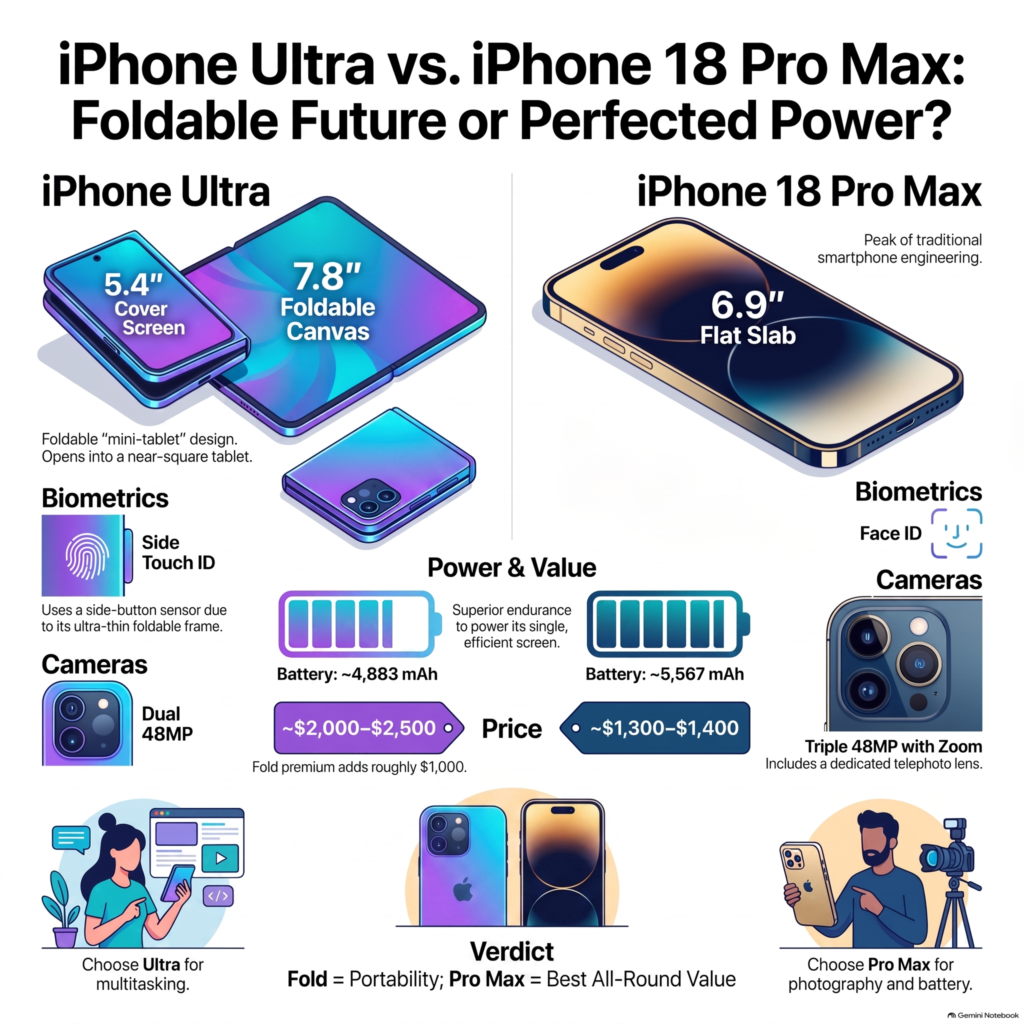
    iPhone Ultra vs iPhone 18 Pro Max specs comparison infographic
    • If you want the most screen and a genuine “phone that becomes a tablet” → the iPhone Ultra. Apple’s first foldable opens to a ~7.8-inch inner display for multitasking, reading and video.
    • If you want the best camera, the biggest battery and the lowest price → the iPhone 18 Pro Max. It keeps the telephoto zoom the fold drops, and costs roughly $1,000 less.
    • For most people → the iPhone 18 Pro Max. Unless the folding form factor is the whole reason you’re buying, the Pro Max is the more complete, more affordable phone. The Ultra is for early adopters who want the new thing and will pay for it.

    Naming note: Apple’s first foldable is widely rumored to launch as the iPhone Ultra, though some reports call it the iPhone Fold. We use “iPhone Ultra” throughout; the device is the same either way.


    Specs at a Glance

    All figures are rumored/expected ahead of the September 9, 2026 reveal.

    FeatureiPhone Ultra (foldable)iPhone 18 Pro Max
    Main display~7.8″ inner (foldable, creaseless) + ~5.3–5.5″ outer cover screen~6.9″ flat display
    Form factorFolds shut like a book; ~9mm folded, as thin as ~4.5mm unfoldedTraditional slab; slim, unibody
    ChipA20 Pro (2nm)A20 Pro (2nm)
    RAM~12GB~12GB (expected)
    Rear camerasDual 48MP — no telephotoTriple 48MP with true optical telephoto zoom
    Variable apertureRumoredRumored (main camera)
    Front cameras18MP on both inner and outer screensUnder-display / TrueDepth
    BiometricsTouch ID (side button — too thin for Face ID)Face ID
    Battery~4,883 mAh (dual-cell for the hinge)~5,567 mAh
    BuildTitanium, crease-minimizing hingeTitanium frame
    Rumored price~$2,000–$2,500~$1,300–$1,400
    AvailabilitySept 9 reveal; wider rollout may come laterSept 9 reveal; on sale that month

    Design & Display

    This is where the iPhone Ultra vs iPhone 18 Pro Max split is widest. The Ultra is Apple’s first foldable: shut, it’s a compact, passport-sized phone with a ~5.3–5.5-inch cover screen for quick tasks. Open it and you get a roughly 7.8-inch, near-square inner display that Apple has reportedly engineered to minimize the visible crease — enough room to run two apps side by side or read comfortably. Rumors point to a device as thin as ~4.5mm unfolded and around 9mm when closed, wrapped in titanium. (For the wider field, see our https://worldvsworld.com/iphone-18-pro-vs-iphone-17-pro/.)

    The iPhone 18 Pro Max takes the opposite approach: perfect the familiar slab. It’s expected to keep a ~6.9-inch flat display with a refined, slimmed-down Dynamic Island. No moving parts, no hinge to worry about, and a design that slips into a pocket the way every iPhone always has. If you’ve owned a Pro Max before, this will feel instantly familiar.

    Bottom line: the Ultra offers far more screen and a new way to use a phone; the Pro Max offers durability, simplicity and a proven form factor.

    Cameras

    The Pro Max is the clear photography pick. It’s rumored to keep a triple-lens 48MP system with a true optical telephoto zoom, plus a possible variable-aperture main camera for manual depth-of-field control. For anyone who shoots portraits, distant subjects or wildlife, that telephoto matters.

    The iPhone Ultra reportedly runs a dual 48MP rear system and drops the telephoto entirely — a common trade-off on foldable phones, where the hinge leaves little room for a periscope lens.

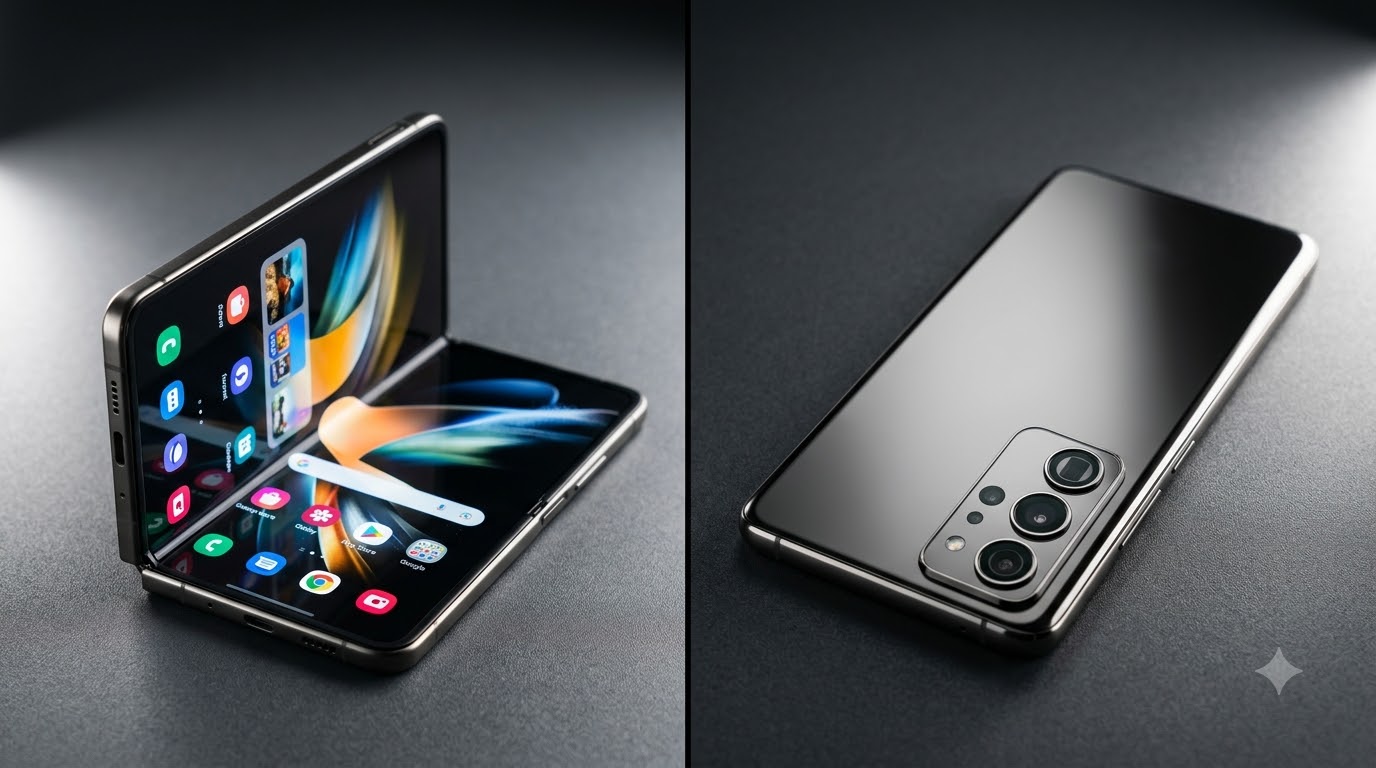
    Foldable iPhone Ultra open showing large inner multitasking screen

    It does have one trick the Pro Max can’t match: because the cover screen doubles as a live viewfinder, you can frame yourself with the main (better) cameras for selfies and vlogs.

    Bottom line: Pro Max wins on reach and versatility; the Ultra wins on selfie quality and creative framing, but loses zoom.

    Performance & Battery

    On raw power, this one’s basically a tie. Both are expected to run Apple’s A20 Pro chip on a 2-nanometer process with around 12GB of RAM, so day-to-day speed, gaming and on-device AI should feel the same.

    Battery is where physics favours the slab. The Pro Max’s unibody reportedly holds around 5,567 mAh, while the Ultra splits roughly 4,883 mAh across two cells to fit the folding hinge — and that larger inner screen is hungrier. Expect the Pro Max to last noticeably longer on a heavy day. (Prefer Android? The same size-versus-battery trade-off shows up in our Pixel 11 vs Pixel 11 Pro comparison.)

    Bottom line: same brain, but the Pro Max should have meaningfully better endurance.

    Multitasking & Everyday Use

    The Ultra’s pitch is productivity: an open 7.8-inch canvas makes split-screen apps, spreadsheets, e-reading and video genuinely more comfortable than any slab phone. The trade-off is a Touch ID side button instead of Face ID (the body is too thin for the Face ID array), and the extra bulk and care a foldable demands.

    The Pro Max keeps Face ID, a single rugged screen, and the reassurance of a design with no hinge to fatigue over years of use. For most daily tasks — messaging, browsing, camera, calls — the difference in convenience is small.

    Price

    Price is the deciding factor for many buyers. The iPhone 18 Pro Max is expected to start somewhere around $1,300–$1,400 (a modest hike over the iPhone 17 Pro Max — see how the tiers stack up in our https://worldvsworld.com/iphone-18-pro-vs-iphone-17-pro/. The iPhone Ultra is rumored to land between $2,000 and $2,500 — potentially close to twice the price. That ~$1,000 gap is the heart of the iPhone Ultra vs iPhone 18 Pro Max decision, which brings us to the calculation below.


    The $950 Question: What Are You Actually Paying For? (Original Angle)

    Most comparisons stop at “the Ultra is expensive.” Here’s a breakdown you won’t find elsewhere. Using rumored mid-range prices and estimated screen dimensions, we worked out what that folding premium actually buys — and the result is counter-intuitive.

    The assumptions (rumored, for illustration):

    • iPhone Ultra: ~$2,300, inner screen ~7.8″ (≈ 29 sq in of display, plus a ~5.4″ cover screen)
    • iPhone 18 Pro Max: ~$1,350, screen ~6.9″ (≈ 18 sq in of display)
    • The “fold premium”: ~$950

    Cost per square inch of main screen:

    • iPhone Ultra: ~$2,300 ÷ 29 sq in ≈ $79 per square inch
    • iPhone 18 Pro Max: ~$1,350 ÷ 18 sq in ≈ $75 per square inch

    Here’s the surprise: on a pure screen-for-your-money basis, the two are almost identical — roughly $75–$79 per square inch. In other words, Apple isn’t charging a huge markup on the glass. That ~$950 premium is almost entirely the price of the folding mechanism and portability — the engineering that lets a ~7.8-inch display fold into your pocket.

    The practical way to think about it: that ~$950 gap is roughly what a base iPad plus an Apple Pencil costs. So the real question isn’t “is the Ultra overpriced?” — it’s “do I want one device that folds into a tablet, or a phone plus an actual separate tablet for about the same total?” If you’ll genuinely use the folded-open screen every day, the Ultra earns its price. If the big screen is a “nice to have,” a Pro Max plus an iPad gives you more total glass, a real telephoto camera, and two devices for one to fail on.

    Use-Case Verdict

    • Buy the iPhone Ultra if: the folding form factor is the reason you’re upgrading, you multitask on your phone daily, you want the newest thing first, and the price isn’t a barrier. You’re paying for portability and a mini-tablet, and you accept losing the telephoto and some battery life.
    • Buy the iPhone 18 Pro Max if: you want the best camera (that telephoto matters), the longest battery life, Face ID, a proven durable design, and roughly $1,000 back in your pocket.
    • For most people: the iPhone 18 Pro Max is the smarter buy. It’s the more complete, more reliable, more affordable phone, and it doesn’t ask you to give up the telephoto or the battery. The iPhone Ultra is a genuinely exciting first-generation foldable — but first-generation is exactly the word to keep in mind. Wait for real-world durability reviews before spending $2,000+.

    FAQ

    When does the iPhone Ultra come out?

    Apple is expected to reveal both the iPhone Ultra and the iPhone 18 Pro Max at its event on September 9, 2026. The Pro Max should go on sale that month; the foldable Ultra may see a wider rollout slightly later. Confirm exact dates from Apple’s official announcement.

    Is the iPhone Ultra worth twice the price of the iPhone 18 Pro Max?

    Only if you’ll actually use the folding screen. Our cost breakdown shows Apple isn’t marking up the display much — the premium pays for the folding mechanism. If portability and a mini-tablet matter to you, it’s worth it; if not, the Pro Max is the better value.

    Does the iPhone Ultra have a telephoto camera?

    No. The iPhone Ultra is rumored to use a dual 48MP rear system with no dedicated telephoto lens. The iPhone 18 Pro Max keeps a triple-camera setup with true optical zoom, making it the stronger choice for zoom photography.

    Face ID or Touch ID?

    The iPhone 18 Pro Max is expected to keep Face ID. The iPhone Ultra is rumored to use Touch ID built into the side button, because its ultra-thin body has no room for the Face ID array.

    Which has better battery life?

    The iPhone 18 Pro Max. Its unibody reportedly holds a larger battery (~5,567 mAh) versus the Ultra’s split ~4,883 mAh, and the Pro Max’s single screen is less power-hungry than the Ultra’s large inner display.


    Disclaimer

    This article compares rumored, pre-launch specifications ahead of Apple’s September 9, 2026 event and is provided for general information only. Details, prices and availability may change once Apple makes its official announcement. We aim to present both devices fairly; always verify current specs from official sources and do your own research before buying.


  • Netflix vs Disney+: Which Streaming Service Is Better in 2026?

    Netflix vs Disney+: Which Streaming Service Is Better in 2026?

    Netflix vs Disney+ is the streaming decision millions of households are re-thinking in 2026, especially after another round of Netflix price rises. One is the biggest, broadest library on the planet; the other is a franchise-and-family powerhouse that now bundles live sports. So which deserves your money this year? This neutral, up-to-date comparison breaks down price, content, quality and value — and gives you a clear, use-case verdict instead of a vague “it depends.”

    Netflix vs Disney+: Quick Answer

    If you want the widest variety — adult dramas, thrillers, international hits, true crime and stand-up — Netflix is the stronger all-round pick. If your household leans on Marvel, Star Wars, Pixar and family co-viewing, or you want live sports in the same app, Disney+ is the smarter buy (and its 4K plan is notably cheaper). For most people the real answer is about who’s watching: a mixed-taste adult household tilts to Netflix, a family-with-kids or sports household tilts to Disney+.

    Netflix vs Disney+ at a Glance (US, 2026)

    NetflixDisney+
    Cheapest plan (with ads)$8.99/mo$11.99/mo
    Ad-free plan$19.99/mo (1080p)$18.99/mo (4K)
    Top / 4K plan$26.99/mo (Premium, 4K)$18.99/mo (Premium, 4K)
    Global subscribers~300 million~124 million
    Library sizeLargest & broadestSmaller but franchise-dense (+ Hulu content)
    Best forVariety, drama, international, originalsFranchises, family, kids
    Live sportsEssentially noneYes, via ESPN bundle
    Simultaneous streams (top plan)44

    (Prices are US, as of 2026, and change often — always check the official Netflix and Disney+ pages before subscribing.)

    Price and Plans

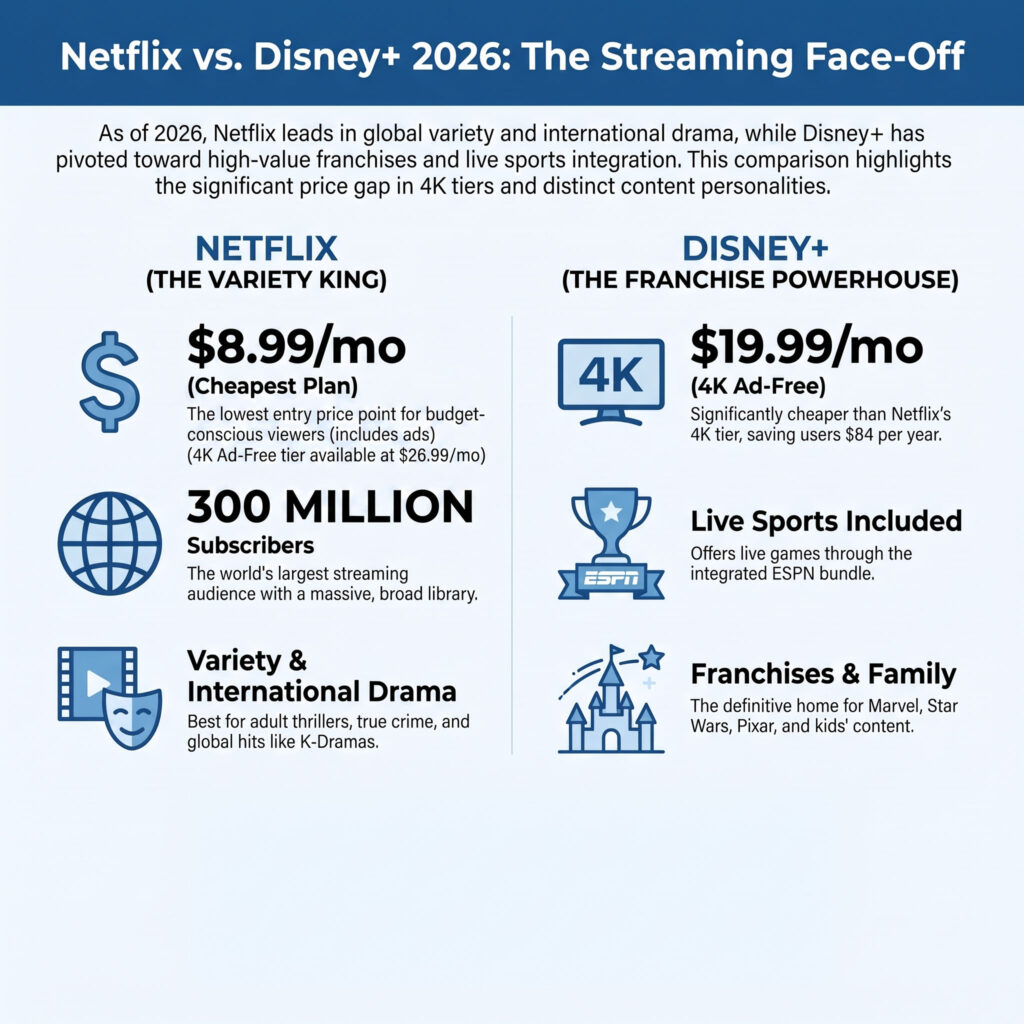
    On raw pricing the two now overlap in interesting ways. Netflix runs three US tiers: Standard with Ads at $8.99, Standard (no ads) at $19.99 in 1080p, and Premium at $26.99 for 4K Ultra HD and four screens — after price increases earlier in 2026. Disney+ keeps it simpler: Basic (with ads) at $11.99 and Premium (no ads) at $18.99, and crucially that Premium plan already includes 4K Ultra HD.

    Two things jump out. Netflix’s ad tier is cheaper ($8.99 vs $12.99), so budget-first viewers who don’t mind ads save with Netflix. But if you want 4K without ads, Disney+ is far cheaper — $18.99 vs Netflix’s $26.99. That gap matters, and we put a number on it in the original-angle section below.

    Content Library

    This is where their personalities split. Netflix is about scale and range: the largest library of the two, strong in adult drama, thrillers, prestige TV, true crime documentaries, stand-up comedy and world-class international content (Korean, Spanish-language and Nordic titles that regularly go global). If you like discovering something new every night across every genre, Netflix has the depth.

    Netflix vs Disney+ 2026 price and features infographic

    Disney+ trades breadth for firepower. Its catalogue is smaller but stacked with the most valuable franchises in entertainment — Marvel, Star Wars, Pixar, Walt Disney Animation and National Geographic — plus general-audience shows and movies pulled in from Hulu inside the same app. It’s the definitive home for family co-viewing and franchise fandom, even if it can’t match Netflix’s sheer volume.

    The honest split: Netflix wins on quantity and variety; Disney+ wins on franchise quality and family appeal.

    Originals and Franchises

    Netflix produces more original content than any streamer, and its hits become cultural events — think long-running global phenomenons that pull in repeat “binge” viewing across seasons. Its weakness is consistency: for every breakout, there’s a lot of filler.

    Disney+ releases fewer titles but with higher hit density, because it’s mining pre-loaded universes with built-in audiences. A new Marvel or Star Wars series arrives as an event with a decade of story behind it. If you value a steady stream of something new, Netflix leads; if you value fewer-but-bigger tentpoles you already care about, Disney+ delivers.

    Netflix vs Disney+ household viewing comparison illustration

    Live Sports

    This is a clean win for Disney+. Through the Disney bundle with ESPN, you can stream live sports alongside your shows and movies in one subscription — a genuine advantage for households that would otherwise pay separately for sports. Netflix has essentially no sports offering beyond the occasional one-off live event, and no sports bundle. If live games are part of your week, Disney+ is the only one of the two that covers it.

    Picture Quality and Households

    Both top tiers deliver 4K Ultra HD with HDR and four simultaneous streams, so a busy household can watch on several screens at once on either service. The difference is what that 4K costs: Disney+ includes it at $19.99, while Netflix reserves 4K for its $26.99 Premium tier. For a multi-screen family that wants the sharpest picture without ads, Disney+ is the cheaper route to the same technical experience.

    The Original Angle: The Household Scorecard and the Real Cost of 4K

    Most comparisons stop at “both are good.” Here are two things you won’t find on other pages.

    1) The household scorecard — pick your winner by who’s watching:

    Your householdBetter pick
    Adults who want variety, drama & true crimeNetflix
    Families with young kidsDisney+
    Marvel / Star Wars / Pixar superfansDisney+
    Sports fans who also want showsDisney+ (ESPN bundle)
    International / K-drama & world cinema loversNetflix
    Cheapest possible plan, ads are fineNetflix ($8.99)

    Scoreline: Disney+ 3, Netflix 3. It’s genuinely even — the “winner” is whichever row describes your living room.

    2) The real cost of 4K (a calculation competitors skip). Both give you 4K, but at very different prices:

    • Netflix 4K (Premium): $26.99/mo = $323.88/year
    • Disney+ 4K (Premium): $18.99/mo = $227.88/year

    That’s an $96-a-year difference for the same 4K, ad-free experience — enough to fund roughly four extra months of Disney+ every year, or a chunk of a separate subscription. If 4K matters to you and franchise content is enough, Disney+ is the clear value pick. And if you truly want both services in 4K, budget around $46/month (~$552/year) combined — worth knowing before you assume you can casually keep both.

    Verdict: Which Should You Subscribe To?

    No fence-sitting — here’s the use-case call, backed by everything above.

    • Choose Netflix if you want the biggest, most varied library, love international and adult drama, or want the cheapest plan overall ($8.99 with ads). It’s the better single service for mixed-taste adult households.
    • Choose Disney+ if you have kids, love Marvel/Star Wars/Pixar, want live sports via the ESPN bundle, or want ad-free 4K for the lowest price ($19.99). It’s the better family and franchise service, and the better 4K value.
    • For most households, it comes down to who’s watching and whether you need sports — not which service is “better” in the abstract. If budget allows and tastes are split, many families keep Netflix for variety and Disney+ for the kids and franchises; if you must pick one, let the scorecard above decide.

    Whichever you choose, 2026 is a good year to review it — prices have moved, so it’s worth checking you’re on the plan that actually matches how your household watches.

    Frequently Asked Questions

    Is Netflix or Disney+ better in 2026? Neither is universally better. Netflix has the larger, more varied library and better adult and international content; Disney+ is stronger for families, franchises (Marvel, Star Wars, Pixar) and live sports via its ESPN bundle. The best pick depends on who’s watching.

    Which is cheaper, Netflix or Disney+? It depends on the plan. Netflix’s ad-supported tier ($8.99) is cheaper than Disney+ Basic ($12.99), but Disney+ Premium with 4K ($18.99) is cheaper than Netflix Premium with 4K ($26.99).

    Does Disney+ have live sports? Yes — through the Disney bundle with ESPN, you can stream live sports alongside Disney+ and Hulu content. Netflix does not offer a comparable sports bundle.

    Which has more content, Netflix or Disney+? Netflix has the larger and more varied library overall. Disney+ has a smaller catalogue but is dense with high-value franchises and adds general content from Hulu inside the same app.

    Can I get both Netflix and Disney+? Yes, and many households do — but budget for it. Both services in ad-free 4K costs roughly $46/month combined, so it’s worth deciding whether one service covers most of your viewing first.

    Disclaimer

    This article is a neutral, fact-based comparison for general information. Streaming plans, prices and content libraries change frequently and vary by country — the figures here are US prices as of 2026 and may already have changed. Always check the official Netflix and Disney+ pages for current pricing and availability, and do your own research for your household’s needs.


  • ChatGPT vs Gemini: Which AI Assistant Is Better in 2026?

    ChatGPT vs Gemini: Which AI Assistant Is Better in 2026?

    ChatGPT vs Gemini is the AI question almost everyone is asking in 2026, and the honest answer has shifted a lot this year. OpenAI’s ChatGPT and Google’s Gemini are now genuinely neck-and-neck on raw intelligence, so the real decision is no longer “which is smarter” but “which fits your life and tools.” This neutral, hands-on comparison breaks down models, coding, writing, image and video generation, ecosystem, and price — so you can pick the right one for you, not just the one with the loudest marketing.

    ChatGPT vs Gemini: Quick Answer

    If you write code, use lots of third-party and Microsoft apps, or want the deepest agent features, ChatGPT is the safer pick. If you live inside Gmail, Docs and Drive, want the best AI video generation, or want the cheapest capable paid plan, Gemini pulls ahead. For most everyday users the two are close enough that the tiebreaker is simple: choose the one that already lives where you work — Google’s ecosystem points to Gemini, a Microsoft or mixed tech stack points to ChatGPT.

    ChatGPT vs Gemini at a Glance

    ChatGPT (OpenAI)Gemini (Google)
    Flagship model lineGPT-5.6 seriesGemini 3 series (3.1 Pro / Deep Think)
    Benchmark performanceTop-tierTop-tier (roughly level)
    Context window~1 million tokens~1 million tokens
    Cheapest paid planGo (~$8/mo)AI Plus ($4.99/mo)
    ~$20 planPlus ($20/mo)AI Pro ($19.99/mo)
    Top consumer planPro ($100–$200/mo)AI Ultra ($99.99–$199.99/mo)
    CodingClass-leading (Codex)Good, still catching up
    Image generationExcellentExcellent (4 images per prompt)
    Video generationLimitedClass-leading (Veo)
    Best ecosystem fitMicrosoft + 140+ appsGoogle Workspace

    (Prices and model versions in AI move fast and vary by region — always check the official OpenAI and Google pages before subscribing.)

    Models and Raw Power

    At the top end, this is close to a dead heat. ChatGPT’s GPT-5.6 family and Google’s Gemini 3 family trade blows across mainstream AI benchmarks, and both now offer a context window of roughly one million tokens — enough to feed in an entire book, a large codebase, or months of documents in a single prompt. A year ago, Gemini’s giant context was a standout advantage; in 2026 ChatGPT has closed that gap, so context size alone is no longer a deciding factor.

    The practical takeaway: for a normal question, email, summary or brainstorm, you will rarely notice a quality difference between the two flagships. The differences show up in what each one is plugged into and what extra media it can create — which is where the rest of this comparison lives.

    Coding and Development

    This is ChatGPT’s clearest win. OpenAI’s coding stack (Codex) is the most widely adopted in the developer world, holding a larger share of enterprise coding use than Google’s equivalent, and ChatGPT’s paid tiers give power users far more high-volume coding headroom. Google’s coding tools are improving quickly but are still playing catch-up.

    If writing, debugging or shipping code is a core part of your day, ChatGPT is the stronger daily driver.

    Writing and Research

    For long-form writing and deep research the two are close, with different flavours. Both offer a “deep research” mode that reads across many sources and a canvas-style workspace for drafting. ChatGPT lets you edit mid-task without cancelling a long job, which is handy for iterative writing. Gemini ties into NotebookLM, Google’s research notebook, which is excellent for working through large piles of source material and generating study aids.

    Call it a tie: pick ChatGPT for smoother iterative drafting, Gemini for source-heavy research projects.

    Image and Video Generation

    For still images it’s essentially level — both produce results that sit at the top of text-to-image quality rankings, though Gemini gives you four images per prompt to ChatGPT’s one, so you get more options per try.

    For video, Gemini is well ahead. Google’s Veo generates high-quality clips with native audio and consistently tops video-generation leaderboards, while OpenAI has pulled back from consumer video (its Sora app was discontinued in early 2026). Gemini also uniquely offers AI music generation. If creating video or multimedia matters to you, Gemini is the clear choice.

    Ecosystem and Integrations

    This is the factor that decides it for most people. Gemini is woven directly into Google Workspace: you can pull from Gmail, Drive, Docs, Maps, Photos and YouTube with simple “@” mentions, and it can proactively bring in context from those apps. If your work and personal life already run on Google, Gemini feels like a native superpower.

    ChatGPT counters with breadth: it connects to 140+ third-party work apps, including the Microsoft stack (Teams, SharePoint, OneDrive), GitHub, Slack and HubSpot. If your tools are spread across many vendors — or centred on Microsoft — ChatGPT slots in more cleanly.

    So the honest rule of thumb: Gemini for Google-first users, ChatGPT for everyone with a mixed or Microsoft-based toolkit.

    Pricing and Value

    The two have converged almost exactly where it counts. ChatGPT Plus is $20/month; Google AI Pro is $19.99/month — the same money for a comparable flagship experience. At the top, the power tiers also match up closely (ChatGPT Pro $100–$200 vs Gemini AI Ultra $99.99–$199.99, both scaling usage 5x to 20x).

    Where Gemini wins is the budget rung: its AI Plus tier at $4.99/month undercuts ChatGPT’s cheapest paid plan (Go, around $8), making Gemini the better value if you want a capable paid assistant for the least money. Both also offer genuinely useful free tiers — good enough for casual daily use — so you can trial each before paying anything.

    The Original Angle: The Task-by-Task Scorecard and the Real $20 Test

    Most “ChatGPT vs Gemini” pages just declare one winner. Here are two things they don’t give you.

    1) The task-by-task scorecard — pick your winner by what you actually do:

    What you’re doingBetter pick
    Writing and shipping code / agentsChatGPT
    Making video or multimedia contentGemini
    Working across Gmail, Docs and DriveGemini
    Connecting Microsoft, Slack, GitHub & many appsChatGPT
    Generating still imagesTie
    Everyday questions, summaries and writingTie

    Scoreline: ChatGPT 2, Gemini 2, two ties. That even split is the real story of 2026 — there is no universal “best.” The winner is whichever column has the row that matches your daily work.

    2) The real $20 test. At almost the same price (ChatGPT Plus $20 vs Google AI Pro $19.99), the smarter buy is decided by ecosystem, not intelligence:

    • If you spend your day in Google apps or make video → the $19.99 Gemini plan gives you more usable power (Workspace access + Veo) for the money.
    • If you code or run a Microsoft/multi-app stack → the $20 ChatGPT plan returns more real value (Codex + 140+ connectors + mid-task editing).
    • If you just want the cheapest capable paid AI → Gemini’s $4.99 AI Plus tier is the value winner outright, with nothing equivalent on the ChatGPT ladder.

    In other words, the “which is cheaper” question has a real answer (Gemini, at the entry level), but the “which is worth $20” question only has a personal one.

    Verdict: Which Should You Choose?

    No fence-sitting — here’s the use-case call, backed by everything above.

    • Choose ChatGPT if you code, rely on agent features, or work across Microsoft and many third-party apps. It leads on development and has the widest app connectivity.
    • Choose Gemini if you live in Google Workspace, want the best AI video (Veo), or want the cheapest capable paid plan ($4.99). It wins on ecosystem fit and multimedia creation.
    • For most people, the two flagships are close enough on everyday quality that the deciding factor is your existing toolkit and budget, not the AI’s IQ. Try both free tiers for a week, then pay for the one that already lives where you work.

    The best AI assistant in 2026 isn’t the “smartest” one on a benchmark — it’s the one that fits your day. Both ChatGPT and Gemini are good enough that you almost can’t lose; you just want to win by a bit more.

    Frequently Asked Questions

    Is ChatGPT or Gemini better in 2026? Neither is universally better — their flagship models (GPT-5.6 and Gemini 3) are roughly level on benchmarks. ChatGPT leads on coding and third-party app connections; Gemini leads on Google Workspace integration and AI video. The best pick depends on the tools you already use.

    Which is cheaper, ChatGPT or Gemini? Gemini is cheaper at the entry level: its AI Plus plan is $4.99/month versus ChatGPT’s cheapest paid plan (Go) at around $8. Their main ~$20 tiers (ChatGPT Plus $20, Google AI Pro $19.99) cost almost the same.

    Which is better for coding? ChatGPT. OpenAI’s coding tools are the most widely used by developers and its paid tiers offer more high-volume coding capacity, though Gemini is improving.

    Which is better for making videos? Gemini. Google’s Veo model leads AI video generation and produces clips with native audio, while ChatGPT has stepped back from consumer video.

    Do I need to pay to use ChatGPT vs Gemini? No. Both offer capable free tiers that are fine for casual, everyday use. Paid plans mainly add higher usage limits, faster responses, and advanced features like deep research and video generation.

    Disclaimer

    This article is a neutral, fact-based comparison for general information. AI models, features and prices change very quickly and vary by country — the figures here reflect the situation in 2026 and may already have moved. Always check the official OpenAI (ChatGPT) and Google (Gemini) pages for the latest before subscribing, and do your own research for your specific needs.


  • Alcaraz vs Sinner: Who Has the Edge at the 2026 US Open?

    Alcaraz vs Sinner: Who Has the Edge at the 2026 US Open?

    The Alcaraz vs Sinner rivalry has become the defining story of men’s tennis, and it heads into the 2026 US Open (August 30 – September 13) with a fresh twist: Carlos Alcaraz is back. After a wrist injury cost him four months and forced him out of the French Open and Wimbledon, the defending champion has confirmed his return in New York — straight into the path of world No. 1 Jannik Sinner. This is a neutral, evidence-based look at how the two stack up and who holds the edge on the fastest hard court of the year.

    Alcaraz vs Sinner: Quick Answer

    • Back Sinner if you value current form and match sharpness. He’s world No. 1, arrives red-hot off a Career Golden Masters run and a second straight Wimbledon title, and hasn’t stopped playing all year.
    • Back Alcaraz if you value big-match pedigree. He leads their head-to-head 10–7, is the defending US Open champion, and owns seven Grand Slam titles to Sinner’s five.
    • For most neutral fans, Sinner is the safer pick for the 2026 US Open on form and fitness — but a fully healthy Alcaraz is the man Sinner least wants to see across the net, and the value pick if his wrist holds up.

    The Two Players at a Glance

    Carlos AlcarazJannik Sinner
    Age2325
    NationalitySpainItaly
    Current rankingWorld No. 2World No. 1
    Grand Slam titles75
    2026 highlightsAustralian Open champion (career Grand Slam); out ~4 months with wrist injury6 straight Masters 1000 titles, Career Golden Masters, Wimbledon champion
    US Open historyChampion 2022 & 2025 (defending)Champion 2024
    Playing styleExplosive all-court game, drop shots, athleticismRelentless flat baseline power, elite hard-court ball-striking
    Head-to-headLeads 10–7Trails 7–10

    Head-to-Head

    Across 17 career meetings, Alcaraz leads Sinner 10–7 — and crucially, he won their most recent Grand Slam final, the 2025 US Open, 6-2, 3-6, 6-1, 6-4. Sinner has hit back hard in 2026, beating Alcaraz in the Monte-Carlo Masters final (7-6(5), 6-3) on clay to reclaim the No. 1 ranking, and he also took their 2025 ATP Finals title match. The pattern that’s emerging: Alcaraz has the edge in the biggest Slam moments, while Sinner has been the more consistent week-to-week winner. Their rivalry has produced a run of finals — Roland Garros, Wimbledon, Cincinnati and the US Open in 2025 alone — at a level the men’s game hasn’t seen since Federer and Nadal.

    Grand Slam Résumé

    Alcaraz is ahead on the biggest metric: seven majors to Sinner’s five. Alcaraz’s 2026 Australian Open win — beating Novak Djokovic in the final — made him the youngest man in the Open Era to complete the Career Grand Slam. Sinner’s five (two Australian Opens, the 2024 US Open, and back-to-back Wimbledons in 2025 and 2026) are built on ruthless hard-court and grass dominance, though the one gap on his résumé is Roland Garros, where a shock second-round loss in 2026 ended his own bid for a career Slam. On silverware, Alcaraz leads; on 2026 tour-level dominance, Sinner is untouched.

    Current Form

    This is where the gap opens up. Sinner has been the most dominant player on tour in 2026 — six consecutive Masters 1000 titles, completing the Career Golden Masters (all nine Masters events), plus a second straight Wimbledon and a long reign at No. 1. Alcaraz, by contrast, hasn’t played a competitive match since April.

    His wrist injury, suffered in Barcelona, wiped out his clay and grass seasons and both US hard-court warm-ups in Toronto and Cincinnati. He’s trained back up to full intensity, but four months out is four months out — especially for a wrist, which is central to the whip and topspin that make his game so dangerous.

    The 2026 US Open Edge Scorecard (Original Angle)

    Head-to-head records don’t fully answer the real question — who has the edge at this specific tournament, on this surface, right now? So here’s an original, transparent scorecard rating each player 1–10 across the five factors that matter most for the 2026 US Open. (It’s an analytical model, not a prediction — upsets are the whole point of sport.)

    Factor (out of 10)AlcarazSinnerWhy
    Hard-court pedigree89Both are elite; Sinner’s flat power is tailor-made for fast hard courts.
    2026 form & momentum59Sinner has dominated the season; Alcaraz has a title but months of inactivity.
    Match sharpness & fitness59Sinner is fully match-tuned; Alcaraz returns from a wrist layoff with zero recent matches.
    Head-to-head & big-match nerve87Alcaraz leads 10–7 and won their last Slam final.
    Motivation & X-factor88Alcaraz defends his title with a point to prove; Sinner wants to flip the rivalry.
    Total34 / 5042 / 50

    The scorecard gives Sinner the pre-tournament edge, 42 to 34 — almost entirely because of form and match sharpness, not talent. Strip those two rows out and the two are dead level. That’s the real headline of Alcaraz vs Sinner in 2026: on pure ability and big-match record it’s a coin flip, but rust and a healing wrist are the difference-makers going in. If Alcaraz proves his wrist is sound in the early rounds, expect that eight-point gap to shrink fast.

    The Verdict

    If you want the safe pick for the 2026 US Open, it’s Sinner — world No. 1, the season’s most dominant player, fully match-fit, and playing on his best surface. If you want the higher-upside pick and believe in big-match pedigree, it’s Alcaraz — he leads the head-to-head, he’s the defending champion, and he raises his game most on the sport’s biggest stages. For most neutral fans, the smart read is this: back Sinner on form, but don’t be surprised if a healthy Alcaraz turns it into another classic — because whenever these two meet in a final, form matters less than nerve, and that’s the one column where Alcaraz still leads.

    Full draws, schedules and live results are on the US Open official site and the ATP Tour.

    FAQ

    When is the 2026 US Open?

    The 2026 US Open runs from August 30 to September 13 at Flushing Meadows in New York — the final Grand Slam of the season.

    What is the Alcaraz vs Sinner head-to-head record?

    Carlos Alcaraz leads Jannik Sinner 10–7 across 17 career meetings. Alcaraz won their most recent Grand Slam final (2025 US Open), while Sinner won their 2026 Monte-Carlo final.

    Is Carlos Alcaraz playing the 2026 US Open?

    Yes. Alcaraz confirmed his return after a wrist injury that kept him out for about four months, including the French Open, Wimbledon, and the Toronto and Cincinnati hard-court events. He is the defending champion.

    Who has more Grand Slam titles, Alcaraz or Sinner?

    Alcaraz has seven major titles; Sinner has five. Alcaraz completed the Career Grand Slam at the 2026 Australian Open; Sinner’s missing major is the French Open.

    Who is the favorite to win the 2026 US Open?

    Sinner enters as the bookmakers’ favorite as world No. 1 and the season’s most consistent player, but a fit Alcaraz — with a 10–7 head-to-head lead — is widely seen as his most dangerous rival.

    Disclaimer

    This comparison aims to be neutral and fair to both players. Rankings, records, and results are accurate as of publication (August 2026) and will change as the tournament unfolds; the Edge Scorecard is an analytical opinion, not a guaranteed prediction. Always check official sources for the latest draws, results, and player news. Do your own research before wagering on any sporting event.

  • iPhone 18 Pro vs iPhone 17 Pro: Should You Wait or Buy Now?

    iPhone 18 Pro vs iPhone 17 Pro: Should You Wait or Buy Now?

    The iPhone 18 Pro vs iPhone 17 Pro decision is the big question for anyone eyeing an Apple flagship this autumn, because Apple’s next Pro phone is expected on stage around September 9, 2026, with a release roughly ten days later. One phone is confirmed, tested and on shelves today; the other is still a stack of credible leaks. This comparison lays out what each side actually offers so you can decide whether to buy the iPhone 17 Pro now or hold out for the iPhone 18 Pro.

    Heads-up on sourcing: Every iPhone 17 Pro figure below is confirmed (it launched in September 2025). Every iPhone 18 Pro figure is based on supply-chain leaks and analyst reports and is not official until Apple announces it. Treat the 18 Pro column as “best current expectation,” not fact.

    iPhone 18 Pro vs iPhone 17 Pro: Quick Answer

    • Buy the iPhone 17 Pro now if you need a phone today, want to pay less, or don’t care about a variable-aperture camera. It is a confirmed, excellent flagship at a known price.
    • Wait for the iPhone 18 Pro if you want the newest 2nm A20 chip, a bigger battery, and the redesigned camera system — and you’re comfortable paying more.
    • For most people upgrading from an older iPhone, waiting the extra few weeks for the iPhone 18 Pro launch is the smart move: even if you buy the 17 Pro, its price often drops once the new model lands.

    Specs at a Glance

    FeatureiPhone 17 Pro (confirmed)iPhone 18 Pro (rumored)
    LaunchSeptember 2025Expected ~Sept 18–19, 2026
    Starting price (US, 256GB)$1,099Rumored ~$1,199–$1,299 (a likely $100–$200 rise)
    ChipA19 Pro (3nm), 12GB RAMA20 (2nm), integrated RAM; up to ~18% faster, ~30% more efficient
    Display6.3″ LTPO OLED, 120Hz, 3000 nits peakSame 6.3″ (Pro) / 6.9″ (Pro Max), LTPO+, possibly smaller Dynamic Island
    Main camera48MP f/1.848MP with variable aperture + new stacked sensor
    Telephoto48MP f/2.8 periscope, 4x optical48MP, larger aperture
    Battery3,998 mAh~4,288 mAh (Pro) / ~5,567 mAh (Pro Max)
    Charging50% in ~20 min wired, 25W MagSafeExpected similar or faster
    BuildAluminum frame, 8.8mm, 206gSlightly thicker (~8.8–9mm), unified back glass
    ColorsSilver, Cosmic Orange, Deep BlueRumored Light Blue, Dark Cherry, Dark Gray, Silver

    Price

    Price is where this matchup gets interesting. The iPhone 17 Pro starts at $1,099 for 256GB in the US — the first time Apple raised its Pro starting price since 2017. The iPhone 18 Pro is widely rumored to climb again, with estimates ranging from about $100 to as much as $300 more, putting a realistic starting point somewhere around $1,199–$1,299. If price is your deciding factor, the 17 Pro is the known quantity and the cheaper one. Nothing about the 18 Pro’s price is official yet, so treat these numbers as a ceiling to plan around, not a quote.

    Design and Display

    Both phones share the same screen sizes — a 6.3-inch Pro and a 6.9-inch Pro Max — and the 17 Pro’s panel is already superb: LTPO OLED, a 120Hz ProMotion refresh rate, and up to 3,000 nits of peak brightness that stays readable in direct sun. The iPhone 18 Pro is expected to refine rather than reinvent this: an upgraded “LTPO+” panel for better efficiency, a possibly slimmer Dynamic Island, a unified back-glass look, and a slightly thicker body to house a bigger battery. If you love the current look, you lose nothing by buying now; if you want the freshest design and new colors like Dark Cherry, that’s a point for waiting.

    Performance

    The iPhone 17 Pro runs the A19 Pro on a 3nm process with 12GB of RAM, and in day-to-day use it is faster than almost anyone needs. The headline 18 Pro upgrade is the A20, reportedly built on a 2nm process with up to ~18% more speed and ~30% better efficiency, plus a new integrated-RAM design. That efficiency gain matters more than the raw speed for most people, because it feeds directly into battery life. Still, no current app will feel slow on the A19 Pro, so this is a “nice to have” rather than a “must have” unless you push heavy games, video editing, or on-device AI.

    Camera

    This is the clearest reason to wait. The iPhone 17 Pro already carries a strong trio: a 48MP main, 48MP ultrawide, and a 48MP periscope telephoto with 4x optical zoom.

    The iPhone 18 Pro’s rumored variable-aperture main camera is a genuine leap — it lets the lens physically control how much light comes in, giving you real depth-of-field control and better low-light shots, paired with a new three-layer stacked sensor and a brighter telephoto. If photography is why, you buy a Pro, the 18 Pro’s camera is the single upgrade most worth holding out for.

    Battery and Charging

    The iPhone 17 Pro packs a 3,998 mAh battery and charges to 50% in about 20 minutes. The iPhone 18 Pro is expected to grow to roughly 4,288 mAh on the Pro and a large 5,567 mAh on the Pro Max — a meaningful bump, especially on the Max. Combined with the A20’s efficiency, the 18 Pro should comfortably outlast the 17 Pro on a charge. If all-day (or two-day) endurance is your priority, this leans toward waiting.

    The Real Upgrade Cost (Original Angle)

    Spec sheets don’t answer the question that actually matters: if you already own an iPhone 17 Pro, what does switching really cost — and is it worth it? Here’s the math, using conservative estimates.

    A one-year-old 256GB iPhone 17 Pro in good condition typically resells for around $700–$800. If the iPhone 18 Pro launches near $1,299, your true out-of-pocket cost to upgrade is roughly:

    Line itemEstimate
    iPhone 18 Pro (256GB, rumored)~$1,299
    Minus resale of your 17 Pro−~$750
    Net cost to switch≈ $549

    So the real question isn’t “$1,299 vs $1,099” — it’s “is about $549 worth an ~18% faster chip, a variable-aperture camera, and roughly 7% more battery?” For most people who bought a 17 Pro last year, the honest answer is no — those gains are real but incremental, and $549 a year is an expensive habit. Spread over a three-year hold, the 18 Pro costs about $183 per year net; upgrading every single year costs roughly three times that for a phone that’s already excellent.

    Where the calculation flips: if you’re coming from an iPhone 15 Pro or older, you skip two generations of camera and efficiency gains at once, and the per-year cost of waiting for the 18 Pro is easy to justify. (Prices and resale values are estimates and will vary by condition, storage, and region — check live trade-in quotes before deciding.)

    The Verdict

    If you want to spend the least and get a phone today, buy the iPhone 17 Pro — it’s a confirmed, top-tier flagship and its price tends to soften once the new model arrives. If you want the best camera and battery Apple offers and don’t mind paying more, wait for the iPhone 18 Pro. And if you’re upgrading from an iPhone 15 Pro or older, waiting the few extra weeks for the 18 Pro launch is the smart pick for most people — you get the biggest leap for your money, and even choosing the 17 Pro afterward often means a better deal. If you already own a 17 Pro, keep it: at roughly $549 net to switch, this is not the year to upgrade.

    For an Android alternative in the same price bracket, see our Pixel 11 vs Pixel 11 Pro comparison.

    FAQ

    When does the iPhone 18 Pro come out?

    Apple hasn’t confirmed a date, but the event is widely expected around September 9, 2026, with pre-orders a few days later and a release around September 18–19, 2026 — following Apple’s usual mid-September pattern.

    Is the iPhone 18 Pro worth waiting for over the iPhone 17 Pro?

    If you want the new 2nm A20 chip, a variable-aperture camera, and a bigger battery, yes. If you need a phone now or want to spend less, the iPhone 17 Pro is a confirmed, excellent choice at a known $1,099 starting price.

    How much will the iPhone 18 Pro cost?

    It’s unofficial, but leaks point to a $100–$200 increase over the 17 Pro, putting the likely starting price around $1,199–$1,299 for 256GB. Apple has not confirmed pricing.

    What’s the biggest upgrade on the iPhone 18 Pro?

    The rumored variable-aperture main camera and the 2nm A20 chip, followed by a noticeably larger battery — especially on the Pro Max.

    Will the iPhone 17 Pro get cheaper when the 18 Pro launches?

    Apple usually discontinues the previous Pro at launch, but retailers and the resale market typically drop prices, so waiting a few weeks can save money on the 17 Pro even if you don’t buy the newest model.

    Disclaimer

    This comparison is written to be neutral and fair. iPhone 17 Pro details are confirmed; all iPhone 18 Pro details are based on leaks and analyst reports and may change before or at Apple’s official announcement. Prices, dates, and resale values are estimates that vary by region, storage, and condition. Always confirm current specs, pricing, and trade-in offers from official sources before buying. Do your own research.

  • Pixel 11 vs Pixel 11 Pro: Which Google Phone Should You Actually Buy?

    Pixel 11 vs Pixel 11 Pro: Which Google Phone Should You Actually Buy?

    By Udit Raj  ·  Updated August 19, 2026

    The Pixel 11 vs Pixel 11 Pro decision really comes down to one question: is Google’s $200 step-up worth it? Both phones launched together at Made by Google 2026 with the same Tensor G6 chip and the same seven years of updates, but they split hard on cameras, screen and price. Below is a neutral, side-by-side breakdown — including an original cost calculation you won’t find on other pages — to help you pick the right one.

    Quick Answer

    • Choose the Pixel 11 ($899) if you want the best value, everyday photos and the longest battery. It shares the same chip and speed as the Pro.

    • Choose the Pixel 11 Pro ($1,099) if you want the 5x optical / 120x zoom, the brightest sharpest screen, the best selfie camera, or you’ll use the 6 months of Google AI Pro included.

    • For most people: the Pixel 11 is the smart pick. Step up to the Pro only if zoom photography or the premium display genuinely matters to you.

    Pixel 11 vs Pixel 11 Pro: Specs at a Glance

    SpecPixel 11Pixel 11 Pro
    Starting price$899 (256GB)$1,099 (256GB)
    Display6.3″ Actua OLED, 1080×2424, 60–120Hz6.3″ Super Actua LTPO OLED, 1280×2856, 1–120Hz
    Peak brightness≈ 2,200 nitsUp to 3,600 nits
    ChipTensor G6 (2nm)Tensor G6 (2nm)
    RAM12GB12GB (256GB); 16GB (512GB/1TB)
    Rear cameras48MP main + 13MP ultrawide50MP main + 48MP ultrawide + 48MP 5x telephoto
    Zoom30x digital Super Zoom5x optical · 120x Pro Zoom
    Front camera13MP42MP
    Battery4,985 mAh4,850 mAh
    Charging~30W wired · 25W wireless (Qi2.2)~30W wired · 25W wireless (Qi2.2)
    Storage256GB256GB / 512GB / 1TB
    Software7 years of updates7 years of updates + 6 months Google AI Pro
    DurabilityIP68IP68 + tougher coating

    Specs verified from Google and hands-on reporting, August 2026. Always confirm current details before purchase.

    Design & Display

    Both phones are 6.3-inch and easy to use one-handed, so size isn’t the divider here — resolution and brightness are. The Pixel 11 uses a sharp 1080p Actua OLED with a 60–120Hz refresh rate. The Pixel 11 Pro steps up to a Super Actua LTPO panel that runs from 1Hz all the way to 120Hz (better for battery and always-on info), pushes a crisper 1280×2856 resolution, and hits up to 3,600 nits of peak brightness — noticeably easier to read in direct sun. If you shoot a lot of outdoor video or watch HDR content, the Pro’s screen is the clearest upgrade. For everyday scrolling, the base panel is still excellent.

    Cameras & Zoom

    This is the biggest real-world gap. The Pixel 11 runs a two-camera system: a 48MP main and a 13MP ultrawide, with digital “Super Zoom” up to 30x. There is no dedicated telephoto lens, so long-range shots are software-enhanced crops. The Pixel 11 Pro adds a true 48MP 5x optical telephoto (reaching 120x Pro Zoom), a larger 50MP main sensor, a much higher-resolution 48MP ultrawide, and a 42MP front camera versus the base phone’s 13MP selfie. If you photograph sports, wildlife, concerts or anything at distance — or you post a lot of selfies — the Pro’s camera bar is where your money goes.

    Pixel 11 vs Pixel 11 Pro comparison

    Performance & Software

    Here the two are twins. Both run Google’s Tensor G6 on a 2nm process with 12GB of RAM at the 256GB tier, so day-to-day speed, app launches and on-device AI feel identical — you are not buying a faster phone by going Pro. Both also get seven years of OS and security updates, so either phone is supported into 2033. The Pro’s only software edge is six months of Google AI Pro included in the box, plus extra RAM (16GB) if you jump to the 512GB or 1TB tiers.

    Battery & Charging

    A small surprise: the cheaper Pixel 11 actually has the bigger battery at 4,985mAh versus the Pro’s 4,850mAh, and it drives a lower-resolution screen — so real-world endurance on the base model is at least as good, often better. Charging is effectively the same on both (around 30W wired and 25W Qi2.2 wireless with Pixelsnap magnetic alignment). Battery life is not a reason to pay more here; if anything it slightly favors the standard Pixel 11.

    The Original Angle: What the $200 Pro Premium Really Costs

    Here’s the part other comparison pages skip. Because the Pixel 11 and Pixel 11 Pro share the same Tensor G6 chip, the same 12GB of base RAM, the same 6.3-inch 120Hz size, the same 256GB of storage and the same 7 years of updates, the $200 price gap ($899 → $1,099) is really buying just four things:

    • The 5x optical telephoto + 120x Pro Zoom (the base phone has none)
    • The sharper LTPO display at up to 3,600 nits
    • Better cameras overall: 50MP main, 48MP ultrawide and a 42MP selfie
    • Six months of Google AI Pro, included

    Now the calculation. Google AI Pro costs $19.99/month, so the six free months bundled with the Pro are worth about $120 in subscription value. Subtract that from the $200 premium and the extra hardware effectively costs around $80 — if you would have paid for Google AI Pro anyway. At $80, the optical telephoto alone arguably justifies the jump.

    But there’s a catch most buyers miss: if you would never subscribe to Google AI Pro, that $120 isn’t real savings to you. In that case the true premium stays the full $200, and the decision comes down purely to whether the zoom lens and brighter screen are worth it.

    One more way to frame it — cost of ownership across the 7-year support window: the Pixel 11 works out to about $128/year, the Pixel 11 Pro about $157/year. You’re paying roughly $29 more per year for the Pro’s camera and screen over the life of the phone.

    The Verdict: Which Pixel Is Right for You?

    Buy the Pixel 11 if you want the best all-round value. It has the same speed as the Pro, a slightly bigger battery, a great main camera for everyday shots, and it saves you $200. For most people, this is the smart pick.

    Buy the Pixel 11 Pro if at least one of these is true: you regularly shoot zoom photos (sports, wildlife, concerts), you want the brightest and sharpest screen for outdoor use or video, you care about a high-resolution selfie camera, or you’ll genuinely use the six months of Google AI Pro. If none of those apply, you’re paying $200 for features you won’t use.

    In short: the telephoto lens is the real deciding factor. If you want optical zoom, get the Pro. If you don’t, the Pixel 11 is the better buy.

    FAQ

    Is the Pixel 11 Pro worth $200 more than the Pixel 11?

    It depends on how you use your phone. If you’ll use the optical zoom or the included Google AI Pro, the effective cost of the upgrade can drop to around $80 and it’s worth it. If you won’t, the standard Pixel 11 is better value.

    Does the Pixel 11 have a telephoto (zoom) lens?

    No. The base Pixel 11 uses digital 30x Super Zoom only. A true 5x optical telephoto (up to 120x Pro Zoom) is exclusive to the Pixel 11 Pro and Pro XL.

    Do both phones have the same processor?

    Yes. Both run the Google Tensor G6, so everyday performance, app speed and on-device AI are essentially identical.

    Which Pixel has better battery life?

    The cheaper Pixel 11 actually has a slightly larger 4,985mAh battery (vs 4,850mAh) and a lower-resolution screen, so its real-world endurance is at least as good as the Pro’s.

    How long will these phones get updates?

    Both the Pixel 11 and Pixel 11 Pro receive 7 years of OS and security updates from launch.

    Disclaimer

    This comparison is intended to be neutral and is based on specifications and prices available as of August 2026. Details can change — always do your own research and confirm current specs and pricing on official sources before making a purchase.

    Pixel 11 vs Pixel 11 Pro

  • 2026 Tech Hub Power Rankings: Where Tech Salaries Go Furthest

    2026 Tech Hub Power Rankings: Where Tech Salaries Go Furthest

    Tech & Society · 2026 Special Report Reading Time: 15 min | Focus: Global Innovation Clusters

    The world’s tech talent is waking up to an uncomfortable truth. When looking at the tech hub rankings 2026, a high salary number means absolutely nothing if it dissolves before it reaches your savings account

    The world’s tech talent is waking up to an uncomfortable truth: a high salary number means absolutely nothing if it dissolves before it reaches your savings account. The global talent pool has spent the last decade chasing the highest gross figures, only to realize that the net yield of their life’s work is being consumed by the very ecosystems that employ them.

    This is the story of the modern tech diaspora. It is an autopsy of five cities, five entirely different economic realities, and a generation of engineers trying to figure out where to build their lives—not just their resumes.


    The Crisis: The “Salary Dissolution” in Bengaluru

    Somewhere in Koramangala or Whitefield, there is a software engineer with a ≈ $1,800/month salary.

    On paper, she has won the game. She is in the top 5% of earners in the country. Her LinkedIn profile projects an aura of a “thriving” professional at a unicorn startup. Her parents back in her hometown casually drop her compensation into family conversations as a point of immense pride.

    Her savings account tells a completely different, almost tragic story.

    $181

    High salary ≠ Rich life anymore

    Average monthly savings | Software Engineer | Bengaluru 2026

    That is not a typo. It is the mathematical reality of the “Silicon Valley Squeeze” exported to South Asia. After rent, transport, food, taxes, and the systemic cost of surviving in a city hyper-inflated by foreign venture capital, an engineer earning about $21,700 per year is left with roughly the same disposable income as a mid-level government employee in a Tier-2 city.

    The “Indian Dream” is being quietly suffocated by real estate monopolies and infrastructure bottlenecks.

    Bengaluru Reality Check (2026)Monthly ($)
    Gross Salary+$1,800
    Income Tax + Deductions−$335
    Take-home (In-hand)≈ $1,465
    Rent (1BHK, Koramangala/HSR)−$385
    Groceries + Eating Out−$180
    Commute (Cabs/Metro/Fuel)−$95
    Internet + Subscriptions−$48
    Health Insurance−$30
    Gym / Lifestyle / Personal Care−$60
    Parents (Remittance/Gifts)−$180
    Clothes / Tech / Misc−$85
    Final Net Savings≈ $180 – $240

    At this current burn rate, it would take this engineer 5.5 years just to save about $14,500 —which is barely a down payment on the very apartment she is currently renting.

    And this math assumes a straight, uninterrupted line. It assumes no medical emergencies. It assumes no dependents. It assumes her company doesn’t casually hand out a 6% “market-corrected” increment while her landlord raises the rent by 22%.

    Bengaluru didn’t fail its engineers. It simply got too good at its job. It attracted the world’s VC money, built the world’s back-office, and the cost of human existence scaled alongside the valuations.


    The Contrast: Shenzhen—The Printing Press of Physical AI

    While Bengaluru’s talent calculates rent-to-income ratios, Shenzhen’s engineers are operating on a completely different physical plane. They are not talking about software as a service; they are talking about software encased in titanium and carbon fiber.

    The 10-Day Rule: That is the exact amount of time it takes the Shenzhen hardware ecosystem to go from a napkin sketch to a functional, factory-tooled prototype.

    If a hardware startup in the United States attempts the same cycle—sourcing components, testing PCBs, printing custom injection molds, and writing firmware—it takes a minimum of 8 months.

    • The Embodied Intelligence Era: In 2026, the frontier is no longer just LLMs answering text prompts. It is “Physical AI”—humanoid robotics, autonomous supply chain drones, and next-generation EVs. Software is bleeding into the physical world. If a product has a lithium battery and an actuator, it was almost certainly born in Shenzhen.
    • The Blood Price of Speed: Shenzhen does not pretend to offer a work-life balance. The 9-9-6 culture (9 AM to 9 PM, 6 days a week) is the mandatory price of admission. It is a city built on exhaustion and sheer willpower. But for a robotics visionary who prioritizes output over comfort, it remains the single most productive square kilometer on planet Earth.
    • https://www.sciencedirect.com/science/article/abs/pii/S0160791X22000604

    The Future: Abu Dhabi’s “Stargate” in the Desert

    If you want to understand the future of global power, do not look at where the software is being written. Look at where the compute is being plugged in. In 2026, the most audacious bet in the history of technology is happening in the desert.

    $30 Billion+ | The Stargate AI Campus

    This joint venture between G42 and Microsoft is the largest AI data center complex outside the United States. It is a sovereign compute stack built to guarantee that the Middle East never has to ask permission to run intelligence-grade workloads.

    This is fundamentally different from a wealthy nation buying luxury real estate. This is a nation-state acquiring the critical infrastructure of the 21st century.

    • Compute is the New Oil: The UAE recognized early that nations unable to train their own massive models on their own data centers will eventually become digital colonies of those who can.
    • The Talent Vacuum: Abu Dhabi is aggressively headhunting the exact demographic that is bleeding out of San Francisco and Bengaluru. They offer Zero Income Tax, premium infrastructure, and an exclusive “AI Visa.” For a senior Machine Learning researcher earning $400,000, moving to Abu Dhabi isn’t just a career shift—it is a wealth-generation cheat code.

    The Reality Check: Silicon Valley as the “Elite Boutique”

    We cannot map the world without addressing the sun at the center of the solar system. Silicon Valley is not dead. It is not dying. It has simply mutated into something entirely inaccessible to the middle class. https://www.siliconvalley.com/2026/02/25/silicon-valley-by-the-numbers-record-wealth-costs/

    Silicon Valley has become an Elite Boutique.

    It is the only place on Earth where a 24-year-old with a compelling frontier AI thesis can walk into a coffee shop on Sand Hill Road and walk out with a $50 million seed round. The concentration of capital, ambition, and specialized knowledge is a gravitational anomaly that cannot be replicated.

    But the Valley has lost its function as a scalable city for human beings.

    • The Cost of Genius: The median home price in San Jose hovers around $1.8 million. A “comfortable” tech salary of $300,000 in San Francisco still often requires living with roommates if you want to aggressively save.
    • The Divergence: The Valley is for building Moonshots. It is for foundational models, quantum computing, and bio-tech breakthroughs that require a decade of unprofitable R&D. But if you are building a standard B2B SaaS tool, a mobile app, or a mid-market marketplace, locating your core engineering team in the Bay Area in 2026 is an act of financial self-sabotage.

    The Old Guard: London’s Regulatory Fortress

    While the US embraces the wild west of AI development and China manufactures the hardware, London has quietly cornered a highly lucrative, entirely unsexy market: Compliance and Financial Rails.

    London is the city where the money actually moves.

    • The Fintech Hegemony: Post-Brexit, London faced an identity crisis. It solved it by becoming the global capital for Fintech and regulatory technology (RegTech). If you are building AI that touches global banking, cross-border payments, or algorithmic compliance, London’s financial ecosystem is unparalleled.
    • The Gray Reality: The salaries are lower than in the US, and the tax burden is heavy. But London offers something the Valley cannot: direct proximity to the world’s oldest financial institutions and a regulatory framework that is actually designed to integrate with tech, rather than fight it in court.

    The Data-Backed Comparison: Funding vs. Purchasing Power

    To truly understand the 2026 tech landscape, we must look at the Purchasing Power Parity of Innovation. A dollar raised is not a dollar spent; it depends entirely on where that dollar is deployed.

    Let’s look at the runway of a hypothetical $5 Million Seed Round across different hubs:

    HubDeveloper Run-Rate (How many Senior Devs $1M buys per year)The Ultimate AdvantageThe Critical Weakness
    San Francisco3 – 4 Senior DevsUnmatched speed to Series A.Catastrophic burn rate. One mistake kills the company.
    Warsaw (Poland)12 – 15 Senior DevsWorld-class C++/Rust talent for a fraction of the cost.Further from the core VC networking nodes.
    Shenzhen8 – 10 Hardware Devs + PrototypingThe physical supply chain is effectively free.High IP theft risk; brutal domestic competition.
    Bengaluru20 – 25 Senior DevsThe ultimate scale engine. Unmatched sheer volume of output.High churn rate. Talent leaves for remote US salaries.

    The math dictates the strategy. In 2026, the most successful startups are geographically decentralized by design. They raise capital in Silicon Valley, build the hardware in Shenzhen, run the compliance through London, and scale the software ops in Warsaw or Bengaluru.


    The Career Hack: Where Your Skills Travel Further

    For the individual contributor, the smartest move in 2026 isn’t asking “Which city is the most prestigious?” The real question is: “Where does my compensation generate the most leverage for my life?”

    The Digital Nomad Arbitrage

    • Lisbon, Portugal: Europe’s golden ticket. The D7 Visa provides a clean path to EU residency. Earning a $5,000/month remote US salary while living in Lisbon places you in the upper echelons of the local economy. You get Atlantic ocean views, extreme safety, and a lifestyle that would cost $15,000/month in California.
    • Warsaw, Poland: For those who want serious engineering culture without the West Coast premium. It is safe, hyper-modern, and fiercely ambitious.

    The Domestic Pivot (For India)

    • Hyderabad & Pune: The quiet rebellion against Bengaluru. For an Indian engineer, moving to Hyderabad or Pune while maintaining a remote role is the equivalent of a 40% pay raise. The infrastructure holds up, the rents are rational, and the savings account actually grows. The cultural gravity of Bengaluru is strong, but financial freedom is stronger.

    The Verdict: Time, Leverage, and the Final Equation

    The era of default tech migration is over. You do not have to move to California to change the world. You do not have to suffer through Koramangala traffic to be a respected engineer.

    The map has fractured into specialized arenas.

    Silicon Valley is the casino where you go to spin the wheel on a billion-dollar valuation. Shenzhen is the forge where you go to sweat over physical steel and silicon. Abu Dhabi is the vault where you go to leverage sovereign capital. London is the courtroom where you build the financial plumbing.

    But stripped of all the venture capital bravado, the tech industry is ultimately just a trade of your finite time for capital and legacy.

    Look back at the engineer in Bengaluru, staring at $181 in monthly savings. Look at the founder in San Francisco, earning $300k but sharing a bathroom with three other adults. They are both playing a game designed by someone else, operating under the illusion that proximity to greatness will eventually make them rich.

    In 2026, loyalty to a city is the ultimate liability. Your loyalty must be to the ecosystem that respects the math of your life.

    You must ask yourself the hardest question in modern technology: Are you building a career that allows you to own your future, or are you just generating revenue to pay off a landlord in a “Tier-1” tech hub?

    If the math doesn’t make sense, it’s time to redraw your own map.

  • Top 10 Safest Countries If World War 3 Happens in 2026–2030 (Best Places to Live During Global Conflict)

    Top 10 Safest Countries If World War 3 Happens in 2026–2030 (Best Places to Live During Global Conflict)

    If a global conflict ever escalates into World War 3, many people start searching for the safest countries if World War 3 happens. Which places in the world would remain stable and secure during a large global conflict?

    1. What Would Happen If World War 3 Started
    2. Key Factors for Evaluating Safety
    3. Top 10 Safest Countries
    4. Comparison Table
    5. Future Outlook
    6. Conclusion

    In recent years, global tensions have been increasing. From conflicts in Eastern Europe to political disputes in the Asia-Pacific, many people are starting to ask an important question: Which countries would be safest if a large global conflict or World War 3 ever happened?

    While no place in the world is completely risk-free, some countries are considered safer because of their geography, political neutrality, strong economies, and distance from major conflict zones.

    In this guide, we’ll explore the top 10 safest countries if World War 3 happens between 2026 and 2030. We will compare them based on factors like political stability, natural resources, immigration opportunities, and overall safety.

    Whether you are planning to move abroad, looking for a secure place to live, or simply curious about global stability, this guide will help you understand which countries may offer the most security in uncertain times.

    What Would Happen If World War 3 Started?

    If a global conflict escalated into World War 3, the effects would likely be felt across the entire world. Modern warfare is not limited to traditional battlefields. It could involve cyber attacks, economic sanctions, energy shortages, and disruptions to global trade.

    Some possible consequences could include:

    • Global supply chain disruptions
    • Shortages of food, fuel, and essential goods
    • Major economic instability in many countries
    • Increased migration as people search for safer places to live

    Because of these risks, many people today are asking which countries might remain relatively stable and secure during a global conflict.

    Key Factors for Evaluating Safety in a Global Conflict

    When people talk about the safest countries during a global conflict or World War 3, several important factors come into play. No country can be completely safe in a large-scale conflict, but some places have advantages that make them more stable and secure.

    Below are some key factors that help determine which countries might remain safer during global tensions.

    Political Neutrality

    Countries that stay politically neutral often avoid getting directly involved in major wars. Neutral countries usually do not join military alliances or take sides in global conflicts.

    A well-known example is Switzerland, which has maintained neutrality for more than two centuries. Because of this policy, it managed to stay out of both World War I and World War II.

    Neutral countries often focus on diplomacy, mediation, and peacekeeping instead of military expansion.

    Military Strength or Defense Alliances

    Strong defense systems can also help a country stay safe. Nations with well-trained militaries or strong defense partnerships are often better prepared to protect their borders.

    However, being part of large military alliances can sometimes increase risk, because allies may be drawn into conflicts together.

    Geographic Isolation

    Geography plays a major role in safety. Countries that are far away from major conflict zones usually face lower risk.

    For example, island nations or countries located in remote regions—such as those in the South Pacific or the North Atlantic—may have a natural advantage because they are harder to reach and less strategically targeted.

    Economic Stability

    A stable economy helps a country manage crises more effectively. Nations with strong economies, diverse industries, and stable governments can better handle disruptions such as trade problems or supply shortages.

    Countries with strong financial systems and long-term economic planning tend to remain more resilient during global uncertainty.

    Natural Resources and Food Security

    Access to natural resources is another important factor. Countries that produce their own food, energy, and freshwater are less dependent on international supply chains.

    For example, nations with strong agriculture, renewable energy, and abundant natural resources are usually better prepared to sustain their populations during global disruptions.

    Immigration Friendliness

    Finally, immigration policies also matter. Some countries make it easier for skilled workers, investors, and families to move there.

    Countries like Canada, Australia, and New Zealand use points-based immigration systems that attract skilled professionals from around the world. During global instability, these policies can make them attractive destinations for people seeking safety and opportunity.

    Together, these factors create a clearer picture of which countries may offer the most relocation options amid fears of a broader conflict. Why? History tells us that during World War II, neutral havens like Switzerland shielded millions from direct harm, while today’s interconnected world amplifies risks from cyber attacks, supply chain stability and security in uncertain global conditions.

    People looking for temporary work opportunities in the United States can also explore the H-2B visa program, which allows foreign workers to work in seasonal industries.

    Top 10 Safest Countries If World War 3 Happens

    Quick Overview

    In recent years, global tensions have been increasing…

    Based on factors like political stability, geographic location, economic strength, and immigration opportunities, some countries appear safer than others during global conflicts. While no place in the world can be completely risk-free, certain nations have natural and political advantages that make them more stable during uncertain times.

    Below are five of the safest countries that experts often mention when discussing global safety and long-term stability.

    1. Iceland

    Overview

    Iceland is a small Nordic island nation with a population of about 380,000 people. Despite its small size, the country consistently ranks as one of the most peaceful places in the world. In fact, Iceland has ranked #1 on the Global Peace Index for more than a decade, making it the most peaceful country globally.

    The country is also known for its volcanic landscapes, glaciers, and strong renewable energy system.


    Why Iceland Could Be Safe

    One of Iceland’s biggest advantages is that it does not maintain a standing army, which makes it less likely to be a military target during global conflicts.

    In addition, Iceland’s remote location in the North Atlantic Ocean, about 1,000 km from mainland Europe, provides a natural geographic buffer from many potential conflict zones.


    Political Position

    Iceland is a member of NATO, but it does not operate its own military forces. Instead, the country focuses on peacekeeping missions and international diplomacy.

    Iceland is also known for maintaining strong diplomatic relations with many countries, which further contributes to its political stability.


    Geographic Advantages

    Iceland’s location in the North Atlantic makes it geographically isolated from major geopolitical hotspots.

    Another important advantage is energy independence. More than 85% of Iceland’s energy comes from renewable sources, mainly geothermal and hydropower. This reduces dependence on foreign energy supplies during global crises.


    Immigration Opportunities

    Iceland offers residence permits for skilled workers, researchers, and entrepreneurs. The country has also introduced digital nomad visa programs that allow remote workers to live in Iceland temporarily.

    Although immigration opportunities exist, the country’s small population means the job market is relatively limited compared to larger economies.


    Pros

    • Ranked #1 on the Global Peace Index for several years
    • One of the lowest crime rates in the world
    • Over 85% renewable energy production

    Cons

    • High cost of living (average monthly expenses can exceed $3,500)
    • Small job market due to limited population
    • Long and cold winters in northern regions

    2. New Zealand

    Overview

    New Zealand is an island nation located in the South Pacific Ocean with a population of around 5.2 million people. The country is widely known for its breathtaking natural landscapes, stable democratic government, and high standard of living.

    According to the Global Peace Index, New Zealand consistently ranks among the top 5 most peaceful countries in the world, making it one of the safest places globally.


    Why New Zealand Could Be Safe

    One of New Zealand’s biggest advantages is its geographic isolation. The country is located more than 1,500 kilometers east of Australia and thousands of kilometers away from most major geopolitical conflict zones.

    Because of this distance, New Zealand is often considered one of the safest countries during global conflicts or international crises.


    Political Position

    New Zealand maintains strong diplomatic relationships with Western countries and cooperates through intelligence partnerships such as the Five Eyes alliance.

    However, the country has also maintained an independent foreign policy and has been officially nuclear-free since 1987, which strengthens its global reputation as a peaceful nation.


    Geographic Advantages

    New Zealand benefits from a combination of mountains, oceans, and fertile agricultural land. Nearly 40% of the country’s land is used for agriculture, allowing strong food production.

    Its island geography also provides natural protection, making the country less vulnerable to many geopolitical tensions occurring in other parts of the world.


    Immigration Opportunities

    New Zealand uses a points-based Skilled Migrant Category visa system to attract international professionals.

    Skilled workers in sectors such as healthcare, engineering, technology, and construction are often in high demand. The country also provides pathways to permanent residency and citizenship for qualified migrants.


    Pros

    • Ranked among the top 5 most peaceful countries globally
    • Strong healthcare and education systems
    • Beautiful natural landscapes and clean environment

    Cons

    • High housing prices in cities like Auckland
    • Earthquake risks due to tectonic activity
    • Geographic distance from major global markets

    3. Switzerland

    Overview

    Switzerland is one of the most well-known neutral countries in the world, with a population of around 8.8 million people. The country is famous for its strong banking sector, luxury watch industry, and highly stable political system.

    Switzerland also ranks among the top 10 most peaceful countries globally according to the Global Peace Index, and it consistently scores very high in global quality-of-life rankings.


    Why Switzerland Could Be Safe

    Switzerland has maintained official political neutrality since 1815, which means it has stayed out of most major international wars for more than 200 years.

    Because of this long-standing neutrality, Switzerland is rarely considered a direct military target during global conflicts.

    Another unique factor is the country’s civil defense system. Switzerland has enough nuclear bunkers to shelter more than 100% of its population, making it one of the most prepared countries in the world for emergencies.


    Political Position

    Switzerland follows a policy of permanent neutrality and does not participate in military alliances such as NATO.

    Instead, the country focuses heavily on diplomacy and international cooperation. Cities like Geneva host many global organizations, including United Nations offices and international peace negotiations.


    Geographic Advantages

    Switzerland is located in the heart of Europe and is surrounded by the Swiss Alps, which provide strong natural geographic protection.

    The country also has extremely advanced infrastructure, emergency planning systems, and one of the most reliable transportation networks in Europe.


    Immigration Opportunities

    Switzerland allows skilled professionals to work and live in the country, particularly in sectors such as finance, engineering, pharmaceuticals, and technology.

    However, immigration policies are relatively strict, and the government sets annual quotas for foreign workers, especially for non-EU citizens.


    Pros

    • Over 200 years of political neutrality
    • One of the strongest and most stable economies in the world
    • Extremely low crime rate and high quality of life

    Cons

    • Very high cost of living (often $4,500+ per month in major cities)
    • Strict immigration quotas for non-EU citizens
    • Mandatory military service for Swiss male citizens

    4. Ireland

    Overview

    Ireland is a peaceful island nation in Western Europe with a population of about 5 million people. The country is known for its strong democratic system, growing technology sector, and high quality of life.

    Ireland also ranks among the top 5 most peaceful countries in the world according to the Global Peace Index, reflecting its political stability and low crime levels.


    Why Ireland Could Be Safe

    Ireland has maintained a long tradition of military neutrality for many decades, which reduces the likelihood of direct involvement in large global conflicts.

    Because it is not heavily militarized and avoids major military alliances, Ireland is often viewed as a relatively low-risk country during international tensions.


    Political Position

    Ireland is a member of the European Union, but it is not part of NATO. Instead, the country focuses mainly on peacekeeping missions and international diplomacy.

    Irish forces have participated in United Nations peacekeeping operations for more than 60 years, which highlights the country’s commitment to global stability rather than military conflict.


    Geographic Advantages

    Ireland’s geographic position also provides certain advantages. As an island located on the western edge of Europe along the Atlantic Ocean, it benefits from natural ocean barriers that separate it from many continental conflict zones.

    This location also provides access to major trade routes while maintaining relative geographic distance from geopolitical hotspots.


    Immigration Opportunities

    Ireland offers several immigration pathways, particularly for skilled professionals. Programs like the Critical Skills Employment Permit allow highly qualified workers in sectors such as technology, healthcare, engineering, and finance to live and work in Ireland.

    The country has also become a major European technology hub, hosting offices of global companies like Google, Apple, Facebook, and Microsoft.


    Pros

    • Ranked among the top 5 most peaceful countries globally
    • Strong technology and finance sectors
    • English-speaking country with a stable democratic government

    Cons

    • Housing shortages in cities like Dublin
    • Frequent rainy weather due to Atlantic climate
    • Rising cost of living in major urban areas

    5. Canada

    Overview

    Canada is the second-largest country in the world by land area, covering about 9.98 million square kilometers, with a population of more than 40 million people. The country is widely known for its natural resources, multicultural society, and high standard of living.

    Canada also ranks among the top 15 most peaceful countries in the world according to the Global Peace Index, reflecting its political stability and strong democratic institutions.


    Why Canada Could Be Safe

    Canada’s vast territory and relatively low population density of about 4 people per square kilometer provide natural advantages during periods of global instability.

    The country also possesses abundant natural resources, including forests, minerals, oil, and one of the world’s largest freshwater supplies. In fact, Canada holds around 20% of the world’s freshwater resources, which is an important advantage during global crises.


    Political Position

    Canada is a member of NATO and the G7 group of major economies, and it maintains strong diplomatic and economic relationships with many countries.

    Despite its military alliances, Canada has also built a global reputation for peacekeeping missions and international diplomacy, which strengthens its image as a stable and cooperative nation.


    Geographic Advantages

    Canada’s geography provides several strategic advantages. The country has enormous forests, lakes, and agricultural land, which help support strong food production and resource independence.

    Its northern location and vast land area also mean that many regions remain sparsely populated, reducing risks associated with overcrowding during crises.


    Immigration Opportunities

    Canada has one of the most open and structured immigration systems in the world. Programs like Express Entry allow skilled workers to apply for permanent residency based on factors such as education, work experience, and language ability.

    The Canadian government also plans to welcome hundreds of thousands of new immigrants each year, making it an attractive destination for professionals and families seeking stability and opportunity.

    If you are considering moving abroad for better opportunities, you may also want to read our detailed comparison of Canada vs UAE to understand which country offers better salaries, taxes, and cost of living for expats.


    Pros

    • One of the largest and resource-rich countries in the world
    • Strong public healthcare and education systems
    • Welcoming immigration policies and multicultural society

    Cons

    • Extremely cold winters in many provinces
    • High housing prices in cities like Toronto and Vancouver
    • Some remote regions have limited infrastructure and job opportunities

    6. Portugal

    Overview

    Portugal is a peaceful country located in Southern Europe with a population of around 10.3 million people. The country is known for its beautiful Atlantic coastline, historic cities like Lisbon and Porto, and a relaxed Mediterranean lifestyle.

    Portugal consistently ranks among the top 10 most peaceful countries in the world according to the Global Peace Index, reflecting its political stability and low crime levels.


    Why Portugal Could Be Safe

    Portugal is located on the western edge of Europe along the Atlantic Ocean, which places it relatively far from many major geopolitical conflict zones in Eastern Europe and Asia.

    Because of this geographic position, Portugal is often considered one of the safer locations in Europe during periods of global instability.


    Political Position

    Portugal is a member of the European Union and NATO, but it is widely recognized for maintaining peaceful international relations and focusing on diplomacy and cooperation rather than military expansion.

    The country also has a stable democratic government and strong political institutions.


    Geographic Advantages

    Portugal benefits from a mild Mediterranean climate, which supports agriculture, fishing, and tourism industries.

    The country also has access to the Atlantic Ocean, fertile farmland, and renewable energy sources, which contribute to stable food production and energy security.


    Immigration Opportunities

    Portugal has become one of the most popular destinations in Europe for international migrants, retirees, and digital nomads.

    Programs like the Golden Visa program and the D7 visa allow investors, remote workers, and retirees to live in Portugal and potentially obtain long-term residency or citizenship.


    Pros

    • Ranked among the top 10 most peaceful countries globally
    • Lower cost of living compared to many Western European countries
    • Access to European Union travel and opportunities

    Cons

    • Risk of wildfires during extremely hot summer months
    • Smaller economy compared to major EU countries like Germany or France
    • Some regions rely heavily on tourism for economic activity

    7. Australia

    Overview

    Australia is a large island continent located in the Southern Hemisphere with a population of around 27 million people. The country is known for its modern cities, strong economy, and very high quality of life.

    Australia also ranks among the top 25 most peaceful countries in the world according to the Global Peace Index, reflecting its political stability and relatively low crime rates.


    Why Australia Could Be Safe

    One of Australia’s biggest advantages is its geographic isolation. The country is surrounded by the Indian and Pacific Oceans and is located thousands of kilometers away from many major geopolitical conflict zones.

    Because of this distance, Australia is often considered one of the safer countries during periods of global instability.


    Political Position

    Australia maintains strong diplomatic and defense relationships with Western allies through partnerships such as the ANZUS alliance and the Five Eyes intelligence network.

    At the same time, Australia actively promotes regional stability and cooperation in the Asia-Pacific region, focusing on diplomacy and economic partnerships.


    Geographic Advantages

    Australia has vast land resources and is one of the world’s leading exporters of iron ore, coal, natural gas, and agricultural products.

    The country also produces large quantities of food, including wheat, beef, and dairy products, which helps strengthen food security and economic resilience during global disruptions.


    Immigration Opportunities

    Australia uses a points-based immigration system designed to attract skilled workers from around the world.

    Professionals in industries such as healthcare, engineering, information technology, and construction are often in high demand. Skilled migrants can also apply for permanent residency and citizenship pathways.


    Pros

    • Strong economy with one of the highest average incomes globally
    • Excellent healthcare and education systems
    • Beautiful natural landscapes, beaches, and outdoor lifestyle

    Cons

    • Large distances between major cities due to vast land area
    • High housing prices in cities such as Sydney and Melbourne
    • Occasional natural challenges such as droughts and bushfires

    8. Norway

    Overview

    Norway is a Scandinavian country in Northern Europe with a population of around 5.5 million people. The country is famous for its dramatic fjords, high living standards, and strong welfare system.

    Norway consistently ranks among the top 20 most peaceful countries in the world according to the Global Peace Index, reflecting its political stability and low crime rates.


    Why Norway Could Be Safe

    One of Norway’s biggest strengths is its strong economic stability. The country has built one of the world’s largest sovereign wealth funds from oil and gas revenues.

    This fund, often called the Norwegian Government Pension Fund Global, is worth more than $1.4 trillion, helping the country maintain economic stability even during global crises.


    Political Position

    Norway is a member of NATO, but it is also well known for promoting diplomacy, international cooperation, and peace negotiations.

    The country has played an important role in several global peace agreements, including the Oslo Accords, which strengthened its reputation as a diplomatic mediator.


    Geographic Advantages

    Norway’s geographic location in Northern Europe provides certain strategic advantages. The country has a rugged mountainous landscape, long coastlines, and relatively low population density.

    Norway also generates more than 90% of its electricity from hydropower, making it one of the most energy-independent countries in Europe.


    Immigration Opportunities

    Norway offers work permits and residence opportunities for skilled professionals, particularly in sectors such as energy, engineering, maritime industries, and technology.

    Although immigration policies are structured and selective, skilled workers can apply for long-term residency and employment permits.


    Pros

    • Extremely strong economy supported by a $1+ trillion sovereign wealth fund
    • Very high quality of life and strong social welfare system
    • Clean environment with stunning natural landscapes

    Cons

    • Very high taxes compared to many countries
    • Cold and dark winters, especially in northern regions
    • High cost of living in major cities

    9. Bhutan

    Overview

    Bhutan is a small Himalayan kingdom located between India and China, with a population of around 780,000 people. The country is globally known for its unique development philosophy called Gross National Happiness (GNH), which prioritizes well-being, environmental protection, and cultural preservation over pure economic growth.

    Bhutan also ranks among the most environmentally protected countries in the world, with strict laws to preserve forests and biodiversity.


    Why Bhutan Could Be Safe

    Bhutan’s biggest advantage is its mountainous geography. The country is surrounded by the Himalayan mountain range, which naturally limits access and makes large-scale military movement difficult.

    Its relatively small population and peaceful political environment also reduce the likelihood of direct involvement in global conflicts.


    Political Position

    Bhutan follows a neutral and peaceful foreign policy, focusing on maintaining strong diplomatic relationships with neighboring countries and international organizations.

    The country transitioned to a constitutional monarchy in 2008, strengthening its democratic institutions while preserving its traditional governance system.


    Geographic Advantages

    Bhutan’s high-altitude terrain and dense forests help protect its natural resources and ecosystems. In fact, more than 70% of Bhutan’s land area is covered by forests, making it one of the greenest countries in the world.

    Bhutan is also recognized as the world’s first carbon-negative country, meaning it absorbs more carbon dioxide than it produces.


    Immigration Opportunities

    Bhutan has very strict immigration policies, and permanent residency for foreigners is extremely rare.

    However, the country allows limited visas for tourism, cultural exchange, and certain professional activities, especially in areas related to development and environmental projects.


    Pros

    • One of the most environmentally protected countries in the world
    • Carbon-negative nation with over 70% forest coverage
    • Peaceful society with strong cultural traditions

    Cons

    • Limited infrastructure and economic opportunities
    • Difficult mountain terrain can affect transportation
    • Very strict immigration policies for foreign residents

    10. Costa Rica

    Overview

    Costa Rica is a small but stable country located in Central America, with a population of around 5.2 million people. The country is widely known for its rich biodiversity, tropical climate, and peaceful lifestyle.

    Costa Rica also ranks among the most peaceful countries in Latin America according to the Global Peace Index, reflecting its political stability and relatively low levels of violence compared to many neighboring countries.


    Why Costa Rica Could Be Safe

    One of Costa Rica’s most unique features is that the country abolished its military in 1948. Instead of spending heavily on armed forces, the government has invested more in education, healthcare, and environmental protection.

    This long-standing commitment to peace has helped Costa Rica maintain political stability and avoid involvement in many regional conflicts.


    Political Position

    Costa Rica follows a neutral foreign policy and focuses on diplomacy, international cooperation, and sustainable development.

    The country is also recognized globally for its strong democratic institutions and environmental policies.


    Geographic Advantages

    Costa Rica benefits from fertile land, tropical forests, and strong agricultural production. Major exports include coffee, bananas, pineapples, and other agricultural products, which help support the country’s economy.

    The country also protects more than 25% of its land through national parks and nature reserves, making it one of the world’s leading conservation-focused nations.


    Immigration Opportunities

    Costa Rica offers several residency programs for foreigners. Popular options include retirement visas, investor residency programs, and digital nomad visas for remote workers.

    These programs make Costa Rica an attractive destination for retirees, entrepreneurs, and international professionals.


    Pros

    • One of the most peaceful countries in Latin America
    • Warm tropical climate with beautiful beaches and rainforests
    • Relatively affordable healthcare and strong environmental protection

    Cons

    • Risk of hurricanes and tropical storms during certain seasons
    • Income inequality in some regions
    • Smaller economy compared to major developed countries

    Comparison Table: Top 10 Safest Countries if World War 3 happens (2026–2030)

    The table below compares the safest countries if World War 3 happens based on geography, economy, and immigration opportunities.

    CountryGlobal Peace Index RankGeographic SafetyEconomic StabilityImmigration OptionsAvg Cost of Living (Monthly)Population
    Iceland#1Remote North Atlantic islandRenewable energy economySkilled visas, digital nomad visa$3,500 – $4,000380,000
    New Zealand#3Remote South Pacific islandsStrong developed economyPoints-based immigration$3,000 – $3,8005.2 million
    Switzerland#5Alpine mountain protectionOne of the strongest global economiesSkilled worker permits$4,500 – $5,5008.8 million
    Ireland#2Atlantic island locationFast-growing EU economyCritical skills employment visa$3,000 – $3,5005 million
    Canada#11Large territory, low population densityResource-rich economyExpress Entry immigration$2,800 – $3,50040 million
    Portugal#7Western European coastal countryStable EU economyGolden Visa, D7 visa$1,800 – $2,50010 million
    Australia#22Isolated island continentStrong developed economySkilled migration system$3,200 – $4,00027 million
    Norway#13Northern European geographyWealthy welfare economySkilled worker programs$4,000 – $4,8005.5 million
    Bhutan#18Himalayan mountain isolationSmall but stable economyLimited immigration$1,200 – $1,800800,000
    Costa Rica#22Central American tropical regionTourism-based economyResidency programs$1,500 – $2,2005 million

    Note:

    • Geographic Safety considers distance from major conflict zones.
    • Immigration Options indicates how easy it is for foreign nationals to relocate.

    Why Some Countries Remain Neutral in Wars

    Some countries choose a policy called neutrality, which means they avoid joining military alliances or taking sides in international conflicts.

    Countries like Switzerland, Ireland, Austria, and Costa Rica have maintained neutrality for many decades. This strategy allows them to focus more on diplomacy, peace negotiations, and international cooperation.

    Neutral countries often benefit from:

    • Reduced risk of being targeted in military conflicts
    • Strong diplomatic relationships with multiple countries
    • Greater political stability during international crises

    For example, Switzerland has hosted many global peace talks and diplomatic negotiations, which strengthens its reputation as a neutral and safe nation.


    Countries That May Be Most Affected by Global Conflicts

    While some regions may remain relatively stable, others are more likely to experience instability during global conflicts.

    Areas that historically face higher risk include:

    • Regions with ongoing political tensions
    • Countries located near major military powers
    • Areas with existing civil conflicts or economic instability

    Examples often mentioned in geopolitical risk reports include parts of Eastern Europe, the Middle East, and certain regions in Africa where conflicts and political tensions already exist.

    This is one reason why countries that are geographically distant from these regions—such as New Zealand or Iceland—are often considered safer options.


    Tips for Choosing a Safe Country During Global Uncertainty

    If someone is considering moving abroad for long-term security or stability, several factors should be carefully evaluated.

    1. Check Political Stability

    Countries with stable governments and strong democratic institutions usually handle crises more effectively.

    2. Look at Geography

    Island nations or remote countries often face fewer risks during large international conflicts.

    3. Consider Immigration Policies

    Some countries make it easier for skilled workers, investors, or remote professionals to relocate.

    4. Evaluate Economic Strength

    A strong and diversified economy helps countries manage supply shortages, economic disruptions, and financial crises.

    5. Research Cost of Living

    Even if a country is safe, living expenses may be high. It’s important to balance safety with affordability.

    6. Plan Long-Term Residency

    If relocation becomes necessary, having legal residency or citizenship options can provide additional security.


    Future Outlook: Which Regions May Be Most Stable by 2030

    Looking toward the future, many analysts believe that geographic stability, strong economies, and renewable energy resources will play a major role in determining which countries remain stable.

    Regions expected to remain relatively stable include:

    • Northern Europe (Norway, Iceland)
    • Oceania (Australia and New Zealand)
    • Parts of Western Europe (Portugal and Ireland)
    • Resource-rich countries like Canada

    Countries that have strong infrastructure, energy independence, and sustainable food production will likely be better prepared for global challenges.


    Safest Regions of the World During Global Conflict

    While individual countries matter, certain regions of the world may remain more stable during large global conflicts.

    Oceania

    Countries like New Zealand and Australia are often considered among the safest because of their geographic isolation and strong economies.

    Northern Europe

    Nations such as Iceland and Norway benefit from strong infrastructure, stable governments, and large renewable energy resources.

    Western Europe

    Countries like Portugal and Ireland are located on the western edge of Europe and have strong democratic systems.

    Remote Mountain Regions

    Countries like Bhutan have natural geographic barriers that make them less likely to be directly involved in global conflicts.

    These regions combine political stability, strong economies, and geographic advantages, which may help them remain relatively secure even during periods of global tension.

    If you are exploring international work opportunities, you may also want to compare different destinations. Our detailed guide on Canada vs UAE explains which country offers better salaries, taxes, and living conditions for expats.

    Conclusion: Safest Countries to Consider for Long-Term Stability

    Predicting the future of global conflicts is never easy. However, by analyzing factors such as political neutrality, geographic isolation, economic strength, and immigration opportunities, we can better understand which places may remain stable during uncertain times.

    Countries like Iceland, New Zealand, and Switzerland are often considered among the safest countries if World War 3 happens, mainly because of their strong political stability, peaceful policies, and natural geographic protection.

    At the same time, nations such as Canada, Portugal, and Australia also rank among the safest countries during global conflict, thanks to their strong economies, natural resources, and well-structured immigration systems.

    For people planning long-term relocation or seeking stability, many experts believe that these nations could remain some of the safest countries to live in by 2030.

    Of course, no country is completely immune to global challenges. But understanding these factors can help individuals and families make smarter decisions about safety, stability, and future opportunities in an uncertain world.


    Frequently Asked Questions (FAQ)

    Which country is safest if World War 3 happens?

    Countries such as Iceland, New Zealand, and Switzerland are often considered among the safest due to their geographic isolation, political neutrality, and strong economic stability.

    What are the safest countries during global conflict?

    Some of the safest countries during global conflict include Iceland, New Zealand, Switzerland, Ireland, Canada, Portugal, Australia, Norway, Bhutan, and Costa Rica.

    Which country is safest in Europe during a war?

    In Europe, countries like Switzerland, Ireland, and Portugal are often considered safer because of their political stability, geographic location, and peaceful foreign policies.

    What is the safest island country in the world?

    Island nations such as Iceland and New Zealand are frequently ranked among the safest because they are geographically isolated and far from major global conflict zones.

    Are neutral countries safer during wars?

    Neutral countries usually have a lower risk of becoming direct targets in wars because they avoid military alliances and focus on diplomacy and peacekeeping.

    What makes a country safe during global conflict?

    Important factors include geographic isolation, political stability, strong economies, natural resources, energy independence, and effective governance.

    Can remote countries survive a nuclear war?

    While no country can be completely immune to global conflict, remote countries with strong infrastructure and food production systems may have better chances of maintaining stability.

    Which countries have the most natural protection during war?

    Countries with mountains, oceans, or remote locations—such as Switzerland, Bhutan, Iceland, and New Zealand—benefit from natural geographic protection.

    Which countries are safest to live in by 2030?

    Experts often highlight countries such as Canada, New Zealand, Iceland, Norway, and Switzerland as stable and secure places to live in the coming decades.

    Is Canada a safe country during global conflict?

    Canada is often considered relatively safe due to its large territory, abundant natural resources, strong economy, and stable democratic government.

    If global tensions continue rising, planning for safety and stability becomes more important than ever.

    Which country do you think would be the safest during a global conflict? Share your thoughts in the comments.