
Category: GENERAL

  • 2026 Tech Hub Power Rankings: Where ₹1.5 Lakh Salaries Go to Die—And Where They Thrive

    2026 Tech Hub Power Rankings: Where ₹1.5 Lakh Salaries Go to Die—And Where They Thrive

    Tech & Society · 2026 Special Report Reading Time: 15 min | Focus: Global Innovation Clusters

    The world’s tech talent is waking up to an uncomfortable truth. When looking at the tech hub rankings 2026, a high salary number means absolutely nothing if it dissolves before it reaches your savings account

    The world’s tech talent is waking up to an uncomfortable truth: a high salary number means absolutely nothing if it dissolves before it reaches your savings account. The global talent pool has spent the last decade chasing the highest gross figures, only to realize that the net yield of their life’s work is being consumed by the very ecosystems that employ them.

    This is the story of the modern tech diaspora. It is an autopsy of five cities, five entirely different economic realities, and a generation of engineers trying to figure out where to build their lives—not just their resumes.


    The Crisis: The “Salary Dissolution” in Bengaluru

    Somewhere in Koramangala or Whitefield, there is a software engineer with a ₹1.5 lakh per month salary.

    On paper, she has won the game. She is in the top 5% of earners in the country. Her LinkedIn profile projects an aura of a “thriving” professional at a unicorn startup. Her parents back in her hometown casually drop her compensation into family conversations as a point of immense pride.

    Her savings account tells a completely different, almost tragic story.

    ₹15,000

    High salary ≠ Rich life anymore

    Average monthly savings | Software Engineer | Bengaluru 2026

    That is not a typo. It is the mathematical reality of the “Silicon Valley Squeeze” exported to South Asia. After rent, transport, food, taxes, and the systemic cost of surviving in a city hyper-inflated by foreign venture capital, an engineer earning ₹18 lakhs per annum is left with roughly the same disposable income as a mid-level government employee in a Tier-2 city.

    The “Indian Dream” is being quietly suffocated by real estate monopolies and infrastructure bottlenecks.

    Bengaluru Reality Check (2026)Monthly (₹)
    Gross Salary+1,50,000
    Income Tax + PF Deductions−28,000
    Take-home (In-hand)≈ 1,22,000
    Rent (1BHK, Koramangala/HSR)−32,000
    Groceries + Eating Out−15,000
    Commute (Cabs/Metro/Fuel)−8,000
    Internet + Subscriptions−4,000
    Health Insurance−2,500
    Gym / Lifestyle / Personal Care−5,000
    Parents (Remittance/Gifts)−15,000
    Clothes / Tech / Misc−7,000
    Final Net Savings≈ ₹15,000 – ₹20,000

    At this current burn rate, it would take this engineer 5.5 years just to save ₹12 lakhs—which is barely a down payment on the very apartment she is currently renting.

    And this math assumes a straight, uninterrupted line. It assumes no medical emergencies. It assumes no dependents. It assumes her company doesn’t casually hand out a 6% “market-corrected” increment while her landlord raises the rent by 22%.

    Bengaluru didn’t fail its engineers. It simply got too good at its job. It attracted the world’s VC money, built the world’s back-office, and the cost of human existence scaled alongside the valuations.


    The Contrast: Shenzhen—The Printing Press of Physical AI

    While Bengaluru’s talent calculates rent-to-income ratios, Shenzhen’s engineers are operating on a completely different physical plane. They are not talking about software as a service; they are talking about software encased in titanium and carbon fiber.

    The 10-Day Rule: That is the exact amount of time it takes the Shenzhen hardware ecosystem to go from a napkin sketch to a functional, factory-tooled prototype.

    If a hardware startup in the United States attempts the same cycle—sourcing components, testing PCBs, printing custom injection molds, and writing firmware—it takes a minimum of 8 months.

    • The Embodied Intelligence Era: In 2026, the frontier is no longer just LLMs answering text prompts. It is “Physical AI”—humanoid robotics, autonomous supply chain drones, and next-generation EVs. Software is bleeding into the physical world. If a product has a lithium battery and an actuator, it was almost certainly born in Shenzhen.
    • The Blood Price of Speed: Shenzhen does not pretend to offer a work-life balance. The 9-9-6 culture (9 AM to 9 PM, 6 days a week) is the mandatory price of admission. It is a city built on exhaustion and sheer willpower. But for a robotics visionary who prioritizes output over comfort, it remains the single most productive square kilometer on planet Earth.
    • https://www.sciencedirect.com/science/article/abs/pii/S0160791X22000604

    The Future: Abu Dhabi’s “Stargate” in the Desert

    If you want to understand the future of global power, do not look at where the software is being written. Look at where the compute is being plugged in. In 2026, the most audacious bet in the history of technology is happening in the desert.

    $30 Billion+ | The Stargate AI Campus

    This joint venture between G42 and Microsoft is the largest AI data center complex outside the United States. It is a sovereign compute stack built to guarantee that the Middle East never has to ask permission to run intelligence-grade workloads.

    This is fundamentally different from a wealthy nation buying luxury real estate. This is a nation-state acquiring the critical infrastructure of the 21st century.

    • Compute is the New Oil: The UAE recognized early that nations unable to train their own massive models on their own data centers will eventually become digital colonies of those who can.
    • The Talent Vacuum: Abu Dhabi is aggressively headhunting the exact demographic that is bleeding out of San Francisco and Bengaluru. They offer Zero Income Tax, premium infrastructure, and an exclusive “AI Visa.” For a senior Machine Learning researcher earning $400,000, moving to Abu Dhabi isn’t just a career shift—it is a wealth-generation cheat code.

    The Reality Check: Silicon Valley as the “Elite Boutique”

    We cannot map the world without addressing the sun at the center of the solar system. Silicon Valley is not dead. It is not dying. It has simply mutated into something entirely inaccessible to the middle class. https://www.siliconvalley.com/2026/02/25/silicon-valley-by-the-numbers-record-wealth-costs/

    Silicon Valley has become an Elite Boutique.

    It is the only place on Earth where a 24-year-old with a compelling frontier AI thesis can walk into a coffee shop on Sand Hill Road and walk out with a $50 million seed round. The concentration of capital, ambition, and specialized knowledge is a gravitational anomaly that cannot be replicated.

    But the Valley has lost its function as a scalable city for human beings.

    • The Cost of Genius: The median home price in San Jose hovers around $1.8 million. A “comfortable” tech salary of $300,000 in San Francisco still often requires living with roommates if you want to aggressively save.
    • The Divergence: The Valley is for building Moonshots. It is for foundational models, quantum computing, and bio-tech breakthroughs that require a decade of unprofitable R&D. But if you are building a standard B2B SaaS tool, a mobile app, or a mid-market marketplace, locating your core engineering team in the Bay Area in 2026 is an act of financial self-sabotage.

    The Old Guard: London’s Regulatory Fortress

    While the US embraces the wild west of AI development and China manufactures the hardware, London has quietly cornered a highly lucrative, entirely unsexy market: Compliance and Financial Rails.

    London is the city where the money actually moves.

    • The Fintech Hegemony: Post-Brexit, London faced an identity crisis. It solved it by becoming the global capital for Fintech and regulatory technology (RegTech). If you are building AI that touches global banking, cross-border payments, or algorithmic compliance, London’s financial ecosystem is unparalleled.
    • The Gray Reality: The salaries are lower than in the US, and the tax burden is heavy. But London offers something the Valley cannot: direct proximity to the world’s oldest financial institutions and a regulatory framework that is actually designed to integrate with tech, rather than fight it in court.

    The Data-Backed Comparison: Funding vs. Purchasing Power

    To truly understand the 2026 tech landscape, we must look at the Purchasing Power Parity of Innovation. A dollar raised is not a dollar spent; it depends entirely on where that dollar is deployed.

    Let’s look at the runway of a hypothetical $5 Million Seed Round across different hubs:

    HubDeveloper Run-Rate (How many Senior Devs $1M buys per year)The Ultimate AdvantageThe Critical Weakness
    San Francisco3 – 4 Senior DevsUnmatched speed to Series A.Catastrophic burn rate. One mistake kills the company.
    Warsaw (Poland)12 – 15 Senior DevsWorld-class C++/Rust talent for a fraction of the cost.Further from the core VC networking nodes.
    Shenzhen8 – 10 Hardware Devs + PrototypingThe physical supply chain is effectively free.High IP theft risk; brutal domestic competition.
    Bengaluru20 – 25 Senior DevsThe ultimate scale engine. Unmatched sheer volume of output.High churn rate. Talent leaves for remote US salaries.

    The math dictates the strategy. In 2026, the most successful startups are geographically decentralized by design. They raise capital in Silicon Valley, build the hardware in Shenzhen, run the compliance through London, and scale the software ops in Warsaw or Bengaluru.


    The Career Hack: Where Your Skills Travel Further

    For the individual contributor, the smartest move in 2026 isn’t asking “Which city is the most prestigious?” The real question is: “Where does my compensation generate the most leverage for my life?”

    The Digital Nomad Arbitrage

    • Lisbon, Portugal: Europe’s golden ticket. The D7 Visa provides a clean path to EU residency. Earning a $5,000/month remote US salary while living in Lisbon places you in the upper echelons of the local economy. You get Atlantic ocean views, extreme safety, and a lifestyle that would cost $15,000/month in California.
    • Warsaw, Poland: For those who want serious engineering culture without the West Coast premium. It is safe, hyper-modern, and fiercely ambitious.

    The Domestic Pivot (For India)

    • Hyderabad & Pune: The quiet rebellion against Bengaluru. For an Indian engineer, moving to Hyderabad or Pune while maintaining a remote role is the equivalent of a 40% pay raise. The infrastructure holds up, the rents are rational, and the savings account actually grows. The cultural gravity of Bengaluru is strong, but financial freedom is stronger.

    The Verdict: Time, Leverage, and the Final Equation

    The era of default tech migration is over. You do not have to move to California to change the world. You do not have to suffer through Koramangala traffic to be a respected engineer.

    The map has fractured into specialized arenas.

    Silicon Valley is the casino where you go to spin the wheel on a billion-dollar valuation. Shenzhen is the forge where you go to sweat over physical steel and silicon. Abu Dhabi is the vault where you go to leverage sovereign capital. London is the courtroom where you build the financial plumbing.

    But stripped of all the venture capital bravado, the tech industry is ultimately just a trade of your finite time for capital and legacy.

    Look back at the engineer in Bengaluru, staring at ₹15,000 in monthly savings. Look at the founder in San Francisco, earning $300k but sharing a bathroom with three other adults. They are both playing a game designed by someone else, operating under the illusion that proximity to greatness will eventually make them rich.

    In 2026, loyalty to a city is the ultimate liability. Your loyalty must be to the ecosystem that respects the math of your life.

    You must ask yourself the hardest question in modern technology: Are you building a career that allows you to own your future, or are you just generating revenue to pay off a landlord in a “Tier-1” tech hub?

    If the math doesn’t make sense, it’s time to redraw your own map.

  • H-2B Visa Increase 2026: Cap Expansion, Eligibility, Salary & Application Guide

    H-2B Visa Increase 2026: Cap Expansion, Eligibility, Salary & Application Guide

    What Is H-2B?

    Pros & Cons

    h-2b-visa-increase-2026

    If you’re a foreign worker eyeing seasonal opportunities in the United States or a U.S. business struggling with staffing gaps, 2026 just got a lot more promising. The H-2B visa increase 2026 brings welcome relief through a major nonimmigrant visa expansion that could nearly double the number of available spots for temporary non-agricultural roles. Announced via a temporary final rule on January 30, 2026, this policy directly addresses persistent labor shortages in industries that keep America’s hospitality, landscaping, tourism, and event sectors humming.

    In this practical guide—written like a friendly immigration advisor—we’ll walk through everything you need to know. You’ll learn the basics of the H-2B program, exact details of the 2026 changes, real impacts on workers and employers, comparisons to other visas, actionable H-2B application tips, and answers to common questions. Whether you’re a hospitality pro from Mexico, a student looking for summer work, or an employer planning for peak season, this guide gives you a clear, step-by-step roadmap to make informed decisions. Let’s dive in.

    Key Points

    • The H-2B visa increase 2026 adds up to 64,716 supplemental visas on top of the standard 66,000 annual cap, potentially doubling available spots for temporary non-agricultural workers.
    • Most supplemental visas prioritize “returning workers” from recent years, with the first allocation (18,490 visas for January–March starts) already reached as of February 6, 2026.
    • Employers must prove irreparable harm without these workers and follow strict wage, attestation, and compliance rules—no major shifts to eligibility or pay standards beyond the cap expansion.
    • This US temporary worker visa 2026 boost helps industries like hospitality, landscaping, and forestry amid ongoing shortages, but opportunities depend on timely applications and lottery outcomes where oversubscribed.
    • Workers can expect seasonal roles lasting up to 3 years total, with prevailing wages that protect U.S. labor standards.

    Why the H-2B Visa Is Trending in 2026

    Seasonal businesses have faced tough labor shortages for years, worsened by post-pandemic recovery and major upcoming events like the U.S. 250th anniversary celebrations and international sporting highlights. The standard H-2B cap of 66,000 visas fills up fast—often within days for the second half of the fiscal year—leaving employers scrambling.

    That’s where the H-2B visa increase 2026 steps in. On January 30, 2026, the Departments of Homeland Security (DHS) and Labor (DOL) jointly issued a temporary final rule authorizing up to 64,716 additional visas for fiscal year 2026 (October 1, 2025–September 30, 2026). This brings the potential total to roughly 130,716 spots, a lifeline for businesses and a golden window for workers.

    What will you learn here?

    Clear explanations of the program, precise policy updates, salary expectations, preparation steps, and smart comparisons to alternatives like Canada’s programs or UAE work permits. By the end, you’ll have a roadmap to navigate this US temporary worker visa 2026 opportunity confidently.

    What Is the H-2B Visa?

    H-2B visa 2026 seasonal workers in US city

    The H-2B visa is a nonimmigrant classification that lets U.S. employers bring foreign nationals to the United States for temporary non-agricultural jobs when they can’t find enough qualified, willing, and available U.S. workers.

    Who it’s for: Foreign workers outside the U.S. (or in limited change-of-status cases) who meet basic requirements—no specific degree needed, but they must be able-bodied and intend to return home after the job ends.

    Common industries: Landscaping and groundskeeping, hospitality and resorts, construction support, forestry, seafood processing, amusement parks, housekeeping, and event staffing. Think ski resort maintenance in winter or beach hotel staffing in summer—roles that spike seasonally.

    Key features:

    • Job must be temporary (seasonal, peak-load, one-time, or intermittent).
    • Employers prove no adverse effect on U.S. workers’ wages/conditions.
    • Maximum stay: Up to 3 years total (with possible extensions in 1-year increments). After 3 years, workers must leave for at least 60 consecutive days before reapplying.
    • No direct path to permanent residency (unlike some skilled visas), but experience can help future applications.

    Real-world example: A family-owned hotel in Florida hires H-2B housekeepers and maintenance staff every summer because local workers prefer year-round jobs elsewhere. Without this visa, rooms might stay unmade and guests disappointed.

    2026 Policy Changes & Expansion

    US temporary work visa process documents

    The headline is the cap increase, but let’s break it down with details.

    Visa Cap Increases:

    • Statutory annual cap remains 66,000 (33,000 per half-year).
    • Supplemental visas: Up to 64,716 additional, distributed in three allocations to match different business needs.
    • 46,226 reserved for “returning workers” (those issued H-2B visas or granted status in FY 2023, 2024, or 2025).
    • 18,490 open to any qualifying workers for late-season needs.

    Here’s a clear table of the allocations:

    AllocationNumber of VisasEligible WorkersEmployment Start DatesFiling Window Notes
    First18,490Returning onlyJan 1 – Mar 31, 2026Cap reached Feb 6, 2026; lottery used for excess petitions
    Second27,736 (+ unused from first)Returning onlyApr 1 – Apr 30, 2026Opens ~15 days after second-half statutory cap reached
    Third18,490 (+ unused from prior)Any workersMay 1 – Sep 30, 2026Opens ~45 days after second-half cap; deadline Sep 15, 2026

    In short, returning workers get priority in the first two allocations, while new applicants have better chances in the third window.

    Process Changes: New attestation form (ETA-9142-B-CAA-10) requires employers to attest they will suffer “irreparable harm” (permanent/severe financial loss) without the workers and retain supporting evidence (contracts, financial statements, payroll records) for 3 years. Random selection (lottery) if oversubscribed. Petitions filed at specific USCIS lockboxes with “Attn: FY2026 H-2B Supplemental Cap.” Premium processing available.

    Wage Rules & Eligibility Updates: No fundamental changes—employers must pay the highest of: prevailing wage (DOL-determined for the occupation and area), federal/state/local minimum wage. Wages paid “free and clear” biweekly or per local practice. No prohibited recruitment fees charged to workers. Eligibility open to nationals of all countries (no country caps on supplementals this year). TLC (temporary labor certification) from DOL still required first.

    These updates make the program more responsive while maintaining strong worker protections.

    Impact on Workers – Opportunities, Salaries & Realities

    Seasonal employment USA 2026 landscaping workers

    For foreign applicants, the H-2B visa increase 2026 means more chances than ever, especially for returning workers who bring experience and lower training costs for employers.

    Salary Expectations: Prevailing wages vary widely but often range $14–$25+ per hour depending on role and location (e.g., higher in high-cost areas like California resorts). Employers must offer at least this rate, plus transportation, housing (if provided), and benefits matching U.S. workers. A landscaper in Texas might earn $16–18/hr for 40+ hours/week during peak season.

    Opportunities: Seasonal work that builds skills, earns U.S. dollars (often sent home as remittances), and allows return year after year. Many workers repeat for 3 years, gaining reliability with the same employer.

    Real-world context: A worker from Central America returns annually to a Colorado ski resort, earning enough in 6 months to support family back home while enjoying structured employment with legal protections.

    Challenges include visa interview wait times, travel costs, and the need to leave after the job ends. But with caps expanded, rejection rates due to numbers (not qualifications) drop significantly this year.


    Returning workers (those who held H-2B status in FY 2023–2025) get priority in the first two allocations. New applicants have a shot in the third for late-season roles. Common industries include resorts, construction support, seafood processing, and event staffing. Salaries follow DOL prevailing wage rules—typically the highest of local market rates or minimum wage—to ensure fairness.

    Implications for Employers – How to Prepare & Stay Compliant

    U.S. businesses facing staffing crises now have breathing room, but compliance is non-negotiable.

    Preparation Steps:

    • Secure DOL Temporary Labor Certification (file 75–90 days before need).
    • Prepare irreparable harm attestation with evidence (keep it detailed but private until audited).
    • File I-129 promptly in the correct allocation window.
    • Use only approved recruiters and maintain records.

    Compliance Tips: Pay prevailing wages on time, provide required transportation/housing, and cooperate with any DOL or DHS audits. Violations can lead to petition denial, debarment, or fines.

    Example: A Maine lobster processor that missed the regular cap last year can now petition under the third allocation for summer workers, proving lost contracts without them.

    Employers who act early and document everything will thrive under this nonimmigrant visa expansion.

    Comparison to Other Work Visas

    H-2B vs. H-1B: H-1B targets specialty occupations requiring a bachelor’s degree or equivalent (e.g., IT engineers, accountants) with a 65,000 + 20,000 cap and up to 6-year stays. H-2B is for non-skilled temporary labor—no degree needed, shorter duration, different cap. H-1B often leads to green cards; H-2B does not.

    H-2B vs. Canada Temporary Foreign Worker Program (TFWP): Canada’s TFWP requires a Labour Market Impact Assessment (LMIA) proving no Canadian worker available—similar to DOL certification. It covers more job types, can lead to permanent residency pathways faster, and has no hard annual cap like H-2B (though streams vary). Processing can be quicker for high-wage roles, making Canada attractive for longer-term stays. See our Canada vs USA immigration comparison for a deep dive.

    H-2B vs. UAE Work Permits: UAE employment visas are employer-sponsored, typically 2–3 years, require medical tests and clean records, and tie workers closely to one sponsor. No seasonal cap system—easier entry for skilled roles but stricter on job changes and with heat/climate considerations. Great for tax-free income in a modern hub, but less “temporary seasonal” flexibility than H-2B. Explore our Canada vs UAE immigration comparison if weighing options.

    In short, H-2B excels for short U.S. seasonal gigs; choose based on your skills, desired duration, and long-term goals.

    Tips for Applicants – Practical H-2B Application Tips

    1. Start Early: Work only with legitimate U.S. employers who have approved DOL certifications.
    2. Avoid Scams: Never pay recruiters upfront fees (prohibited). Check DOL’s Foreign Labor Recruiter List.
    3. Prepare Documents: Valid passport (6+ months), job offer, proof of ties home, and interview readiness.
    4. Timelines: Expect 3–6 months total—from job offer to visa stamp. Monitor USCIS cap alerts.
    5. Errors to Avoid: Missing allocation windows, incomplete attestations on employer side, or overstaying.
    6. Boost Chances: Highlight prior U.S. experience if returning; learn basic English for interviews.

    Pro tip: Premium processing ($1,780 fee) speeds USCIS review to 15 days—worth it for time-sensitive starts.

    Is H-2B Worth It in 2026? (Pros & Cons)

    For seasonal workers evaluating short-term U.S. opportunities, the expanded 2026 cap makes H-2B more attractive than in previous years. However, it’s important to weigh both benefits and limitations.

    ### Pros

    • Higher visa cap in 2026 (better approval chances)
    • Prevailing wage protection
    • Strong seasonal earning potential in USD
    • Opportunity to return for up to 3 years

    ### Cons

    • No direct pathway to permanent residency
    • Lottery risk if oversubscribed
    • Temporary stay limit (maximum 3 years)
    • Dependent family members cannot work

    Frequently Asked Questions (FAQs)

    Is the H-2B visa increase 2026 Permanent every year?
    No—it’s temporary, time-limited authority that expires after FY 2026. Future years depend on congressional action.

    Can I apply directly as a worker?
    No—U.S. employers must petition on your behalf after DOL approval.

    What if the allocation fills up?
    Unused visas roll over; later allocations or regular cap (if available) may still work. Check USCIS alerts weekly.

    How much can I earn?
    At least the prevailing wage for your job and location—often $15–$25+/hr plus benefits. Exact rate listed in the job order.

    Does H-2B lead to a green card?
    Not directly, but years of experience can strengthen future employment-based petitions.

    Conclusion & Next Steps

    The H-2B visa increase 2026 represents a smart, targeted nonimmigrant visa expansion that balances employer needs with worker protections. With expanded caps, focused allocations, and strong wage safeguards, it creates real opportunities for seasonal work in the U.S. while helping businesses avoid financial harm.

    Next Steps for Interested Readers
    Workers should connect with vetted U.S. employers early; employers need to prepare labor certifications and harm documentation now. Always verify details on official USCIS and DOL sites, as processing times and caps can shift. Key takeaways: Act fast on remaining allocations, prioritize compliance, and explore returning-worker advantages. For workers, this could mean reliable income and valuable experience; for employers, a stable workforce.

    Ready to explore alternatives?

    Read our Canada vs USA immigration comparison for longer-term options north of the border, or check the Canada vs UAE immigration comparison if sunny, tax-free opportunities appeal more.

    For official updates, always verify details on USCIS.gov and DOL.gov. The 2026 H-2B window is competitive—start preparing your documentation today.

  • Canada vs UAE 2026: Which Country Is Better for Expats, Taxes & Cost of Living?

    In this detailed Canada vs UAE 2026 comparison, we break down immigration, taxes, cost of living, healthcare, and lifestyle differences.

    Dreaming of an international move in 2026?

    As a skilled professional or high-earner, you’re likely torn between two powerhouse destinations:

    Canada’s secure, family-oriented path to citizenship and the UAE’s tax-free, high-velocity career rocket.

    Canada delivers long-term roots, universal healthcare, free public education, and democratic stability. The UAE counters with zero income tax, world-class infrastructure, rapid promotions in booming sectors, and exceptional safety.

    FeatureCanada (Toronto) 🇨🇦UAE (Dubai) 🇦🇪
    Immigration GoalPermanent Residency → CitizenshipFlexible 5–10 Year Renewable Residency
    Income TaxHigh (Progressive, ~40%+ effective)0% (Tax-Free)
    Overall Cost of LivingSimilar / Slightly higher (incl. rent)~10% cheaper excl. rent; mixed incl. rent
    GroceriesHigher~35% lower
    City-Center Rent (1BR)Lower~38% higher
    HealthcareFree public system, longer wait timesPrivate insurance, fast access
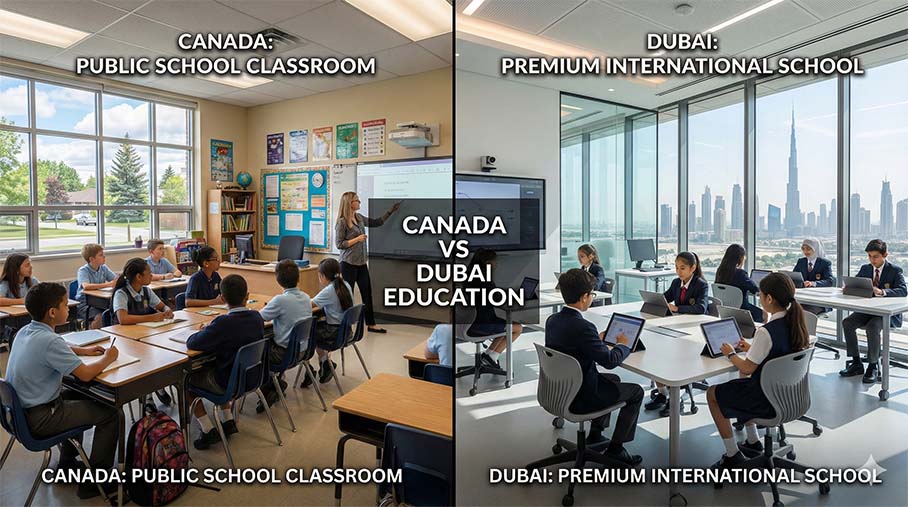
    Education (for kids)Free public schoolsExpensive private international schools
    Work CultureStable, balanced lifestyleFast-paced, high-reward environment
    ClimateFour seasons, cold wintersYear-round sun, hot summers

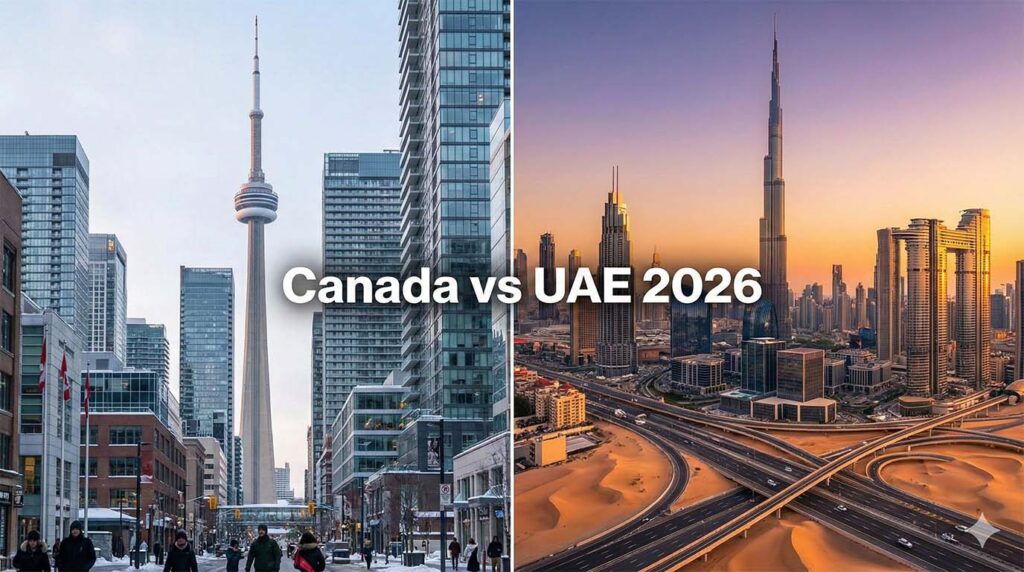
    Toronto vs. Dubai: Which wins for you in 2026?

    This Canada vs UAE 2026 comparison highlights key differences in immigration and taxes.

    This data-driven breakdown (sourced from Numbeo Feb 2026, Expatistan, official government sites) compares immigration, finances, work culture, social services, and lifestyle to help you decide.

    1.Canada vs UAE 2026 Immigration Comparison

    Canada vs UAE immigration comparison – PR vs Residency 2026

    Canada: Clear Path to Citizenship Canada’s system prioritizes permanent settlement. Express Entry (with category-based draws in 2026 focusing on French proficiency, healthcare, trades, education, STEM, and agriculture) leads to Permanent Residency (PR), which unlocks near-citizen rights and a straightforward citizenship route after 3–5 years. Recent draws emphasize in-Canada experience and targeted occupations, making it accessible for skilled workers.

    UAE: Self-Sponsored, Renewable Residency (No Citizenship Path) The UAE has shifted toward talent retention with employer-independent options:

    • Golden Visa (5–10 years, renewable): For investors (e.g., AED 2M+ real estate), entrepreneurs, top talents (PhDs, executives), and new 2025–2026 categories like humanitarian contributors, content creators, nurses, educators, and e-sports/gaming specialists.
    • Green Visa (5 years, renewable): For skilled employees (min. AED 15,000/month salary in MOHRE levels 1–3), freelancers (AED 360,000+ annual income over 2 years), and self-employed with permits. Self-sponsorship and family flexibility make it ideal for mid-to-senior pros.

    2. Financial Reality: Take-Home Pay, Taxes & Everyday Costs

    Disposable income is often the decider—and the gap is huge for high earners.

    Income & Taxes

    • Canada (Toronto): Progressive taxes fund public services. A CAD 250,000 salary in Ontario yields roughly CAD 148,000–156,000 net after federal/provincial taxes (avg. ~40–41% effective rate, per 2026 calculators).
    • UAE (Dubai): 0% personal income tax. The same equivalent salary stays fully yours—massive savings accelerator, especially for expats in tech, finance, or real estate.

    Housing

    • Rent: Dubai city-center one-bedroom is ~38% higher than Toronto’s (Numbeo 2026). Suburban/outskirts options in Dubai can be cheaper or comparable.
    • Buying: Dubai remains far more affordable per square meter—no annual property tax, unlike Canada.

    Daily Expenses (Numbeo Feb 2026)

    • Groceries: ~35% lower in Dubai (staples like bread, produce, dairy significantly cheaper).
    • Fuel: Substantially lower in UAE (~40–50% cheaper).
    • Utilities & Connectivity: Higher in Dubai (especially internet/mobile plans).
    • Overall: Excluding rent, Dubai is ~10–12% cheaper; including rent, it’s roughly similar or slightly higher in prime areas (Numbeo/Expatistan show mixed results, with Dubai 5–7% cheaper in some full comparisons).

    3. Work Culture & Career Momentum

    • Canada: Stable, protected environment with strong labor laws, reasonable hours, and family-friendly policies. Great for long-term building and work-life balance—but competitive and slower-paced in many sectors.
    • UAE: High-intensity, merit-driven. Fast promotions and bonuses in growth industries (tech, tourism, finance), but longer hours common. Global surveys note challenges with work-life balance for many expats, though rewards scale quickly for top performers.

    4. Healthcare & Education – Public Rights vs. Premium Private

    Healthcare

    • Canada: Universal public system—free at point-of-use for PRs/citizens, but specialist wait times can stretch months.
    • UAE: Private insurance mandatory; fast, high-quality access. Basic plans start low (~AED 320/year), but expats typically choose comprehensive coverage for top hospitals.

    Education

    5. Lifestyle & Environment

    Both rank among the world’s safest cities, but vibes differ:

    • Canada (Toronto): Four seasons, harsh winters, incredible nature access, multicultural vibrancy, and outdoor lifestyle.
    • UAE (Dubai): 365-day sunshine, desert climate (intense summers mean AC everywhere), luxury malls, beaches, and futuristic infrastructure.

    The 2026 Verdict

    Your choice boils down to life stage and priorities:

    • Choose Canada if you want permanent roots, citizenship for your family, free public healthcare/education, and balanced living—even if it means higher taxes and slower wealth buildup. Ideal for families planning decades ahead.
    • Choose UAE (Dubai) if maximum savings, tax-free acceleration, luxury lifestyle, and career speed matter most—while accepting private schooling costs, intense work pace, and no citizenship path. Perfect for ambitious professionals in peak earning years.

    Which aligns with your 2026 goals: Canada’s enduring stability or Dubai’s financial turbocharge? Drop your thoughts (or your target salary/sector) in the comments—I’d love to hear!

    Ultimately, your decision between Canada vs UAE 2026 depends on your financial and lifestyle priorities.

    Ready to move? Research current visa draws and cost tools like Numbeo for your exact profile.

    Canada vs UAE 2026 FAQs

    Is Canada better than UAE for families in 2026?

    Yes, Canada is generally better for families because it offers permanent residency, a clear path to citizenship, free public education, and publicly funded healthcare.

    Is UAE really tax-free in 2026?

    Yes, the UAE has 0% personal income tax. This makes it highly attractive for high-income professionals and entrepreneurs.

    Which country is cheaper: Canada or UAE?

    Groceries are usually cheaper in the UAE. However, rent in major cities like Dubai can be higher than in Toronto, depending on location and lifestyle.

    Can you get citizenship in the UAE?

    Unlike Canada, the UAE does not provide a straightforward path to citizenship for most expatriates. Residency is typically renewable but not permanent.