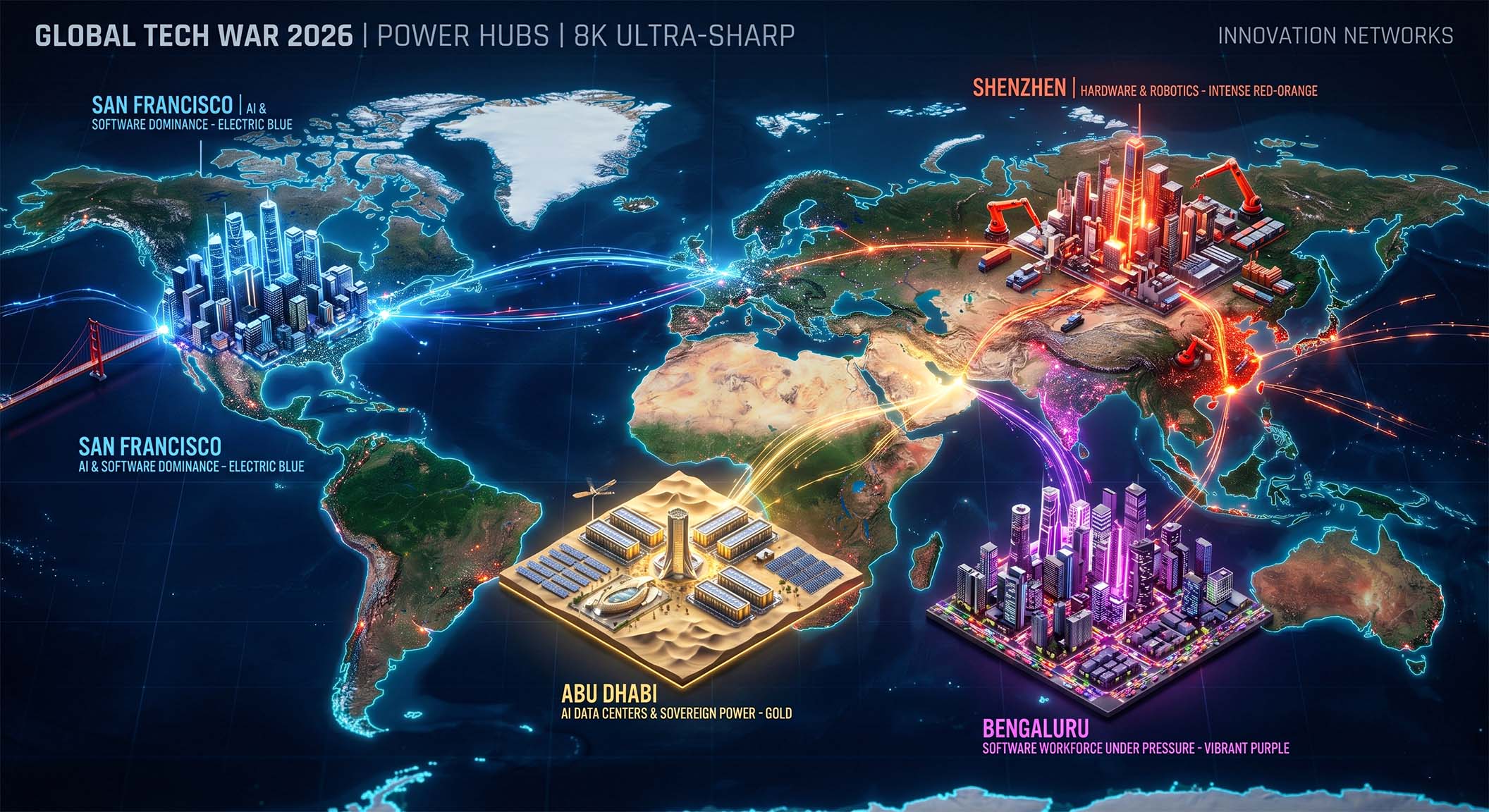
Tech & Society · 2026 Special Report Reading Time: 15 min | Focus: Global Innovation Clusters
The world’s tech talent is waking up to an uncomfortable truth. When looking at the tech hub rankings 2026, a high salary number means absolutely nothing if it dissolves before it reaches your savings account
The world’s tech talent is waking up to an uncomfortable truth: a high salary number means absolutely nothing if it dissolves before it reaches your savings account. The global talent pool has spent the last decade chasing the highest gross figures, only to realize that the net yield of their life’s work is being consumed by the very ecosystems that employ them.
This is the story of the modern tech diaspora. It is an autopsy of five cities, five entirely different economic realities, and a generation of engineers trying to figure out where to build their lives—not just their resumes.
The Crisis: The “Salary Dissolution” in Bengaluru
Somewhere in Koramangala or Whitefield, there is a software engineer with a ₹1.5 lakh per month salary.
On paper, she has won the game. She is in the top 5% of earners in the country. Her LinkedIn profile projects an aura of a “thriving” professional at a unicorn startup. Her parents back in her hometown casually drop her compensation into family conversations as a point of immense pride.
Her savings account tells a completely different, almost tragic story.
₹15,000
High salary ≠ Rich life anymore

Average monthly savings | Software Engineer | Bengaluru 2026
That is not a typo. It is the mathematical reality of the “Silicon Valley Squeeze” exported to South Asia. After rent, transport, food, taxes, and the systemic cost of surviving in a city hyper-inflated by foreign venture capital, an engineer earning ₹18 lakhs per annum is left with roughly the same disposable income as a mid-level government employee in a Tier-2 city.
The “Indian Dream” is being quietly suffocated by real estate monopolies and infrastructure bottlenecks.
| Bengaluru Reality Check (2026) | Monthly (₹) |
| Gross Salary | +1,50,000 |
| Income Tax + PF Deductions | −28,000 |
| Take-home (In-hand) | ≈ 1,22,000 |
| Rent (1BHK, Koramangala/HSR) | −32,000 |
| Groceries + Eating Out | −15,000 |
| Commute (Cabs/Metro/Fuel) | −8,000 |
| Internet + Subscriptions | −4,000 |
| Health Insurance | −2,500 |
| Gym / Lifestyle / Personal Care | −5,000 |
| Parents (Remittance/Gifts) | −15,000 |
| Clothes / Tech / Misc | −7,000 |
| Final Net Savings | ≈ ₹15,000 – ₹20,000 |
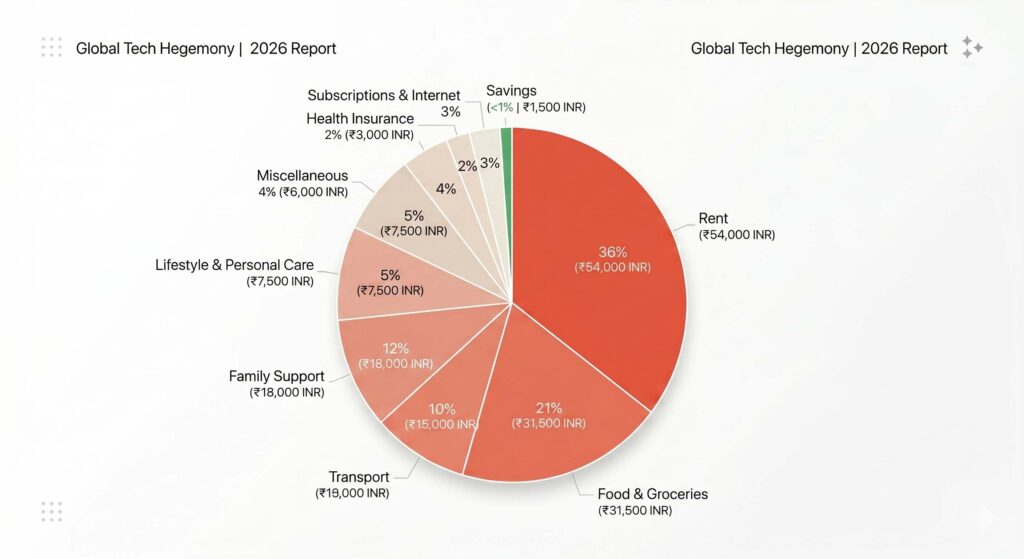
At this current burn rate, it would take this engineer 5.5 years just to save ₹12 lakhs—which is barely a down payment on the very apartment she is currently renting.
And this math assumes a straight, uninterrupted line. It assumes no medical emergencies. It assumes no dependents. It assumes her company doesn’t casually hand out a 6% “market-corrected” increment while her landlord raises the rent by 22%.
Bengaluru didn’t fail its engineers. It simply got too good at its job. It attracted the world’s VC money, built the world’s back-office, and the cost of human existence scaled alongside the valuations.
The Contrast: Shenzhen—The Printing Press of Physical AI
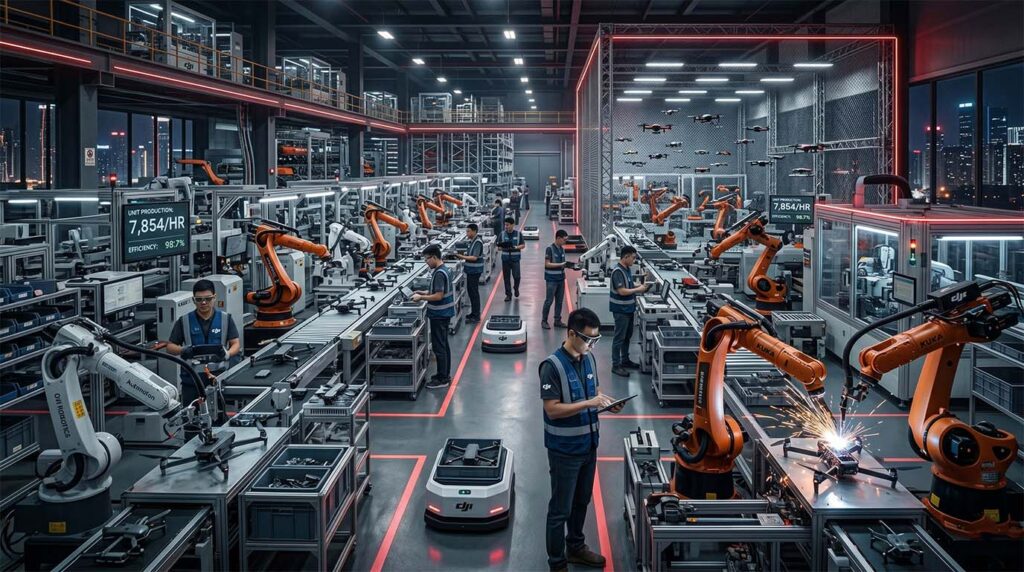
While Bengaluru’s talent calculates rent-to-income ratios, Shenzhen’s engineers are operating on a completely different physical plane. They are not talking about software as a service; they are talking about software encased in titanium and carbon fiber.
The 10-Day Rule: That is the exact amount of time it takes the Shenzhen hardware ecosystem to go from a napkin sketch to a functional, factory-tooled prototype.
If a hardware startup in the United States attempts the same cycle—sourcing components, testing PCBs, printing custom injection molds, and writing firmware—it takes a minimum of 8 months.
- The Embodied Intelligence Era: In 2026, the frontier is no longer just LLMs answering text prompts. It is “Physical AI”—humanoid robotics, autonomous supply chain drones, and next-generation EVs. Software is bleeding into the physical world. If a product has a lithium battery and an actuator, it was almost certainly born in Shenzhen.
- The Blood Price of Speed: Shenzhen does not pretend to offer a work-life balance. The 9-9-6 culture (9 AM to 9 PM, 6 days a week) is the mandatory price of admission. It is a city built on exhaustion and sheer willpower. But for a robotics visionary who prioritizes output over comfort, it remains the single most productive square kilometer on planet Earth.
- https://www.sciencedirect.com/science/article/abs/pii/S0160791X22000604
The Future: Abu Dhabi’s “Stargate” in the Desert
If you want to understand the future of global power, do not look at where the software is being written. Look at where the compute is being plugged in. In 2026, the most audacious bet in the history of technology is happening in the desert.
$30 Billion+ | The Stargate AI Campus
This joint venture between G42 and Microsoft is the largest AI data center complex outside the United States. It is a sovereign compute stack built to guarantee that the Middle East never has to ask permission to run intelligence-grade workloads.

This is fundamentally different from a wealthy nation buying luxury real estate. This is a nation-state acquiring the critical infrastructure of the 21st century.
- Compute is the New Oil: The UAE recognized early that nations unable to train their own massive models on their own data centers will eventually become digital colonies of those who can.
- The Talent Vacuum: Abu Dhabi is aggressively headhunting the exact demographic that is bleeding out of San Francisco and Bengaluru. They offer Zero Income Tax, premium infrastructure, and an exclusive “AI Visa.” For a senior Machine Learning researcher earning $400,000, moving to Abu Dhabi isn’t just a career shift—it is a wealth-generation cheat code.
The Reality Check: Silicon Valley as the “Elite Boutique”
We cannot map the world without addressing the sun at the center of the solar system. Silicon Valley is not dead. It is not dying. It has simply mutated into something entirely inaccessible to the middle class. https://www.siliconvalley.com/2026/02/25/silicon-valley-by-the-numbers-record-wealth-costs/
Silicon Valley has become an Elite Boutique.
It is the only place on Earth where a 24-year-old with a compelling frontier AI thesis can walk into a coffee shop on Sand Hill Road and walk out with a $50 million seed round. The concentration of capital, ambition, and specialized knowledge is a gravitational anomaly that cannot be replicated.
But the Valley has lost its function as a scalable city for human beings.
- The Cost of Genius: The median home price in San Jose hovers around $1.8 million. A “comfortable” tech salary of $300,000 in San Francisco still often requires living with roommates if you want to aggressively save.
- The Divergence: The Valley is for building Moonshots. It is for foundational models, quantum computing, and bio-tech breakthroughs that require a decade of unprofitable R&D. But if you are building a standard B2B SaaS tool, a mobile app, or a mid-market marketplace, locating your core engineering team in the Bay Area in 2026 is an act of financial self-sabotage.
The Old Guard: London’s Regulatory Fortress
While the US embraces the wild west of AI development and China manufactures the hardware, London has quietly cornered a highly lucrative, entirely unsexy market: Compliance and Financial Rails.
London is the city where the money actually moves.
- The Fintech Hegemony: Post-Brexit, London faced an identity crisis. It solved it by becoming the global capital for Fintech and regulatory technology (RegTech). If you are building AI that touches global banking, cross-border payments, or algorithmic compliance, London’s financial ecosystem is unparalleled.
- The Gray Reality: The salaries are lower than in the US, and the tax burden is heavy. But London offers something the Valley cannot: direct proximity to the world’s oldest financial institutions and a regulatory framework that is actually designed to integrate with tech, rather than fight it in court.
The Data-Backed Comparison: Funding vs. Purchasing Power
To truly understand the 2026 tech landscape, we must look at the Purchasing Power Parity of Innovation. A dollar raised is not a dollar spent; it depends entirely on where that dollar is deployed.
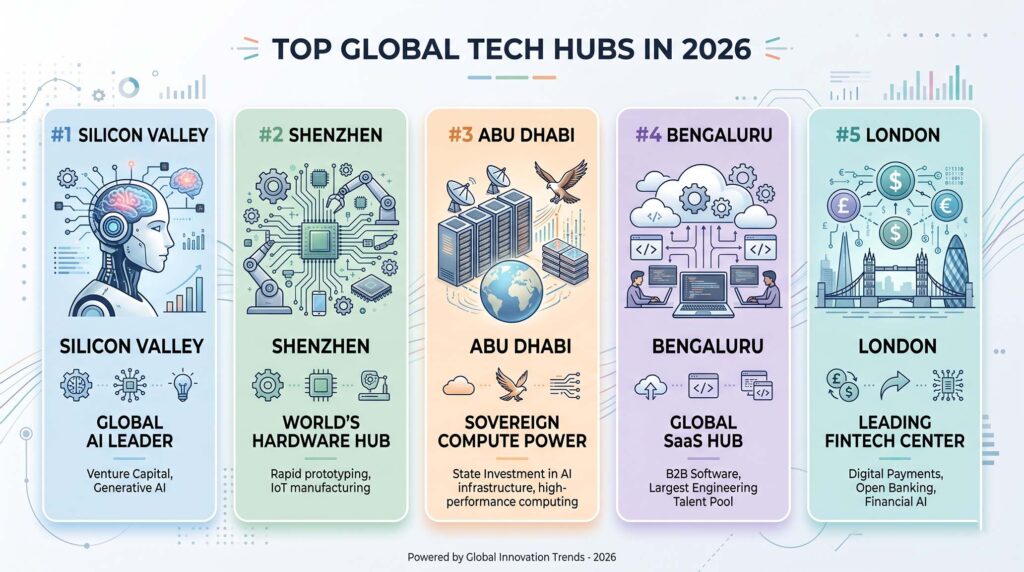
Let’s look at the runway of a hypothetical $5 Million Seed Round across different hubs:
| Hub | Developer Run-Rate (How many Senior Devs $1M buys per year) | The Ultimate Advantage | The Critical Weakness |
| San Francisco | 3 – 4 Senior Devs | Unmatched speed to Series A. | Catastrophic burn rate. One mistake kills the company. |
| Warsaw (Poland) | 12 – 15 Senior Devs | World-class C++/Rust talent for a fraction of the cost. | Further from the core VC networking nodes. |
| Shenzhen | 8 – 10 Hardware Devs + Prototyping | The physical supply chain is effectively free. | High IP theft risk; brutal domestic competition. |
| Bengaluru | 20 – 25 Senior Devs | The ultimate scale engine. Unmatched sheer volume of output. | High churn rate. Talent leaves for remote US salaries. |
The math dictates the strategy. In 2026, the most successful startups are geographically decentralized by design. They raise capital in Silicon Valley, build the hardware in Shenzhen, run the compliance through London, and scale the software ops in Warsaw or Bengaluru.
The Career Hack: Where Your Skills Travel Further
For the individual contributor, the smartest move in 2026 isn’t asking “Which city is the most prestigious?” The real question is: “Where does my compensation generate the most leverage for my life?”

The Digital Nomad Arbitrage
- Lisbon, Portugal: Europe’s golden ticket. The D7 Visa provides a clean path to EU residency. Earning a $5,000/month remote US salary while living in Lisbon places you in the upper echelons of the local economy. You get Atlantic ocean views, extreme safety, and a lifestyle that would cost $15,000/month in California.
- Warsaw, Poland: For those who want serious engineering culture without the West Coast premium. It is safe, hyper-modern, and fiercely ambitious.
The Domestic Pivot (For India)
- Hyderabad & Pune: The quiet rebellion against Bengaluru. For an Indian engineer, moving to Hyderabad or Pune while maintaining a remote role is the equivalent of a 40% pay raise. The infrastructure holds up, the rents are rational, and the savings account actually grows. The cultural gravity of Bengaluru is strong, but financial freedom is stronger.
The Verdict: Time, Leverage, and the Final Equation
The era of default tech migration is over. You do not have to move to California to change the world. You do not have to suffer through Koramangala traffic to be a respected engineer.
The map has fractured into specialized arenas.
Silicon Valley is the casino where you go to spin the wheel on a billion-dollar valuation. Shenzhen is the forge where you go to sweat over physical steel and silicon. Abu Dhabi is the vault where you go to leverage sovereign capital. London is the courtroom where you build the financial plumbing.
But stripped of all the venture capital bravado, the tech industry is ultimately just a trade of your finite time for capital and legacy.
Look back at the engineer in Bengaluru, staring at ₹15,000 in monthly savings. Look at the founder in San Francisco, earning $300k but sharing a bathroom with three other adults. They are both playing a game designed by someone else, operating under the illusion that proximity to greatness will eventually make them rich.
In 2026, loyalty to a city is the ultimate liability. Your loyalty must be to the ecosystem that respects the math of your life.
You must ask yourself the hardest question in modern technology: Are you building a career that allows you to own your future, or are you just generating revenue to pay off a landlord in a “Tier-1” tech hub?
If the math doesn’t make sense, it’s time to redraw your own map.