
ChatGPT vs Gemini is the AI question almost everyone is asking in 2026, and the honest answer has shifted a lot this year. OpenAI’s ChatGPT and Google’s Gemini are now genuinely neck-and-neck on raw intelligence, so the real decision is no longer “which is smarter” but “which fits your life and tools.” This neutral, hands-on comparison breaks down models, coding, writing, image and video generation, ecosystem, and price — so you can pick the right one for you, not just the one with the loudest marketing.
ChatGPT vs Gemini: Quick Answer
If you write code, use lots of third-party and Microsoft apps, or want the deepest agent features, ChatGPT is the safer pick. If you live inside Gmail, Docs and Drive, want the best AI video generation, or want the cheapest capable paid plan, Gemini pulls ahead. For most everyday users the two are close enough that the tiebreaker is simple: choose the one that already lives where you work — Google’s ecosystem points to Gemini, a Microsoft or mixed tech stack points to ChatGPT.
ChatGPT vs Gemini at a Glance
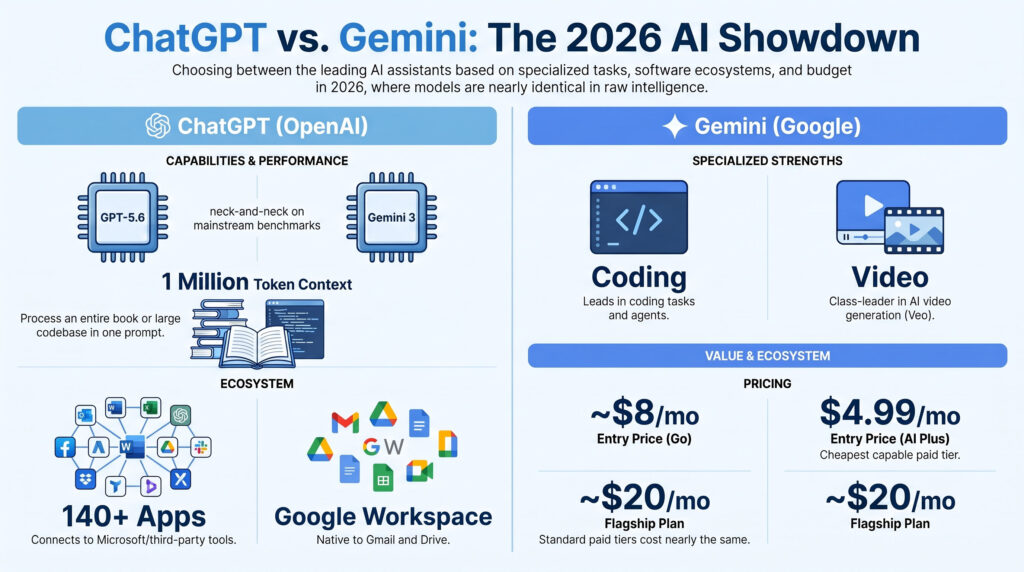
| ChatGPT (OpenAI) | Gemini (Google) | |
|---|---|---|
| Flagship model line | GPT-5.6 series | Gemini 3 series (3.1 Pro / Deep Think) |
| Benchmark performance | Top-tier | Top-tier (roughly level) |
| Context window | ~1 million tokens | ~1 million tokens |
| Cheapest paid plan | Go (~$8/mo) | AI Plus ($4.99/mo) |
| ~$20 plan | Plus ($20/mo) | AI Pro ($19.99/mo) |
| Top consumer plan | Pro ($100–$200/mo) | AI Ultra ($99.99–$199.99/mo) |
| Coding | Class-leading (Codex) | Good, still catching up |
| Image generation | Excellent | Excellent (4 images per prompt) |
| Video generation | Limited | Class-leading (Veo) |
| Best ecosystem fit | Microsoft + 140+ apps | Google Workspace |
(Prices and model versions in AI move fast and vary by region — always check the official OpenAI and Google pages before subscribing.)
Models and Raw Power
At the top end, this is close to a dead heat. ChatGPT’s GPT-5.6 family and Google’s Gemini 3 family trade blows across mainstream AI benchmarks, and both now offer a context window of roughly one million tokens — enough to feed in an entire book, a large codebase, or months of documents in a single prompt. A year ago, Gemini’s giant context was a standout advantage; in 2026 ChatGPT has closed that gap, so context size alone is no longer a deciding factor.
The practical takeaway: for a normal question, email, summary or brainstorm, you will rarely notice a quality difference between the two flagships. The differences show up in what each one is plugged into and what extra media it can create — which is where the rest of this comparison lives.
Coding and Development
This is ChatGPT’s clearest win. OpenAI’s coding stack (Codex) is the most widely adopted in the developer world, holding a larger share of enterprise coding use than Google’s equivalent, and ChatGPT’s paid tiers give power users far more high-volume coding headroom. Google’s coding tools are improving quickly but are still playing catch-up.
If writing, debugging or shipping code is a core part of your day, ChatGPT is the stronger daily driver.
Writing and Research
For long-form writing and deep research the two are close, with different flavours. Both offer a “deep research” mode that reads across many sources and a canvas-style workspace for drafting. ChatGPT lets you edit mid-task without cancelling a long job, which is handy for iterative writing. Gemini ties into NotebookLM, Google’s research notebook, which is excellent for working through large piles of source material and generating study aids.
Call it a tie: pick ChatGPT for smoother iterative drafting, Gemini for source-heavy research projects.
Image and Video Generation
For still images it’s essentially level — both produce results that sit at the top of text-to-image quality rankings, though Gemini gives you four images per prompt to ChatGPT’s one, so you get more options per try.
For video, Gemini is well ahead. Google’s Veo generates high-quality clips with native audio and consistently tops video-generation leaderboards, while OpenAI has pulled back from consumer video (its Sora app was discontinued in early 2026). Gemini also uniquely offers AI music generation. If creating video or multimedia matters to you, Gemini is the clear choice.
Ecosystem and Integrations
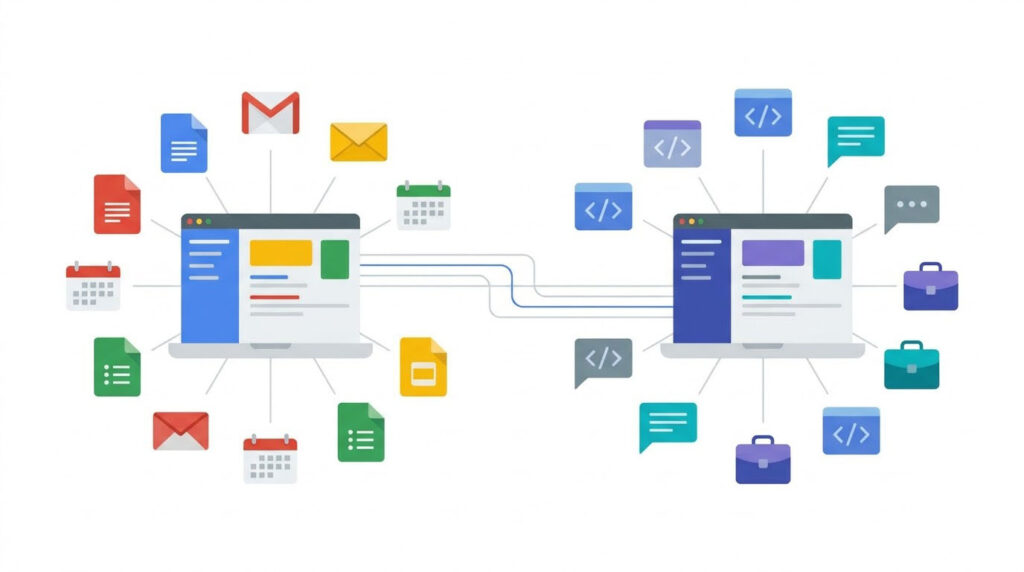
This is the factor that decides it for most people. Gemini is woven directly into Google Workspace: you can pull from Gmail, Drive, Docs, Maps, Photos and YouTube with simple “@” mentions, and it can proactively bring in context from those apps. If your work and personal life already run on Google, Gemini feels like a native superpower.
ChatGPT counters with breadth: it connects to 140+ third-party work apps, including the Microsoft stack (Teams, SharePoint, OneDrive), GitHub, Slack and HubSpot. If your tools are spread across many vendors — or centred on Microsoft — ChatGPT slots in more cleanly.
So the honest rule of thumb: Gemini for Google-first users, ChatGPT for everyone with a mixed or Microsoft-based toolkit.
Pricing and Value
The two have converged almost exactly where it counts. ChatGPT Plus is $20/month; Google AI Pro is $19.99/month — the same money for a comparable flagship experience. At the top, the power tiers also match up closely (ChatGPT Pro $100–$200 vs Gemini AI Ultra $99.99–$199.99, both scaling usage 5x to 20x).
Where Gemini wins is the budget rung: its AI Plus tier at $4.99/month undercuts ChatGPT’s cheapest paid plan (Go, around $8), making Gemini the better value if you want a capable paid assistant for the least money. Both also offer genuinely useful free tiers — good enough for casual daily use — so you can trial each before paying anything.
The Original Angle: The Task-by-Task Scorecard and the Real $20 Test
Most “ChatGPT vs Gemini” pages just declare one winner. Here are two things they don’t give you.
1) The task-by-task scorecard — pick your winner by what you actually do:
| What you’re doing | Better pick |
|---|---|
| Writing and shipping code / agents | ChatGPT |
| Making video or multimedia content | Gemini |
| Working across Gmail, Docs and Drive | Gemini |
| Connecting Microsoft, Slack, GitHub & many apps | ChatGPT |
| Generating still images | Tie |
| Everyday questions, summaries and writing | Tie |
Scoreline: ChatGPT 2, Gemini 2, two ties. That even split is the real story of 2026 — there is no universal “best.” The winner is whichever column has the row that matches your daily work.
2) The real $20 test. At almost the same price (ChatGPT Plus $20 vs Google AI Pro $19.99), the smarter buy is decided by ecosystem, not intelligence:
- If you spend your day in Google apps or make video → the $19.99 Gemini plan gives you more usable power (Workspace access + Veo) for the money.
- If you code or run a Microsoft/multi-app stack → the $20 ChatGPT plan returns more real value (Codex + 140+ connectors + mid-task editing).
- If you just want the cheapest capable paid AI → Gemini’s $4.99 AI Plus tier is the value winner outright, with nothing equivalent on the ChatGPT ladder.
In other words, the “which is cheaper” question has a real answer (Gemini, at the entry level), but the “which is worth $20” question only has a personal one.
Verdict: Which Should You Choose?
No fence-sitting — here’s the use-case call, backed by everything above.
- Choose ChatGPT if you code, rely on agent features, or work across Microsoft and many third-party apps. It leads on development and has the widest app connectivity.
- Choose Gemini if you live in Google Workspace, want the best AI video (Veo), or want the cheapest capable paid plan ($4.99). It wins on ecosystem fit and multimedia creation.
- For most people, the two flagships are close enough on everyday quality that the deciding factor is your existing toolkit and budget, not the AI’s IQ. Try both free tiers for a week, then pay for the one that already lives where you work.
The best AI assistant in 2026 isn’t the “smartest” one on a benchmark — it’s the one that fits your day. Both ChatGPT and Gemini are good enough that you almost can’t lose; you just want to win by a bit more.
Frequently Asked Questions
Is ChatGPT or Gemini better in 2026? Neither is universally better — their flagship models (GPT-5.6 and Gemini 3) are roughly level on benchmarks. ChatGPT leads on coding and third-party app connections; Gemini leads on Google Workspace integration and AI video. The best pick depends on the tools you already use.
Which is cheaper, ChatGPT or Gemini? Gemini is cheaper at the entry level: its AI Plus plan is $4.99/month versus ChatGPT’s cheapest paid plan (Go) at around $8. Their main ~$20 tiers (ChatGPT Plus $20, Google AI Pro $19.99) cost almost the same.
Which is better for coding? ChatGPT. OpenAI’s coding tools are the most widely used by developers and its paid tiers offer more high-volume coding capacity, though Gemini is improving.
Which is better for making videos? Gemini. Google’s Veo model leads AI video generation and produces clips with native audio, while ChatGPT has stepped back from consumer video.
Do I need to pay to use ChatGPT vs Gemini? No. Both offer capable free tiers that are fine for casual, everyday use. Paid plans mainly add higher usage limits, faster responses, and advanced features like deep research and video generation.
Disclaimer
This article is a neutral, fact-based comparison for general information. AI models, features and prices change very quickly and vary by country — the figures here reflect the situation in 2026 and may already have moved. Always check the official OpenAI (ChatGPT) and Google (Gemini) pages for the latest before subscribing, and do your own research for your specific needs.