

College vs trade school is the question a lot of families are quietly rethinking in 2026 — and it’s not the slam-dunk it used to be. For decades, “go to college” was the default advice. But tuition keeps climbing, student debt just crossed a new record, and for the first time in modern history, young college grads are having a harder time finding work than the country as a whole. Meanwhile, the trades are short-staffed, apprentices get paid to train instead of paying to train, and skilled workers are aging out faster than new ones are coming in. So which path actually leaves you better off? Let’s walk through the real numbers, side by side, so you can decide for your own situation — not someone else’s.
College vs Trade School: Quick Answer
- If you want the highest long-run earnings ceiling, plan to work in a field that legally requires a degree (medicine, law, engineering, teaching), or you’re aiming for corporate/management roles → college is still usually worth it.
- If you want to start earning fast, avoid debt, and enjoy hands-on work that can’t be outsourced or automated → trade school (especially a paid apprenticeship) comes out ahead, often by a lot, in the first several years.
- For most 18-to-22-year-olds who aren’t set on a degree-required career → the trades now offer the faster, cheaper, lower-risk path to a solid income — while a degree remains the better bet only if you actually need it for the job you want.
College vs Trade School: At a Glance (2026, U.S.)
| College (4-year degree) | Trade School / Apprenticeship | |
|---|---|---|
| Typical time to first paycheck | 4+ years (only 44% finish in 4 years) | 1–2 years (certificate) or paid from day one (apprenticeship) |
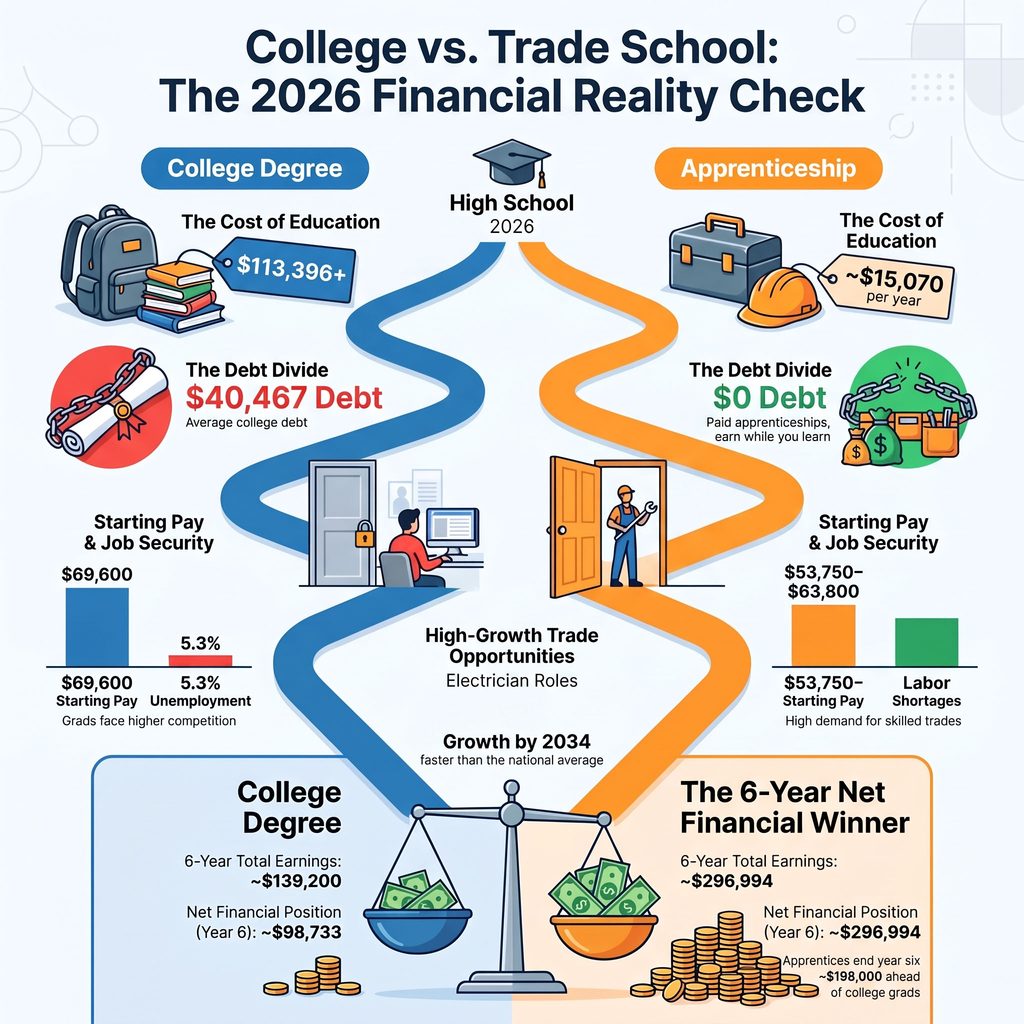
| Average total cost | $113,396 (public, in-state) to $243,696 (private) | $15,070/year average; often $0 out-of-pocket via a paid apprenticeship |
| Average debt carried | $40,467 per borrower | Typically $0 (apprenticeships), or a few thousand for a paid certificate program |
| Average starting pay | $69,600 (2025 grads) | $28,400–$34,754 first-year apprentice; $53,750–$63,800 once certified/journeyman |
| Unemployment rate | 5.3% for young grads (age 22–27) — higher than the national rate | Skilled trades are broadly labor-short, not job-short |
| Job growth outlook | Varies widely by major | Electricians: ~9% growth by 2034, faster than average |
The Cost Side: What Each Path Actually Takes Out of Your Pocket
Here’s the part nobody enjoys but everyone should look at honestly. A four-year degree at a public, in-state school now runs about $113,396 all-in — tuition, fees, room, board, the works, per the College Board’s own pricing data — and that’s if you finish in four years, which only 44% of students actually do. Push it to the more realistic six-year timeline (97.3% finish by then) and the number climbs toward $236,000. Go private, and you’re looking at roughly $243,696 for the same degree.
Most families don’t pay that in cash. The average student loan borrower now carries $40,467 in debt, and across the country that adds up to a jaw-dropping $1.863 trillion owed by 42.6 million people — a debt load that follows you around for years after graduation, often into your 30s. It’s the same kind of big-money, run-the-real-numbers decision we broke down in our rent vs buy comparison: a bigger commitment of cash today for a payoff that only shows up years later, if it shows up at all.
Trade school flips the script. The average trade or vocational program costs about $15,070 a year (community-college routes run closer to $8,730), and most programs wrap up in one to two years, not four. But the real headline is the apprenticeship route: in a registered apprenticeship, an employer or union trains you on the job and pays you a wage while you learn — no tuition bill at all. You’re earning from week one instead of borrowing from week one.
Time to Your First Real Paycheck
This is where the trades pull ahead fastest. A college student typically earns nothing for four straight years while the meter runs on tuition, rent and living costs. A trade-school student can be certified and working within 12 to 24 months. An apprentice starts even sooner — you’re on a job site and getting a paycheck almost immediately, just at a training wage.
Think of it like two people leaving the same starting line: one spends four years with their income at zero while their debt grows, and the other spends those same four years with their income climbing every year and their debt at zero. That gap compounds, and it’s the whole reason the numbers below look the way they do.
What You Actually Earn Once You’re Working
A college degree still opens the door to a higher average starting number: $69,600 for the class of 2025, though that swings widely by major — engineering grads start around $77,500, while many humanities majors start closer to $68,500 (and plenty of majors sit well below that).
The trades don’t lag as far behind as people assume. Once certified, median pay lands at $63,800 for plumbers, $63,190 for electricians, $61,010 for HVAC technicians, and $53,750 for welders — and that’s before overtime, union scale, or running your own shop, all of which push experienced tradespeople well into six figures. During an apprenticeship, first-year pay typically runs 40–50% of the full journeyman rate (around $28,400 a year for an electrician apprentice), climbing to 85–95% by the final year — so the wage grows steadily every year you’re training, unlike a college student’s wage, which is zero until graduation.
Job Security: A Reversal Worth Knowing About
For most of modern history, a college degree meant lower unemployment than average. That’s flipped. As of March 2026, young college graduates (ages 22–27) face a 5.3% unemployment rate, compared to a 4.3% national average — the first time in decades that recent grads are doing worse than the overall labor market, largely due to a tougher entry-level white-collar hiring environment.
The skilled trades are dealing with the opposite problem: not enough workers. Hundreds of thousands of trade positions sit unfilled as experienced tradespeople retire faster than new ones are trained, and the Bureau of Labor Statistics projects electrician jobs alone to grow roughly 9% by 2034 — faster than the average occupation. Work that requires hands-on, in-person skill (wiring a house, fixing a furnace, running plumbing) also isn’t something you can outsource overseas or hand to a chatbot, which is quietly becoming part of the trades’ appeal.
The Original Angle: The Real 6-Year Money Snapshot
Sticker prices and starting salaries only tell half the story. Here’s a calculation most “college vs trade school” articles skip: where does each path actually leave you financially after six years?
The setup: We’re comparing a public in-state college grad (4 years earning $0, then 2 years working at the average starting salary) against an electrician apprentice (a 4-year paid apprenticeship with wages rising from 45% to 90% of journeyman pay, then 2 years working at the journeyman median). Same six-year window, two very different paths.
| College Grad | Electrician Apprentice | |
|---|---|---|
| Year 1–4 earnings | $0 (full-time student) | $28,436 → $37,914 → $47,393 → $56,871 (rising apprentice wages) |
| Year 5–6 earnings | $69,600 × 2 = $139,200 | $63,190 × 2 = $126,380 |
| Total earned over 6 years | ~$139,200 | ~$296,994 |
| Debt/tuition owed | ~$40,467 (average) | ~$0 (apprenticeship is paid, not billed) |
| Net financial position at Year 6 | ≈ $98,733 | ≈ $296,994 |
Under this model, the apprentice comes out roughly $198,000 ahead of the college grad by year six — almost entirely because of the four years of real wages the apprentice earns while the college student’s income sits at zero.
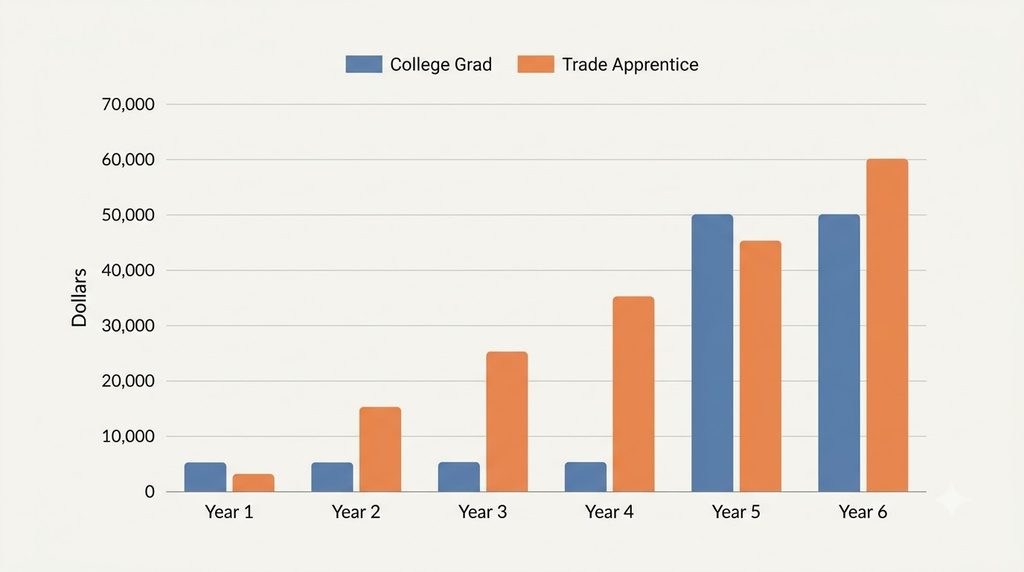
That gap doesn’t mean college is a bad investment; it means the break-even point for a degree is much further out than most people assume, and it depends heavily on landing a job in a field where that degree actually pays a premium.
(This is our own simplified model, not a prediction — it ignores raises beyond what’s shown, cost-of-living differences, the possibility of scholarships or employer tuition help, and the fact that some college majors out-earn the trades by a wide margin over a full career. Run your own numbers based on your intended major or trade.)
Which One Actually Fits You?
Money isn’t the only variable, so let’s be honest about the rest of it. College tends to suit you better if you already know you want a career that legally requires a degree, you thrive in a classroom setting, or you value the broader network and flexibility a four-year experience can build. Trade school tends to suit you better if you’d rather learn by doing than by lecture, you want to avoid debt and start earning quickly, or you like the idea of a skill that’s always in demand and hard to automate. Plenty of people also do both — a trade now, a degree later (often paid for by the trade income), or a two-year associate degree as a middle path.
Verdict: Which Should You Choose?
- Choose college if your target career requires a degree, you’re likely to land in a high-paying field (engineering, computer science, nursing, finance), or the non-financial parts of the experience genuinely matter to you.
- Choose trade school or an apprenticeship if you want to start earning sooner, avoid the average $40,467 in debt, and work in a field with strong hands-on demand and a shrinking pool of skilled workers.
- For most people without a specific degree-requiring career in mind, the trades are the financially safer bet in 2026 — faster paycheck, little to no debt, and a labor market that’s short on workers rather than short on jobs. College remains the better call, but only when it’s aimed at a career that actually needs one.
Neither path is universally “right” — the honest answer depends on what you want to do for a living, not which option sounds more prestigious.
If You’re a Student Actually Weighing This Decision
If you’re the one making this call right now rather than just reading about it in the abstract, a few related things are worth having on your radar before you commit to either path. Once the paychecks start — whether from a trade or a degree job — where that money goes matters almost as much as how much of it there is; our Roth IRA vs Traditional IRA comparison is a good next read for getting retirement savings started early, which compounds more the sooner you begin. It’s also worth knowing that the same labor shortage pulling students toward the trades is showing up in immigration policy too — see our H-2B Visa Increase 2026 coverage for how the government is widening the cap specifically to plug gaps in construction and other hands-on trades. And if location factors into your decision at all — where the jobs, pay and growth actually are — our Tech Hub Rankings 2026 breaks down which U.S. regions are seeing the strongest job and wage growth across both tech and skilled-labor markets.
Frequently Asked Questions
Is trade school cheaper than college in 2026? Yes, significantly. The average trade program costs about $15,070 a year and takes one to two years, versus $113,396–$243,696 total for a four-year degree. Paid apprenticeships can bring the out-of-pocket cost to essentially $0.
Do trade school graduates make less than college graduates? Not by as much as most people think. Median trade pay ($53,750–$63,800) is close to the average new college grad’s starting salary ($69,600), and many tradespeople who run their own business or work overtime/union jobs earn well into six figures.
Is it harder to get a job with a trade certificate or a college degree right now? Currently, it’s easier in the trades. Young college graduates face a 5.3% unemployment rate versus a 4.3% national average, while skilled trades face a labor shortage, not a hiring slowdown.
What is an apprenticeship, and how is it different from trade school? Trade school is classroom-based training you typically pay for. An apprenticeship is paid, on-the-job training run by an employer or union — you earn a wage (starting around 40–50% of full pay) while you learn, with no tuition bill.
Is a college degree still worth it? Often, yes — especially for careers that legally require one (medicine, law, teaching, engineering) or fields with strong average pay. The math in this article shows the break-even point is further out than people assume, so it’s worth being specific about your intended career before committing to four years and the debt that comes with it.
Disclaimer
This article is a neutral, fact-based comparison for general information and uses national U.S. averages, which vary widely by state, school, trade and individual circumstances. The 6-year financial model above is a simplified illustration, not a guarantee or personalized advice. Costs, salaries and job-market conditions change — always check official sources and consider speaking with a school counselor or financial advisor before making a decision, and do your own research for your specific situation.