
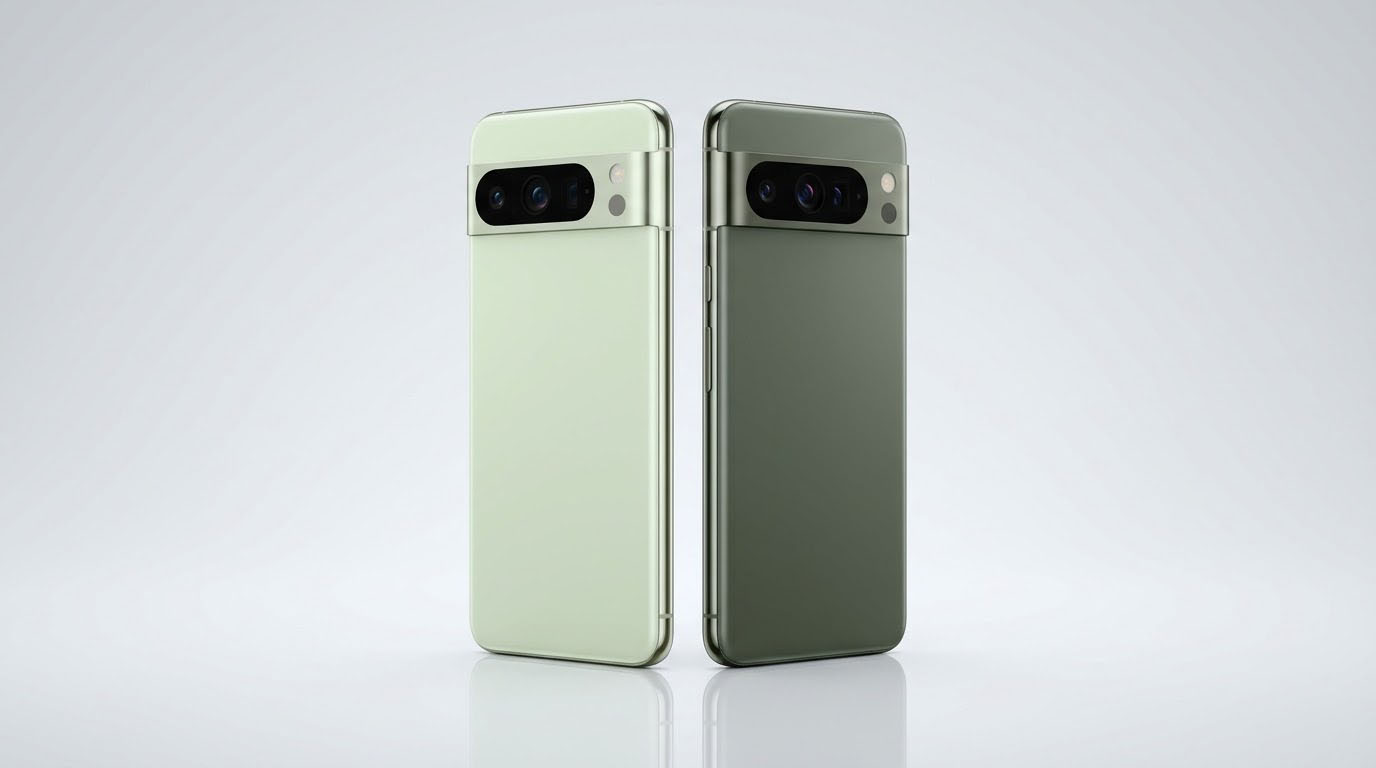
By Udit Raj · Updated August 19, 2026
The Pixel 11 vs Pixel 11 Pro decision really comes down to one question: is Google’s $200 step-up worth it? Both phones launched together at Made by Google 2026 with the same Tensor G6 chip and the same seven years of updates, but they split hard on cameras, screen and price. Below is a neutral, side-by-side breakdown — including an original cost calculation you won’t find on other pages — to help you pick the right one.
| Quick Answer • Choose the Pixel 11 ($899) if you want the best value, everyday photos and the longest battery. It shares the same chip and speed as the Pro. • Choose the Pixel 11 Pro ($1,099) if you want the 5x optical / 120x zoom, the brightest sharpest screen, the best selfie camera, or you’ll use the 6 months of Google AI Pro included. • For most people: the Pixel 11 is the smart pick. Step up to the Pro only if zoom photography or the premium display genuinely matters to you. |
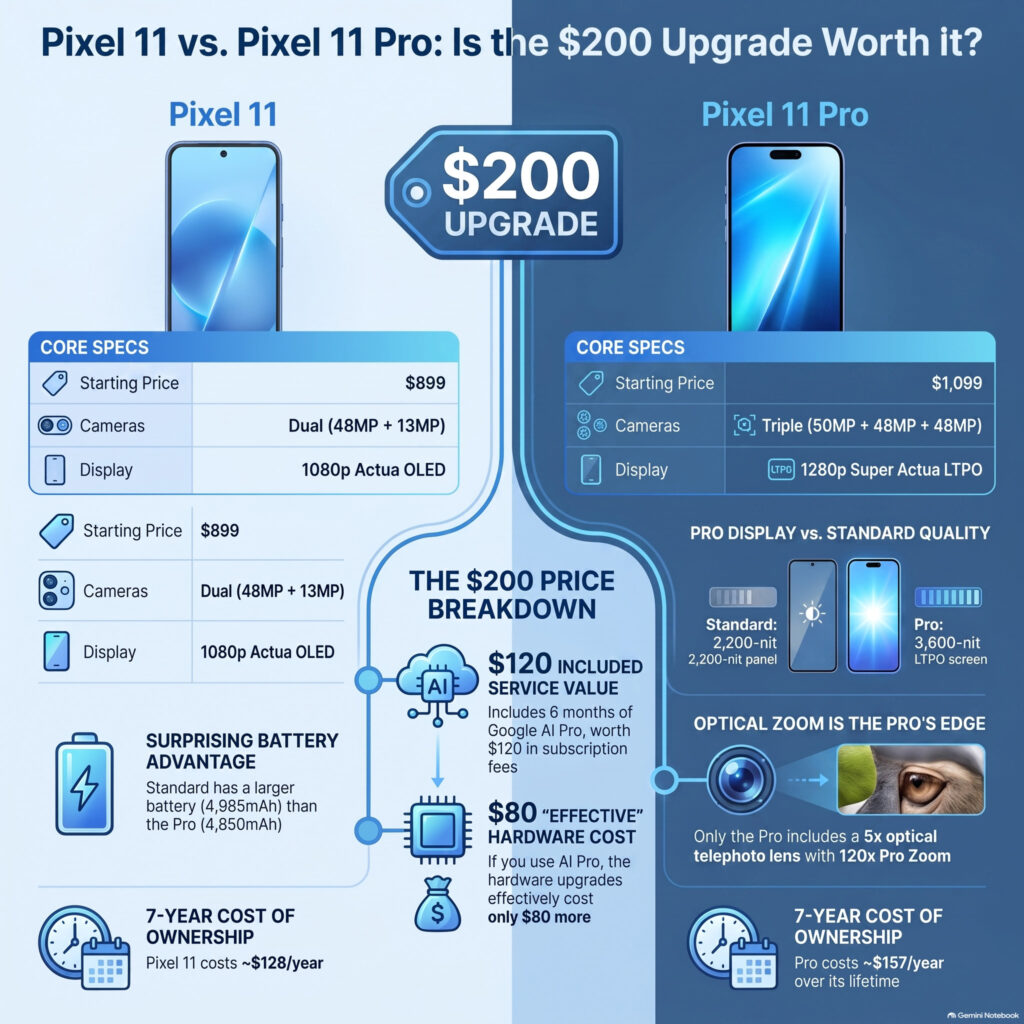
Pixel 11 vs Pixel 11 Pro: Specs at a Glance
| Spec | Pixel 11 | Pixel 11 Pro |
|---|---|---|
| Starting price | $899 (256GB) | $1,099 (256GB) |
| Display | 6.3″ Actua OLED, 1080×2424, 60–120Hz | 6.3″ Super Actua LTPO OLED, 1280×2856, 1–120Hz |
| Peak brightness | ≈ 2,200 nits | Up to 3,600 nits |
| Chip | Tensor G6 (2nm) | Tensor G6 (2nm) |
| RAM | 12GB | 12GB (256GB); 16GB (512GB/1TB) |
| Rear cameras | 48MP main + 13MP ultrawide | 50MP main + 48MP ultrawide + 48MP 5x telephoto |
| Zoom | 30x digital Super Zoom | 5x optical · 120x Pro Zoom |
| Front camera | 13MP | 42MP |
| Battery | 4,985 mAh | 4,850 mAh |
| Charging | ~30W wired · 25W wireless (Qi2.2) | ~30W wired · 25W wireless (Qi2.2) |
| Storage | 256GB | 256GB / 512GB / 1TB |
| Software | 7 years of updates | 7 years of updates + 6 months Google AI Pro |
| Durability | IP68 | IP68 + tougher coating |
Specs verified from Google and hands-on reporting, August 2026. Always confirm current details before purchase.
Design & Display
Both phones are 6.3-inch and easy to use one-handed, so size isn’t the divider here — resolution and brightness are. The Pixel 11 uses a sharp 1080p Actua OLED with a 60–120Hz refresh rate. The Pixel 11 Pro steps up to a Super Actua LTPO panel that runs from 1Hz all the way to 120Hz (better for battery and always-on info), pushes a crisper 1280×2856 resolution, and hits up to 3,600 nits of peak brightness — noticeably easier to read in direct sun. If you shoot a lot of outdoor video or watch HDR content, the Pro’s screen is the clearest upgrade. For everyday scrolling, the base panel is still excellent.
Cameras & Zoom
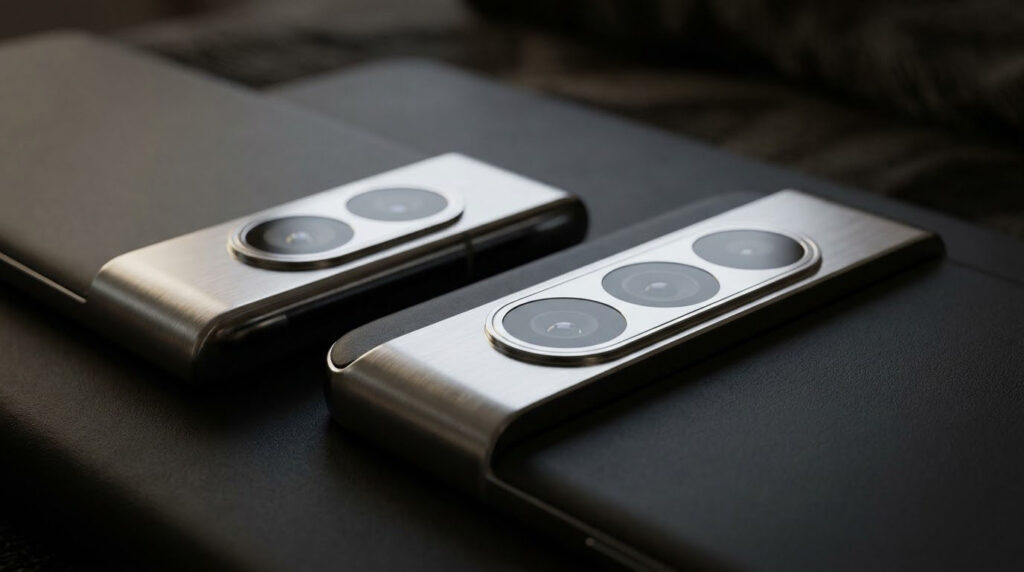
This is the biggest real-world gap. The Pixel 11 runs a two-camera system: a 48MP main and a 13MP ultrawide, with digital “Super Zoom” up to 30x. There is no dedicated telephoto lens, so long-range shots are software-enhanced crops. The Pixel 11 Pro adds a true 48MP 5x optical telephoto (reaching 120x Pro Zoom), a larger 50MP main sensor, a much higher-resolution 48MP ultrawide, and a 42MP front camera versus the base phone’s 13MP selfie. If you photograph sports, wildlife, concerts or anything at distance — or you post a lot of selfies — the Pro’s camera bar is where your money goes.
Performance & Software
Here the two are twins. Both run Google’s Tensor G6 on a 2nm process with 12GB of RAM at the 256GB tier, so day-to-day speed, app launches and on-device AI feel identical — you are not buying a faster phone by going Pro. Both also get seven years of OS and security updates, so either phone is supported into 2033. The Pro’s only software edge is six months of Google AI Pro included in the box, plus extra RAM (16GB) if you jump to the 512GB or 1TB tiers.
Battery & Charging
A small surprise: the cheaper Pixel 11 actually has the bigger battery at 4,985mAh versus the Pro’s 4,850mAh, and it drives a lower-resolution screen — so real-world endurance on the base model is at least as good, often better. Charging is effectively the same on both (around 30W wired and 25W Qi2.2 wireless with Pixelsnap magnetic alignment). Battery life is not a reason to pay more here; if anything it slightly favors the standard Pixel 11.
The Original Angle: What the $200 Pro Premium Really Costs
Here’s the part other comparison pages skip. Because the Pixel 11 and Pixel 11 Pro share the same Tensor G6 chip, the same 12GB of base RAM, the same 6.3-inch 120Hz size, the same 256GB of storage and the same 7 years of updates, the $200 price gap ($899 → $1,099) is really buying just four things:
- The 5x optical telephoto + 120x Pro Zoom (the base phone has none)
- The sharper LTPO display at up to 3,600 nits
- Better cameras overall: 50MP main, 48MP ultrawide and a 42MP selfie
- Six months of Google AI Pro, included
Now the calculation. Google AI Pro costs $19.99/month, so the six free months bundled with the Pro are worth about $120 in subscription value. Subtract that from the $200 premium and the extra hardware effectively costs around $80 — if you would have paid for Google AI Pro anyway. At $80, the optical telephoto alone arguably justifies the jump.
But there’s a catch most buyers miss: if you would never subscribe to Google AI Pro, that $120 isn’t real savings to you. In that case the true premium stays the full $200, and the decision comes down purely to whether the zoom lens and brighter screen are worth it.
One more way to frame it — cost of ownership across the 7-year support window: the Pixel 11 works out to about $128/year, the Pixel 11 Pro about $157/year. You’re paying roughly $29 more per year for the Pro’s camera and screen over the life of the phone.
The Verdict: Which Pixel Is Right for You?
Buy the Pixel 11 if you want the best all-round value. It has the same speed as the Pro, a slightly bigger battery, a great main camera for everyday shots, and it saves you $200. For most people, this is the smart pick.
Buy the Pixel 11 Pro if at least one of these is true: you regularly shoot zoom photos (sports, wildlife, concerts), you want the brightest and sharpest screen for outdoor use or video, you care about a high-resolution selfie camera, or you’ll genuinely use the six months of Google AI Pro. If none of those apply, you’re paying $200 for features you won’t use.
In short: the telephoto lens is the real deciding factor. If you want optical zoom, get the Pro. If you don’t, the Pixel 11 is the better buy.
- Google Store — official Pixel 11 / Pixel 11 Pro pages
- Google blog — official Pixel 11 series announcement
- Wikipedia — Pixel 11 Pro
- Pixel 11 vs Pixel 11 Pro
FAQ
Is the Pixel 11 Pro worth $200 more than the Pixel 11?
It depends on how you use your phone. If you’ll use the optical zoom or the included Google AI Pro, the effective cost of the upgrade can drop to around $80 and it’s worth it. If you won’t, the standard Pixel 11 is better value.
Does the Pixel 11 have a telephoto (zoom) lens?
No. The base Pixel 11 uses digital 30x Super Zoom only. A true 5x optical telephoto (up to 120x Pro Zoom) is exclusive to the Pixel 11 Pro and Pro XL.
Do both phones have the same processor?
Yes. Both run the Google Tensor G6, so everyday performance, app speed and on-device AI are essentially identical.
Which Pixel has better battery life?
The cheaper Pixel 11 actually has a slightly larger 4,985mAh battery (vs 4,850mAh) and a lower-resolution screen, so its real-world endurance is at least as good as the Pro’s.
How long will these phones get updates?
Both the Pixel 11 and Pixel 11 Pro receive 7 years of OS and security updates from launch.
Disclaimer
This comparison is intended to be neutral and is based on specifications and prices available as of August 2026. Details can change — always do your own research and confirm current specs and pricing on official sources before making a purchase.
Pixel 11 vs Pixel 11 Pro