The iPhone Ultra vs iPhone 18 Pro Max decision is shaping up to be the most interesting Apple choice in years — because for the first time, the two flagships aren’t just different sizes of the same phone. One folds into a mini tablet; the other is the biggest, most powerful slab iPhone Apple has ever refined. Both are expected at Apple’s September 9, 2026 event, and the gap between them is roughly $1,000, so this is a real decision, not a spec-sheet formality.
Here’s a neutral, side-by-side look at what each one is rumored to offer — and, further down, an original cost breakdown you won’t find on other comparison pages.
iPhone Ultra vs iPhone 18 Pro Max: The Quick Answer
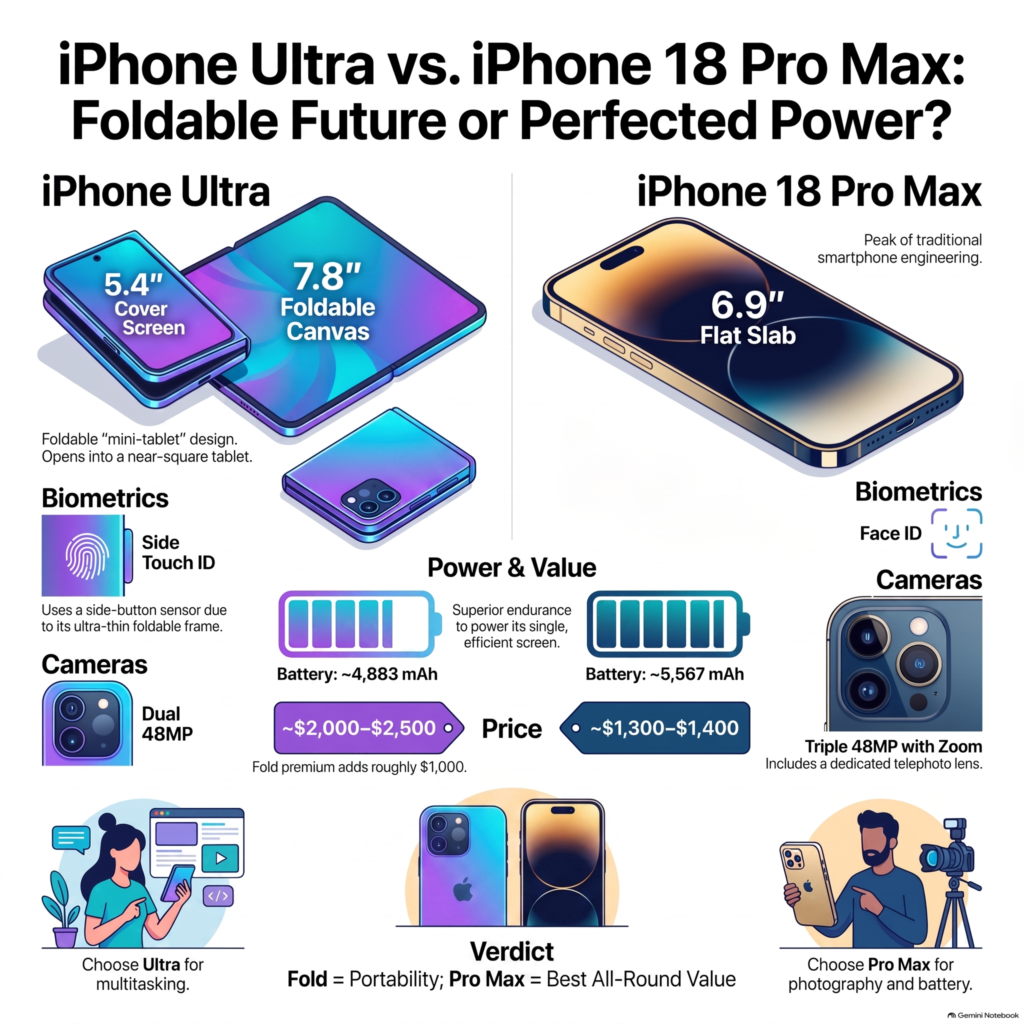
- If you want the most screen and a genuine “phone that becomes a tablet” → the iPhone Ultra. Apple’s first foldable opens to a ~7.8-inch inner display for multitasking, reading and video.
- If you want the best camera, the biggest battery and the lowest price → the iPhone 18 Pro Max. It keeps the telephoto zoom the fold drops, and costs roughly $1,000 less.
- For most people → the iPhone 18 Pro Max. Unless the folding form factor is the whole reason you’re buying, the Pro Max is the more complete, more affordable phone. The Ultra is for early adopters who want the new thing and will pay for it.
Naming note: Apple’s first foldable is widely rumored to launch as the iPhone Ultra, though some reports call it the iPhone Fold. We use “iPhone Ultra” throughout; the device is the same either way.
Specs at a Glance
All figures are rumored/expected ahead of the September 9, 2026 reveal.
| Feature | iPhone Ultra (foldable) | iPhone 18 Pro Max |
|---|---|---|
| Main display | ~7.8″ inner (foldable, creaseless) + ~5.3–5.5″ outer cover screen | ~6.9″ flat display |
| Form factor | Folds shut like a book; ~9mm folded, as thin as ~4.5mm unfolded | Traditional slab; slim, unibody |
| Chip | A20 Pro (2nm) | A20 Pro (2nm) |
| RAM | ~12GB | ~12GB (expected) |
| Rear cameras | Dual 48MP — no telephoto | Triple 48MP with true optical telephoto zoom |
| Variable aperture | Rumored | Rumored (main camera) |
| Front cameras | 18MP on both inner and outer screens | Under-display / TrueDepth |
| Biometrics | Touch ID (side button — too thin for Face ID) | Face ID |
| Battery | ~4,883 mAh (dual-cell for the hinge) | ~5,567 mAh |
| Build | Titanium, crease-minimizing hinge | Titanium frame |
| Rumored price | ~$2,000–$2,500 | ~$1,300–$1,400 |
| Availability | Sept 9 reveal; wider rollout may come later | Sept 9 reveal; on sale that month |
Design & Display
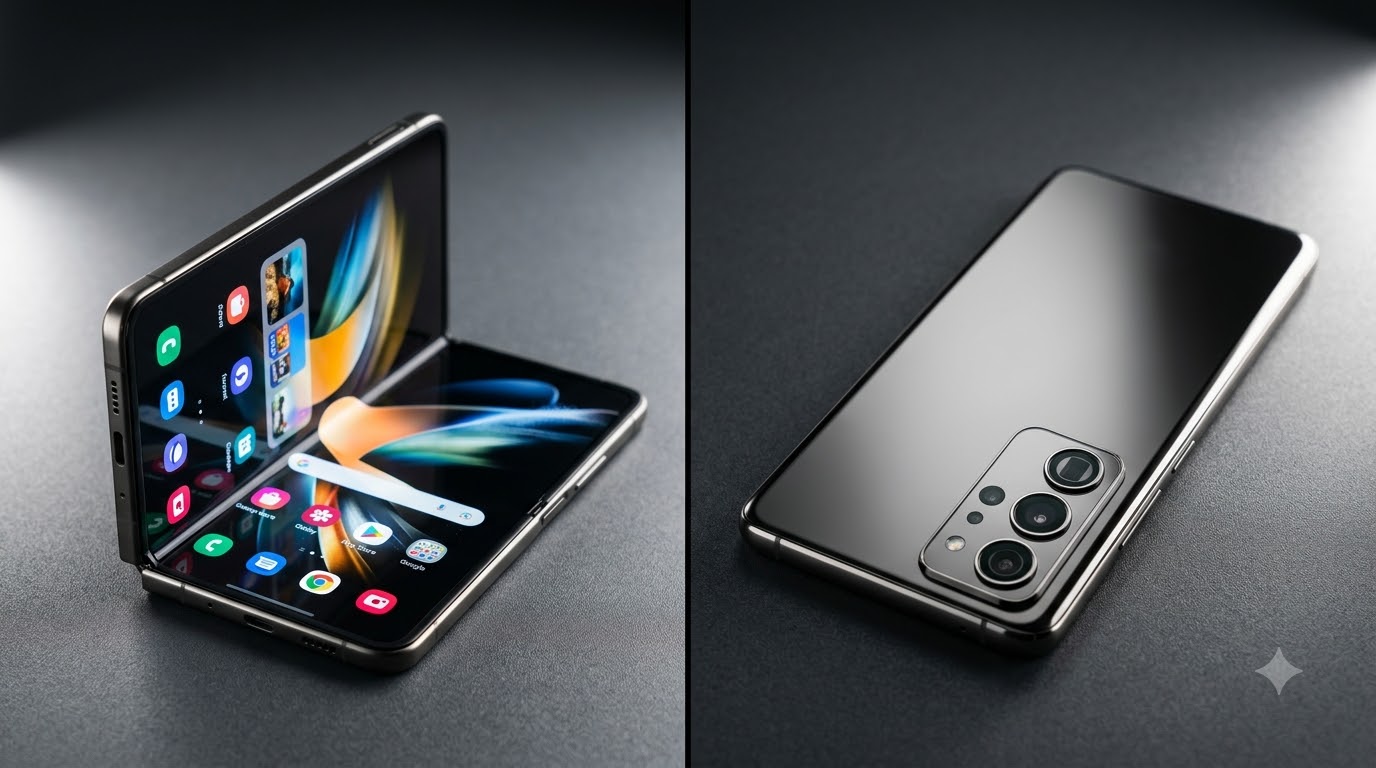
This is where the iPhone Ultra vs iPhone 18 Pro Max split is widest. The Ultra is Apple’s first foldable: shut, it’s a compact, passport-sized phone with a ~5.3–5.5-inch cover screen for quick tasks. Open it and you get a roughly 7.8-inch, near-square inner display that Apple has reportedly engineered to minimize the visible crease — enough room to run two apps side by side or read comfortably. Rumors point to a device as thin as ~4.5mm unfolded and around 9mm when closed, wrapped in titanium. (For the wider field, see our https://worldvsworld.com/iphone-18-pro-vs-iphone-17-pro/.)
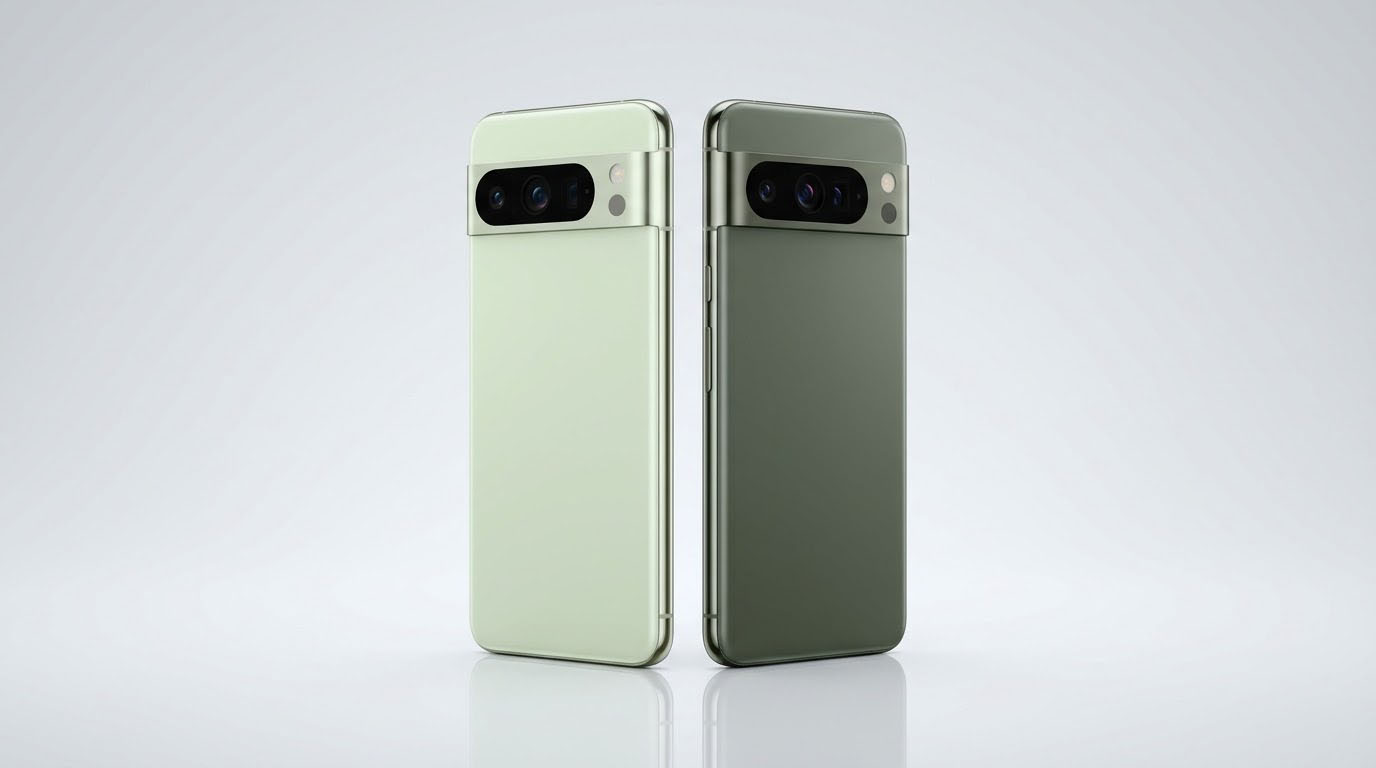
The iPhone 18 Pro Max takes the opposite approach: perfect the familiar slab. It’s expected to keep a ~6.9-inch flat display with a refined, slimmed-down Dynamic Island. No moving parts, no hinge to worry about, and a design that slips into a pocket the way every iPhone always has. If you’ve owned a Pro Max before, this will feel instantly familiar.
Bottom line: the Ultra offers far more screen and a new way to use a phone; the Pro Max offers durability, simplicity and a proven form factor.
Cameras
The Pro Max is the clear photography pick. It’s rumored to keep a triple-lens 48MP system with a true optical telephoto zoom, plus a possible variable-aperture main camera for manual depth-of-field control. For anyone who shoots portraits, distant subjects or wildlife, that telephoto matters.
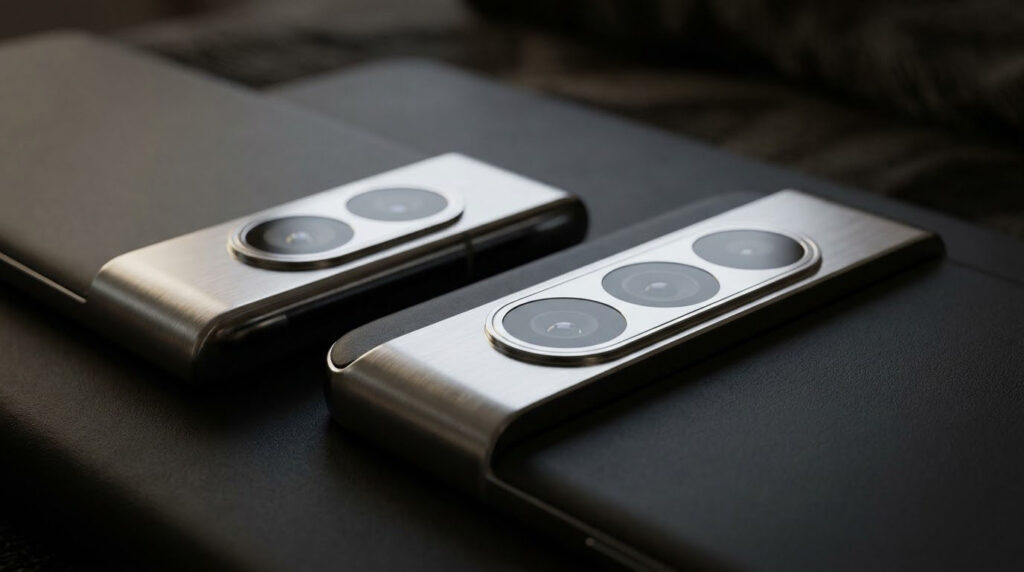
The iPhone Ultra reportedly runs a dual 48MP rear system and drops the telephoto entirely — a common trade-off on foldable phones, where the hinge leaves little room for a periscope lens.
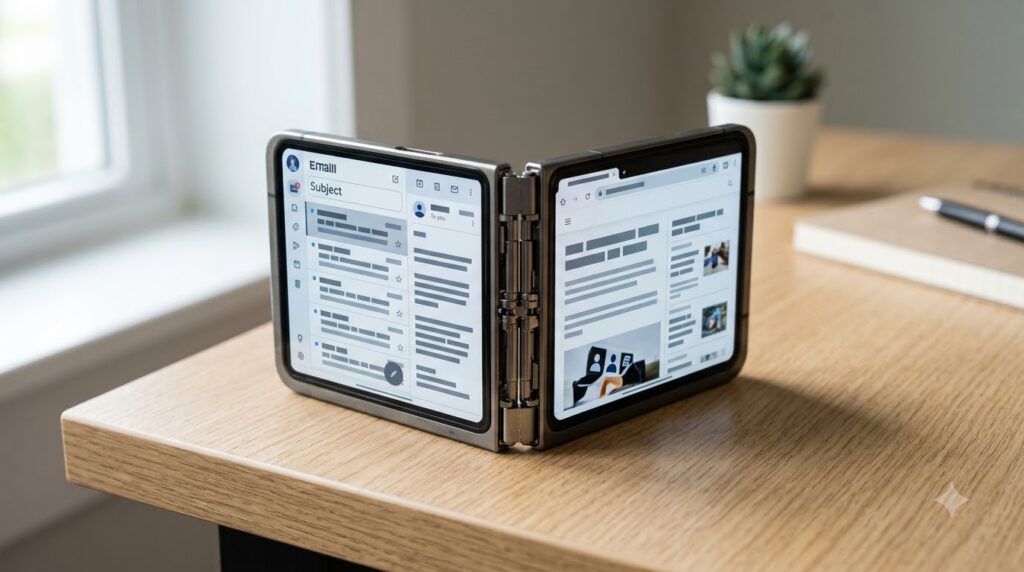
It does have one trick the Pro Max can’t match: because the cover screen doubles as a live viewfinder, you can frame yourself with the main (better) cameras for selfies and vlogs.
Bottom line: Pro Max wins on reach and versatility; the Ultra wins on selfie quality and creative framing, but loses zoom.
Performance & Battery
On raw power, this one’s basically a tie. Both are expected to run Apple’s A20 Pro chip on a 2-nanometer process with around 12GB of RAM, so day-to-day speed, gaming and on-device AI should feel the same.
Battery is where physics favours the slab. The Pro Max’s unibody reportedly holds around 5,567 mAh, while the Ultra splits roughly 4,883 mAh across two cells to fit the folding hinge — and that larger inner screen is hungrier. Expect the Pro Max to last noticeably longer on a heavy day. (Prefer Android? The same size-versus-battery trade-off shows up in our Pixel 11 vs Pixel 11 Pro comparison.)
Bottom line: same brain, but the Pro Max should have meaningfully better endurance.
Multitasking & Everyday Use
The Ultra’s pitch is productivity: an open 7.8-inch canvas makes split-screen apps, spreadsheets, e-reading and video genuinely more comfortable than any slab phone. The trade-off is a Touch ID side button instead of Face ID (the body is too thin for the Face ID array), and the extra bulk and care a foldable demands.
The Pro Max keeps Face ID, a single rugged screen, and the reassurance of a design with no hinge to fatigue over years of use. For most daily tasks — messaging, browsing, camera, calls — the difference in convenience is small.
Price
Price is the deciding factor for many buyers. The iPhone 18 Pro Max is expected to start somewhere around $1,300–$1,400 (a modest hike over the iPhone 17 Pro Max — see how the tiers stack up in our https://worldvsworld.com/iphone-18-pro-vs-iphone-17-pro/. The iPhone Ultra is rumored to land between $2,000 and $2,500 — potentially close to twice the price. That ~$1,000 gap is the heart of the iPhone Ultra vs iPhone 18 Pro Max decision, which brings us to the calculation below.
The $950 Question: What Are You Actually Paying For? (Original Angle)
Most comparisons stop at “the Ultra is expensive.” Here’s a breakdown you won’t find elsewhere. Using rumored mid-range prices and estimated screen dimensions, we worked out what that folding premium actually buys — and the result is counter-intuitive.
The assumptions (rumored, for illustration):
- iPhone Ultra: ~$2,300, inner screen ~7.8″ (≈ 29 sq in of display, plus a ~5.4″ cover screen)
- iPhone 18 Pro Max: ~$1,350, screen ~6.9″ (≈ 18 sq in of display)
- The “fold premium”: ~$950
Cost per square inch of main screen:
- iPhone Ultra: ~$2,300 ÷ 29 sq in ≈ $79 per square inch
- iPhone 18 Pro Max: ~$1,350 ÷ 18 sq in ≈ $75 per square inch
Here’s the surprise: on a pure screen-for-your-money basis, the two are almost identical — roughly $75–$79 per square inch. In other words, Apple isn’t charging a huge markup on the glass. That ~$950 premium is almost entirely the price of the folding mechanism and portability — the engineering that lets a ~7.8-inch display fold into your pocket.
The practical way to think about it: that ~$950 gap is roughly what a base iPad plus an Apple Pencil costs. So the real question isn’t “is the Ultra overpriced?” — it’s “do I want one device that folds into a tablet, or a phone plus an actual separate tablet for about the same total?” If you’ll genuinely use the folded-open screen every day, the Ultra earns its price. If the big screen is a “nice to have,” a Pro Max plus an iPad gives you more total glass, a real telephoto camera, and two devices for one to fail on.
Use-Case Verdict
- Buy the iPhone Ultra if: the folding form factor is the reason you’re upgrading, you multitask on your phone daily, you want the newest thing first, and the price isn’t a barrier. You’re paying for portability and a mini-tablet, and you accept losing the telephoto and some battery life.
- Buy the iPhone 18 Pro Max if: you want the best camera (that telephoto matters), the longest battery life, Face ID, a proven durable design, and roughly $1,000 back in your pocket.
- For most people: the iPhone 18 Pro Max is the smarter buy. It’s the more complete, more reliable, more affordable phone, and it doesn’t ask you to give up the telephoto or the battery. The iPhone Ultra is a genuinely exciting first-generation foldable — but first-generation is exactly the word to keep in mind. Wait for real-world durability reviews before spending $2,000+.
FAQ
When does the iPhone Ultra come out?
Apple is expected to reveal both the iPhone Ultra and the iPhone 18 Pro Max at its event on September 9, 2026. The Pro Max should go on sale that month; the foldable Ultra may see a wider rollout slightly later. Confirm exact dates from Apple’s official announcement.
Is the iPhone Ultra worth twice the price of the iPhone 18 Pro Max?
Only if you’ll actually use the folding screen. Our cost breakdown shows Apple isn’t marking up the display much — the premium pays for the folding mechanism. If portability and a mini-tablet matter to you, it’s worth it; if not, the Pro Max is the better value.
Does the iPhone Ultra have a telephoto camera?
No. The iPhone Ultra is rumored to use a dual 48MP rear system with no dedicated telephoto lens. The iPhone 18 Pro Max keeps a triple-camera setup with true optical zoom, making it the stronger choice for zoom photography.
Face ID or Touch ID?
The iPhone 18 Pro Max is expected to keep Face ID. The iPhone Ultra is rumored to use Touch ID built into the side button, because its ultra-thin body has no room for the Face ID array.
Which has better battery life?
The iPhone 18 Pro Max. Its unibody reportedly holds a larger battery (~5,567 mAh) versus the Ultra’s split ~4,883 mAh, and the Pro Max’s single screen is less power-hungry than the Ultra’s large inner display.
Disclaimer
This article compares rumored, pre-launch specifications ahead of Apple’s September 9, 2026 event and is provided for general information only. Details, prices and availability may change once Apple makes its official announcement. We aim to present both devices fairly; always verify current specs from official sources and do your own research before buying.