
Roth IRA vs Traditional IRA is one of the most common money questions in America — and the honest answer is that neither is universally “better.” They hold the same investments and share the same yearly limit; the real difference is when you pay tax: now, or in retirement. This neutral, up-to-date comparison breaks down the 2026 rules, the tax trade-off, income limits and withdrawal differences — and gives you a clear, situation-based way to decide instead of a vague “it depends.”
Roth IRA vs Traditional IRA: Quick Answer
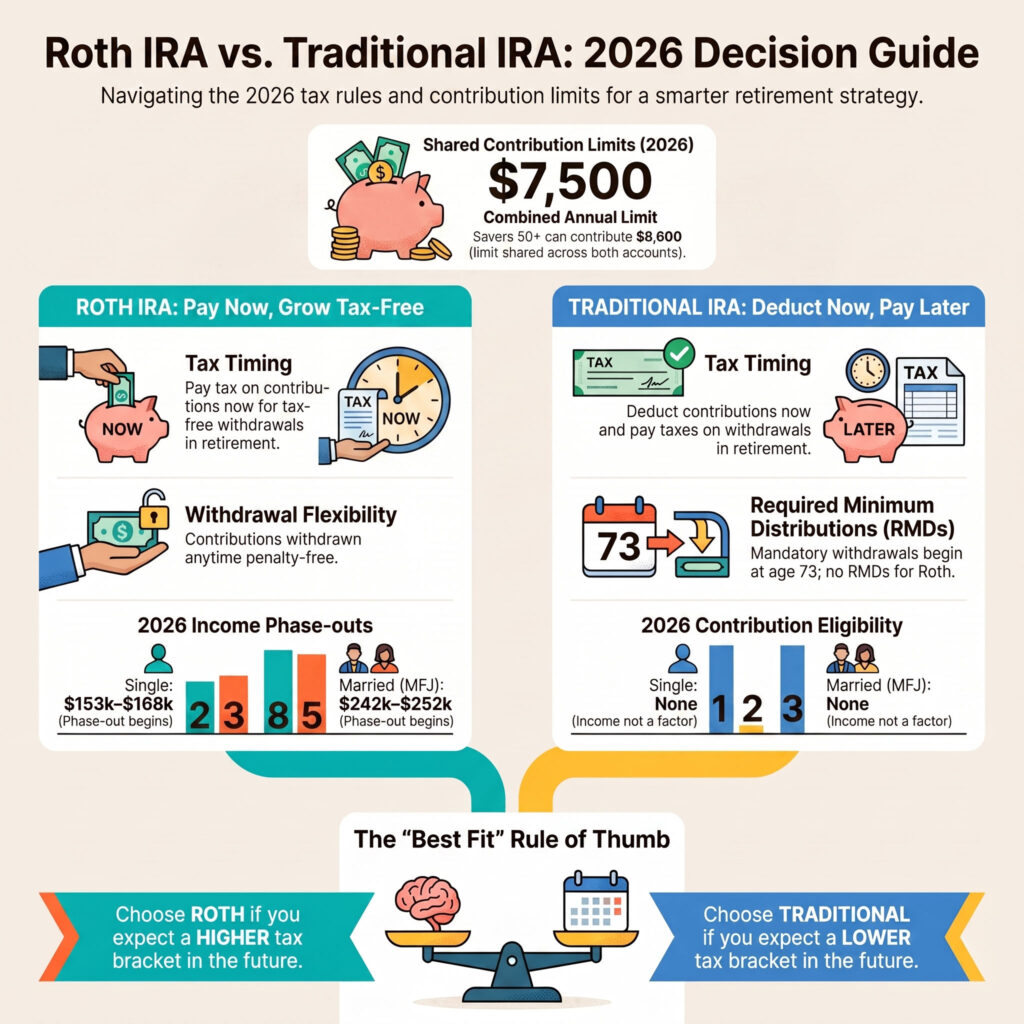
If you expect to be in a higher tax bracket later (early career, lower income now, decades to grow), a Roth IRA usually wins — you pay tax now and withdraw tax-free. If you’re in a high-earning year now and want to lower this year’s taxable income (and expect a lower bracket in retirement), a Traditional IRA often makes more sense — you deduct now and pay tax later. For most people the deciding question is simple: do you think your tax rate will be higher or lower when you retire than it is today? Higher later → Roth; lower later → Traditional.
Roth IRA vs Traditional IRA at a Glance (US, 2026)
| Roth IRA | Traditional IRA | |
|---|---|---|
| Tax on contributions | After-tax (no deduction) | Pre-tax (may be deductible) |
| Tax on qualified withdrawals | Tax-free | Taxed as ordinary income |
| 2026 contribution limit | $7,500 (under 50) / $8,600 (50+) | $7,500 (under 50) / $8,600 (50+) |
| Income limit to contribute | Yes — phases out at high income | No limit to contribute |
| Deduction income limit | N/A | Yes, if covered by a work plan |
| Required withdrawals (RMDs) | None during owner’s lifetime | Yes, starting at age 73 |
| Early withdrawal of contributions | Anytime, penalty-free | Generally taxed + 10% penalty |
| Best fit | Higher tax bracket expected later | Lower tax bracket expected later |
(Figures are 2026 US IRS limits and can change yearly — always check IRS.gov before contributing.)
How They Work: The Core Tax Trade-Off
The entire Roth IRA vs Traditional IRA decision comes down to one thing: when the government takes its cut.
With a Traditional IRA, you contribute pre-tax money. If you qualify for the deduction, it lowers your taxable income this year — a real, immediate saving. Your money then grows tax-deferred, and you pay ordinary income tax on every dollar you withdraw in retirement.
With a Roth IRA, you contribute money you’ve already paid tax on. There’s no deduction today, but the account grows tax-free and — as long as you follow the rules — you pay zero tax on qualified withdrawals in retirement, including all the investment growth.
So it’s not “free money vs taxed money.” Both are taxed once. The only question is whether you’d rather pay that tax now (Roth) or later (Traditional).
2026 Contribution Limits
For 2026, the IRS set the combined IRA contribution limit at $7,500 for savers under 50, and $8,600 for those 50 and older (the extra $1,100 is the “catch-up” contribution). Importantly, this limit is shared across both account types: you can split it between a Roth and a Traditional IRA, but the total across both can’t exceed the annual cap.
You have until the tax-filing deadline to contribute for a given year — so 2026 contributions can be made through April 15, 2027.
Income Limits and Eligibility
This is where the two accounts diverge sharply, and it’s often the deciding factor before personal preference even enters.
Roth IRA has income limits to contribute. For 2026, the ability to contribute directly phases out between a modified adjusted gross income (MAGI) of $153,000–$168,000 for single filers, and $242,000–$252,000 for married couples filing jointly. Earn above the top of your range and you can’t contribute directly at all (though a “backdoor Roth” conversion is a legal workaround many higher earners use).
Traditional IRA has no income limit to contribute — anyone with earned income can put money in. The catch is deductibility: if you (or your spouse) are covered by a workplace retirement plan like a 401(k), your deduction phases out at $81,000–$91,000 (single) and $129,000–$149,000 (married filing jointly, contributor covered). Above that, you can still contribute — you just won’t get the tax break, which removes much of the Traditional IRA’s appeal.
The honest takeaway: high earners are often pushed toward one option by the rules, not by choice.
Withdrawals and Flexibility
A big practical difference shows up when you need access to your money.
With a Roth IRA, you can withdraw your contributions (not earnings) at any time, tax- and penalty-free, because you already paid tax on them. That flexibility makes a Roth double as a soft emergency backstop. Earnings, however, generally need the account to be five years old and you to be 59½ to come out tax-free.
With a Traditional IRA, early withdrawals before 59½ are generally hit with ordinary income tax plus a 10% penalty, with limited exceptions. There’s far less flexibility to tap the money early without cost.
Required Minimum Distributions (RMDs)
Here’s a difference that matters most for retirees and estate planning. A Traditional IRA forces you to start withdrawing — and paying tax — via Required Minimum Distributions beginning at age 73, whether you need the money or not.
A Roth IRA has no RMDs during the original owner’s lifetime. You can leave it untouched to grow tax-free for as long as you like, which makes it a powerful tool for passing wealth to heirs. For anyone who wants control over when they draw down (or wants to leave the account alone entirely), the Roth’s flexibility is a clear edge.
The Original Angle: The “Tax Rate Break-Even” Test
Most Roth IRA vs Traditional IRA articles stop at “it depends on your tax bracket.” Here’s a way to actually pressure-test that for yourself — a simple framework you won’t find on most comparison pages.

The core math nobody spells out: if your tax rate is exactly the same now and in retirement, a Roth and a Traditional IRA produce the identical after-tax result. The dollar amounts look different along the way, but the ending spendable money is the same. Here’s a simplified illustration (ignoring income limits, at a flat 22% rate):
| Roth IRA | Traditional IRA | |
|---|---|---|
| You want to invest | $7,500 | $7,500 |
| Tax paid now (22%) | $1,650 (paid upfront) | $0 (deducted) |
| Amount actually invested | $7,500 | $7,500 |
| Grows to (say, 3x over time) | $22,500 | $22,500 |
| Tax paid at withdrawal (22%) | $0 | $4,950 |
| After-tax money in hand | $22,500 | $17,550 |
At first glance Roth looks like a runaway winner — but that’s because the Traditional saver also got a $1,650 tax deduction upfront that isn’t shown here. Invest that refund too, and the two even out at equal tax rates. That’s the real insight: the winner is decided almost entirely by whether your tax rate changes.
The practical rule this gives you:
- Expect a higher tax rate in retirement than today? Roth wins — lock in today’s lower rate.
- Expect a lower tax rate in retirement? Traditional wins — deduct at today’s high rate, pay less later.
- Not sure? Many savers split contributions across both to hedge — “tax diversification” — so they have taxable and tax-free buckets to draw from later.
The number to figure out isn’t a return rate — it’s your future tax bracket relative to today’s. That single guess drives the whole decision.
Verdict: Which Should You Choose?
No fence-sitting — here’s the situation-based call, backed by everything above.
- Choose a Roth IRA if you’re early in your career, in a relatively low tax bracket now, expect to earn (and be taxed) more later, want withdrawal flexibility, or want to avoid forced withdrawals in retirement. It’s the stronger pick for younger savers and anyone betting tax rates rise.
- Choose a Traditional IRA if you’re a high earner today wanting to cut this year’s taxable income, expect a lower bracket in retirement, and value the immediate deduction — assuming your income still qualifies you to deduct.
- For most people, the deciding factor is the tax-rate question, not the account itself: higher rate later points to Roth, lower rate later points to Traditional, and genuine uncertainty is a fair reason to split between both. If income limits make the choice for you, follow the rules first — then optimise.
Whichever you choose, the biggest win is simply contributing consistently and early; the account type fine-tunes the outcome, but time in the market does the heavy lifting.
Frequently Asked Questions
Is a Roth IRA or Traditional IRA better in 2026? Neither is universally better. A Roth IRA is generally better if you expect a higher tax bracket in retirement, since withdrawals are tax-free. A Traditional IRA is often better if you want to lower your taxable income now and expect a lower bracket later. The best pick depends on your current versus future tax rate.
What is the 2026 IRA contribution limit? For 2026, you can contribute up to $7,500 if you’re under 50, or $8,600 if you’re 50 or older. This limit is shared across both Roth and Traditional IRAs combined — not per account.
Can I contribute to both a Roth IRA and a Traditional IRA? Yes, but your total contributions across both can’t exceed the annual limit ($7,500, or $8,600 if 50+). Many savers split contributions between the two for tax diversification.
Who can’t contribute to a Roth IRA? High earners above the income phase-out — for 2026, a MAGI above $168,000 (single) or $252,000 (married filing jointly) blocks direct Roth contributions. A “backdoor Roth” conversion is a common legal workaround.
Does a Traditional IRA have required withdrawals? Yes. Traditional IRAs require minimum distributions (RMDs) starting at age 73. Roth IRAs have no required withdrawals during the original owner’s lifetime, which is one of their key advantages.
Disclaimer
This article is a neutral, fact-based comparison for general information only and is not financial, tax or investment advice. IRA rules, contribution limits and income thresholds change yearly and depend on your personal situation — the figures here are 2026 US IRS figures and may change. Always check IRS.gov and consult a qualified financial or tax professional before making retirement account decisions, and do your own research for your circumstances.